A $150 billion data centre boom is brewing, and housebuilding targets could become a victim of progress

Are we staring down the barrel of an AI-powered housebuilding recession?
For years, the story of Australia's housing shortfall has been about planning delays, interest rates and a construction sector that never quite recovered from the pandemic. Now there's a new variable in the equation: a wave of data centre investment worth tens of billions of dollars, fuelled by an insatiable appetite for AI computing power.
To meet the demand that’s powering everything from stem cell research to AI-generated social media slop, Australia has emerged as a data centre powerhouse. And it’s arriving at the exact moment the residential building industry can least afford the competition.
The early signs, according to new industry data, suggest something has to give.
The $150 billion data centre boom
Non-residential construction approvals have doubled over the past 12 months, according to CreditorWatch's August 2026 Business Risk Index, with two of the highest readings on record posted in the past three months alone.
Data centres are now one of, if not the biggest sources of non-residential construction approvals, even though many projects remain in the early stages.
Anthropic's newly signed lease at Queensland's Western Downs Digital Park is a case in point: the $30 billion project, being developed by Singapore's Zerra DC near Dalby, is expected to require up to 1,500 construction workers alone, on top of the 1,400 needed to operate it once complete – a single project drawing on the same electrical, mechanical and specialist trades that residential builders are already short of.
Commonwealth Bank estimates Australia's data centre build-out could be worth around $150 billion by 2030, with NSW and Victoria accounting for roughly 91% of that future pipeline – concentrating demand for land and labour in two of the country's busiest construction markets.
CBA estimates Australia has around six gigawatts of potential data centre capacity in its pipeline, which is roughly four times the operational capacity Australia had at the end of 2025, according to CBA’s economics and markets economist Lucinda Jerogin.
CreditorWatch chief economist Ivan Colhoun said competition for skilled labour, particularly electrical contractors, is already being felt on the ground. While an outright shortage probably won’t materialise, “it will probably keep materials prices quite high, you would think”, said Colhoun.
“Businesses have already been experiencing elevated rates of cost increase for many years and the equal highest interest rates in over a decade. Recent increases in fuel costs, the unwise quantum of this year's minimum wage increase and a prospective further interest rate rise in September, will add to these pressures.
“The winning sectors are likely to be parts of mining, parts of construction and other businesses that might directly benefit from the AI investment boom – businesses providing services to these sectors including finance and professional services.
“At the same time, any companies with high debt loads, sectors where fuel is a significant input or transport costs are significant as well as sectors exposed to consumers' discretionary spending are likely to also face more challenging operating conditions.”
The pressure is likely to intensify over the next six to eighteen months, with Colhoun drawing a historical parallel to past investment booms, where interest rates tend to stay elevated and the residential sector effectively "makes way" for the more heavily capitalised non-residential boom.
"The residential construction sector... isn't as well financed or as resilient,” he said. “It's more risky than the commercial construction sector. And since rates went up out of COVID, we've seen the risk of the number of defaults that we track in CreditorWatch rise."
A growing default gap
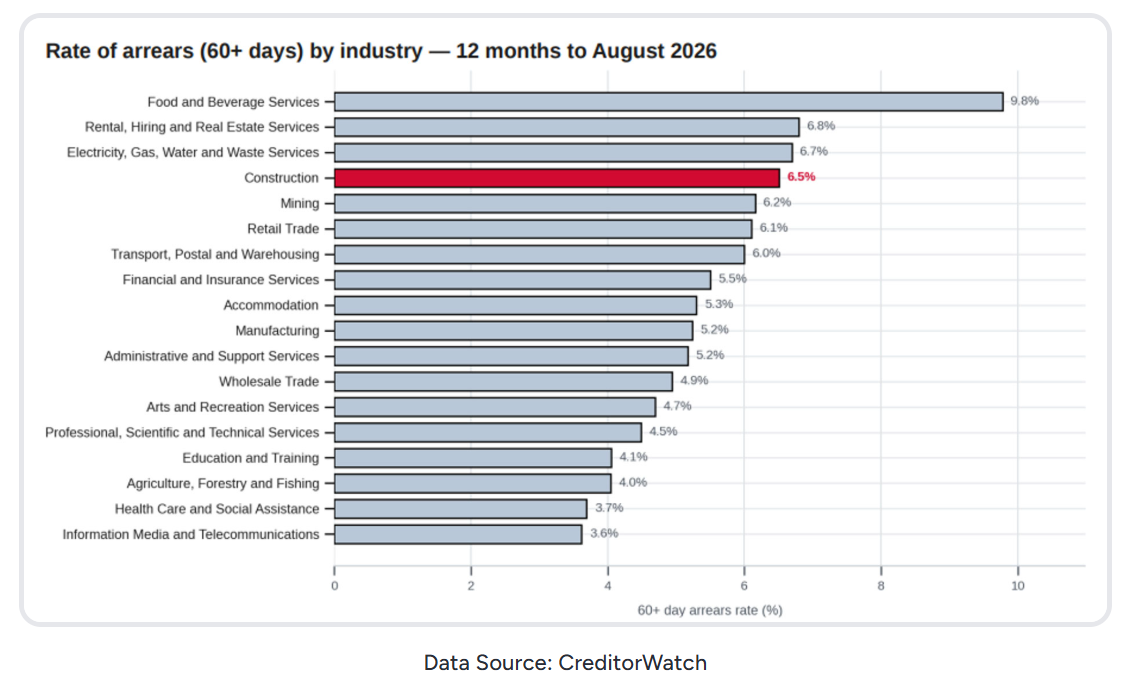
CreditorWatch's data puts a number on where that pressure is landing. Across the construction industry, the 60-plus-day payment arrears rate sat at 6.5% over the past year – an increase of 13.3% – the fourth-highest of the 18 industries CreditorWatch tracks.
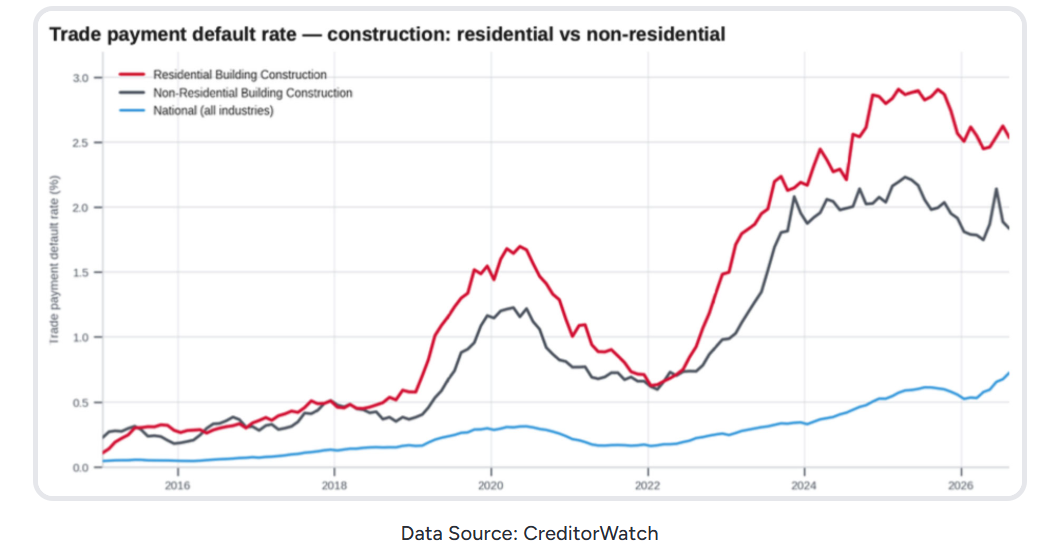
But that strain isn't evenly spread: residential trade payment defaults are currently running at more than three times the national average, and construction's overall trade-payment default rate of 1.94% is the third-highest of any industry, alongside a 1.58% ATO tax-default rate, the second-highest.
ATO tax defaults are up roughly 10% over the past six months, and Colhoun estimates around 30% of those firms will ultimately become insolvent.
Trade payment defaults (a leading indicator of insolvency) registered against construction firms have risen approximately 12% in the past three months alone, with the spread between residential and non-residential default rising, reversing the brief relief that followed 2024's tax and rate cuts.
The Bathla example
Sydney developer Bathla's collapse in early September, with debts of more than $3.4 billion, offers a concrete example of what distress can lead to.
The company's failure has left 2,500 half-built apartments in limbo, alongside a further pipeline of 14,000 homes, and required administrators Teneo to seek emergency funding just to keep 45 construction sites running across its 219 projects.
Private credit carried much of the exposure – Centuria Bass alone had built a 24% exposure to the developer through its $300 million fund before freezing redemptions in August – underscoring how residential-side financing, already thinner and more interest-sensitive than the commercial credit backing data centre builds, is where the strain is showing up first.
CreditorWatch’s insolvency data shows construction first-time insolvencies jumped to 868 in August, up sharply from around 300 a month through most of the past year, with the increase concentrated in residential building – the same segment already carrying the industry's highest arrears and default rates, and the one least positioned to benefit from the data centre boom's upside.
An AI-powered housing shortage?
When data centre projects can outbid residential builders for the same electricians, mechanical trades and materials, new home completions slow and construction costs rise – and both of those flow directly into affordability and monetary policy.
CreditorWatch chief executive Patrick Coghlan warns the data centre boom "draws skilled labour and materials away from housing and essential infrastructure" at a time Australia can least afford it.
MPA has reported extensively on the scale of the cost problem already facing the sector: Master Builders Australia chief executive Denita Wawn has pointed out that construction costs have jumped more than 40% since 2019, warning that "there is a clear gap between policy ambition and reality, with approvals going backwards, not forwards”.
A separate industry analysis puts the increase even higher over a longer window – average construction cost per dwelling up 88% since 2014-15, and up 122% for apartments specifically.
Colhoun (pictured, below) described the current setting as an unusually direct convergence of three forces at once: elevated interest rates, high energy prices, and an AI investment boom, all landing on the construction sector simultaneously.

The result is a “two-speed” economy – sectors tied to AI, mining, defence and renewables are performing strongly, while interest-sensitive and discretionary sectors, residential construction chief among them, are being squeezed from the other direction.
And it’s probably not a temporary distortion: Colhoun pointed to past investment booms where interest rates stay elevated for longer than usual precisely because the more capitalised, non-residential side of the economy keeps demand and cost pressure alive even as housing softens.
For borrowers, that cost pressure shows up twice. First, directly, in higher build costs and stretched completion timeframes for anyone with a residential construction loan or a house-and-land package. Second, indirectly, through monetary policy: Colhoun flagged a further Reserve Bank of Australia (RBA) rate rise as likely by the end of this month, thanks in no small part to input costs and wage pressures the data centre pipeline is reinforcing.
That inverts the usual playbook, where a softening housing market would typically argue for lower rates rather than higher ones.
Subsidising residential projects or increasing migration to support the stretched workforce could both help ease the pressure, but domestic politics may render either option untenable: the former risks adding to inflation, the latter comes at a time of rising anti-migration sentiment and a reinvigorated One Nation
This is all landing on a National Housing Accord that was already short of its own numbers before the data centre boom accelerated.
The Housing Industry Association now expects Australia to fall 186,000 homes short of the 1.2 million homes targeted by 2029, with HIA chief economist Tim Reardon warning that "confidence is hard won and easily lost" as recent federal budget changes add further uncertainty to new home commencements.
That follows an earlier shortfall of more than 60,000 homes in the Accord's first year alone, against a required build rate of over 255,000 new homes annually just to stay on track.
Australia’s housebuilding progress was already strained before data centres entered the equation. There's a real risk that the AI revolution will make it far worse.