Tech is helping brokers cut friction, accelerate decisions and have greater certainty on deals, says CommBank’s Joann Dakwer

Ask brokers what they want most out of the origination journey and “speed” invariably comes up at the top of the list.
It’s understandable. With the overwhelming majority – over 81% in fact – of new home loans now coming through the broker channel, they’ve got a lot on their plate – and brokers aren’t just dealmakers anymore. Increasingly, they’re strategists and trusted partners to an ever-expanding client list.
At that scale, friction stops being a minor inconvenience and becomes a systemic problem. A clunky escalation process, a slow valuation turnaround, a documentation bottleneck – multiplied across a channel now responsible for eight in 10 new home loans, even small inefficiencies can add up, creating unnecessary time and complexity for brokers and their customers.
For lenders, that arithmetic cuts the other way too.
Brokers aren’t bound to a single lender – they place business wherever it best serves their client, which means friction has become a genuine point of competitive differentiation between banks. A lender that makes the process easier – faster answers, fewer manual touchpoints, better visibility over a deal in progress – doesn’t just win goodwill from brokers. It wins a larger share of flow in a channel that now decides where most home lending actually lands.
The data backs that up. MPA’s Brokers on Banks 2026 survey found turnaround times among the top three factors brokers use to judge a lender, behind only credit policy and BDM support, with digital platforms and technology both scoring above four out of five on importance. Turnaround times are also coming into sharper focus for brokers: the share of brokers reporting deteriorating turnaround times soared from below 7% in 2025 to nearly 30% in 2026.
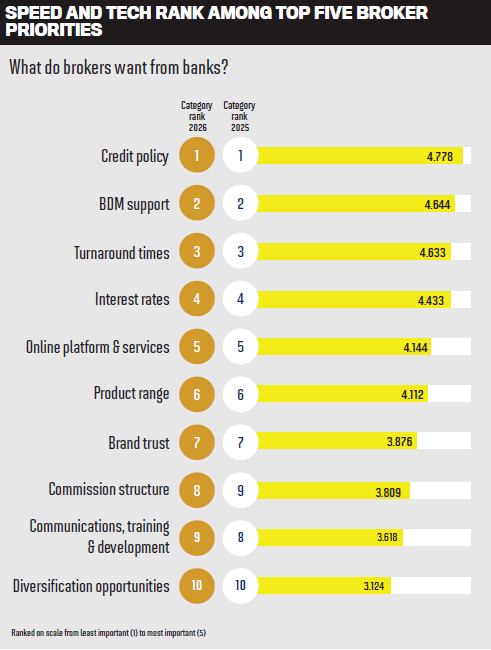
Source: MPA's Brokers on Banks 2026 survey
While Joann Dakwer (pictured, top of page), CommBank’s technology and broker enablement lead, agrees that speed-to-yes matters – she thinks it’s often a proxy for something else. “What sits behind that is certainty. When someone is buying a home, they want to know where they stand, and their broker wants to be able to give them that confidence as quickly as possible.” she tells MPA.
“That’s why time-to-yes is an important lens for us when we think about where technology can make the biggest difference,” she explains. “We’re investing in greater automation, better use of data and simpler processes to help us make decisions faster. We’re seeing the impact of that investment already, and we’ll keep looking for opportunities to make the experience faster and simpler for brokers and their customers.”
CommBank has spent recent years attacking these friction points, starting with a fairly simple process. “We’re always asking where the points of friction are, what’s taking too long, what’s harder than it needs to be,” Dakwer says. “And then looking at how technology can help us change that.”
“We’re always asking where the points of friction are, what’s taking too long, what’s harder than it needs to be. And then looking at how technology can help us change that” – Joann Dakwer, CommBank
Built for choice, tailored for brokers
While brokers are now the clear preference for home loan originations, CommBank’s philosophy has to flex across a genuinely mixed customer base – some want a broker, some want to deal with the bank directly, others are happy doing it all digitally. Its answer is a multichannel approach built on shared foundations, so the experience stays consistent no matter which door a customer walks through.
But Dakwer is clear that broker-specific investment matters immensely, especially given how unique the broker journey is. “That is why we invest specifically in broker tools and experiences that make it simpler to do business with us, give brokers better access to the information they need and help them deliver a great experience for their customers.”
One of the clearest examples of that is CommBank’s new self-serve escalations feature, which lets brokers flag or query a stalled application digitally, rather than picking up the phone to the Broker Support Hub. The feature is about making that process quicker and easier, while giving brokers more visibility and control over managing their pipeline.
It’s an area where CommBank is already registering with brokers. In MPA’s Brokers on Banks 2026 survey, CommBank ranked second nationally for online platform and services, with brokers highlighting clean portals and systems that support faster assessment.
That same instinct feeds into how CommBank thinks about its broader broker contact strategy. The goal, Dakwer says, is to use technology to create efficiencies in the way brokers and their teams work, freeing up time and energy to focus on the moments that matter most with their customers. Artificial intelligence is a growing part of that equation, but strictly as a support act.
Dakwer says, “It’s not there to replace relationships – it should enhance them, giving our people and brokers more time for the conversations where human judgement, experience and connection really count.”
Freeing up relationship managers
For all the talk of automation, speed and self-serve tools, broking remains, at its core, a relationship business – arguably more so now than ever, as clients lean on brokers for guidance through an increasingly complex lending environment.
The risk with any technology investment is that it could start to compete with that relationship rather than support it. CommBank’s approach has been to keep the two firmly separate: let automation take on the process-driven work, and free up the humans on both sides of the deal to do the parts that humans do best.
That thinking runs through the bank’s own relationship managers just as much as it does its broker-facing tools. As automation absorbs more of the process-driven work – escalations among them – relationship managers are freed up for the conversations that actually require their judgement.
As Dakwer says, “By automating some of the simpler workflows, we can give our people more time to focus on the conversations, relationships and support where that human connection really matters.”
“By automating some of the simpler workflows, we can give our people more time to focus on the conversations, relationships and support where that human connection really matters” – Joann Dakwer, CommBank
Beyond the broker portal, CommBank is applying the same efficiency lens right across the origination journey – from information capture and verification, through valuations, credit decisioning, documentation and settlement. The aim is fewer manual handoffs and a faster path to an answer.
New in-app application tracking gives homebuyers visibility over their own progress – with the benefit flowing back to brokers as well. “They’re not only helping their customers into home ownership, but in many cases helping them navigate a broader banking relationship,” Dakwer says. “By creating a better experience around the customer throughout that journey, we can complement the role brokers play.”
More to do
Looking ahead, Dakwer’s priority is bringing more of CommBank’s broader technology capability into the broker experience – but only the parts brokers actually say they need.
“We want to keep making it easier for brokers to do business with us and give them the technology, information and support they need to deliver great outcomes for their customers,” she says.
“What excites me about where we’re heading is the opportunity to bring more of the technology and capabilities we’re building across CommBank into the broker experience. But equally, we want to make sure we’re building the things that matter to brokers.”
That’s why ongoing feedback remains central to the approach.
“Listening to their feedback and understanding what would make it easier to do business with us is a really important part of how we shape that experience. There’s a lot more we can do, and we’re excited about what that can mean for brokers and their customers,” Dakwer says.