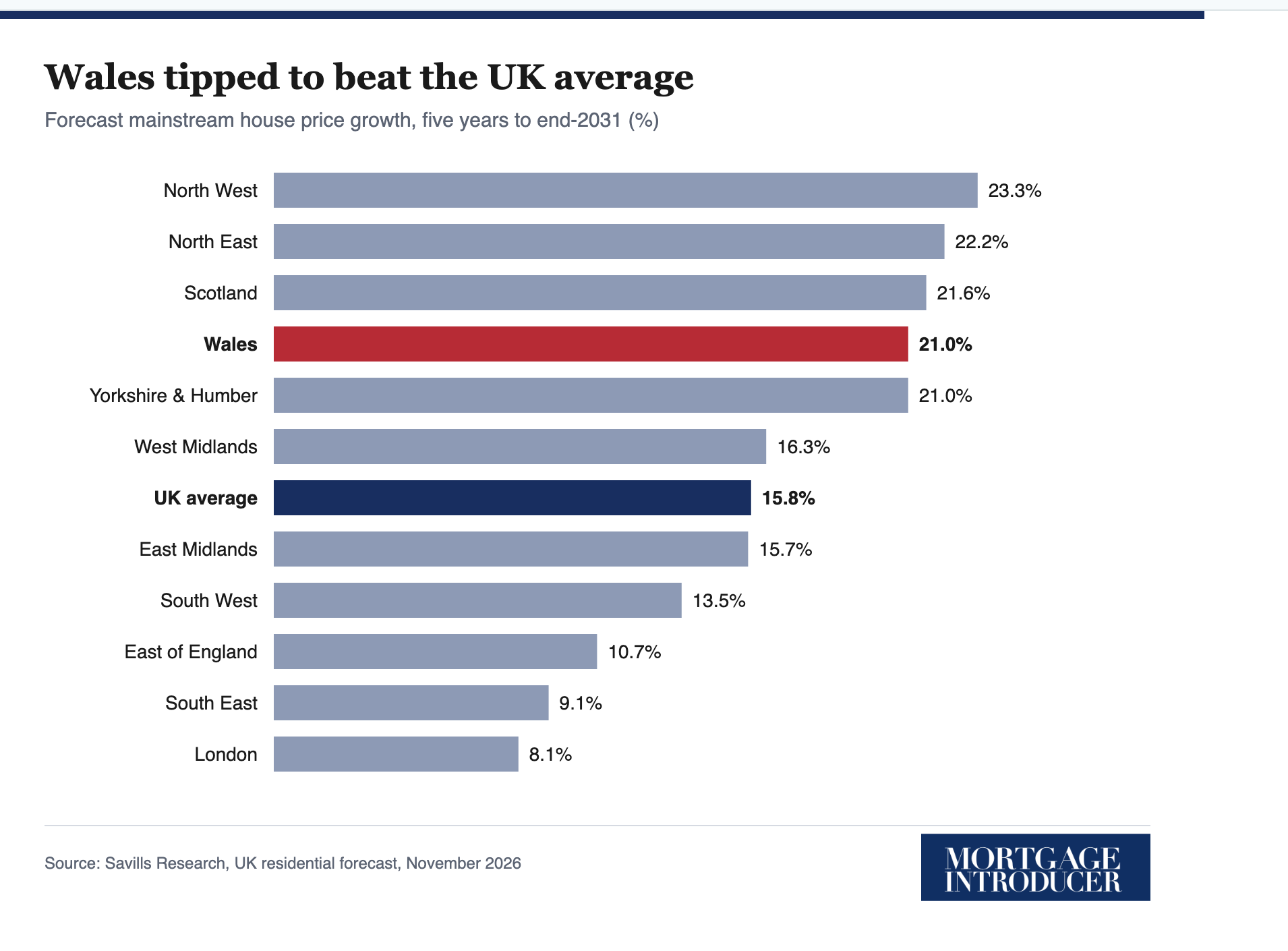
Savills expects values to rise 21% by the end of 2031, against 15.8% for the rest of the UK. Planning consents, housing starts and social housing delivery are all running below what it needs

House prices in Wales are forecast to rise faster than the UK average over the next five years, even though high mortgage rates are expected to weigh on the market through 2027.
The forecast comes from Savills’ latest Welsh housing market and supply update, published this week at law firm Hugh James’ annual Housing Week. Savills expects the average Welsh home to rise from about £206,000 at the end of this year to £249,500 by the end of 2031, an increase of 21% or £43,500.
For the UK as a whole, Savills is pencilling in growth of 15.8% over the same period, or about £56,500 in cash terms, according to its November 2026 five-year residential forecast. The UK’s cash gain is bigger only because its average price starts higher.
Wales has not escaped the current slowdown, though. Nationwide’s third-quarter figures put the average Welsh home at £214,816, up just 0.7% on a year earlier and down 1.4% on the previous quarter.
Cheaper homes, smaller hit
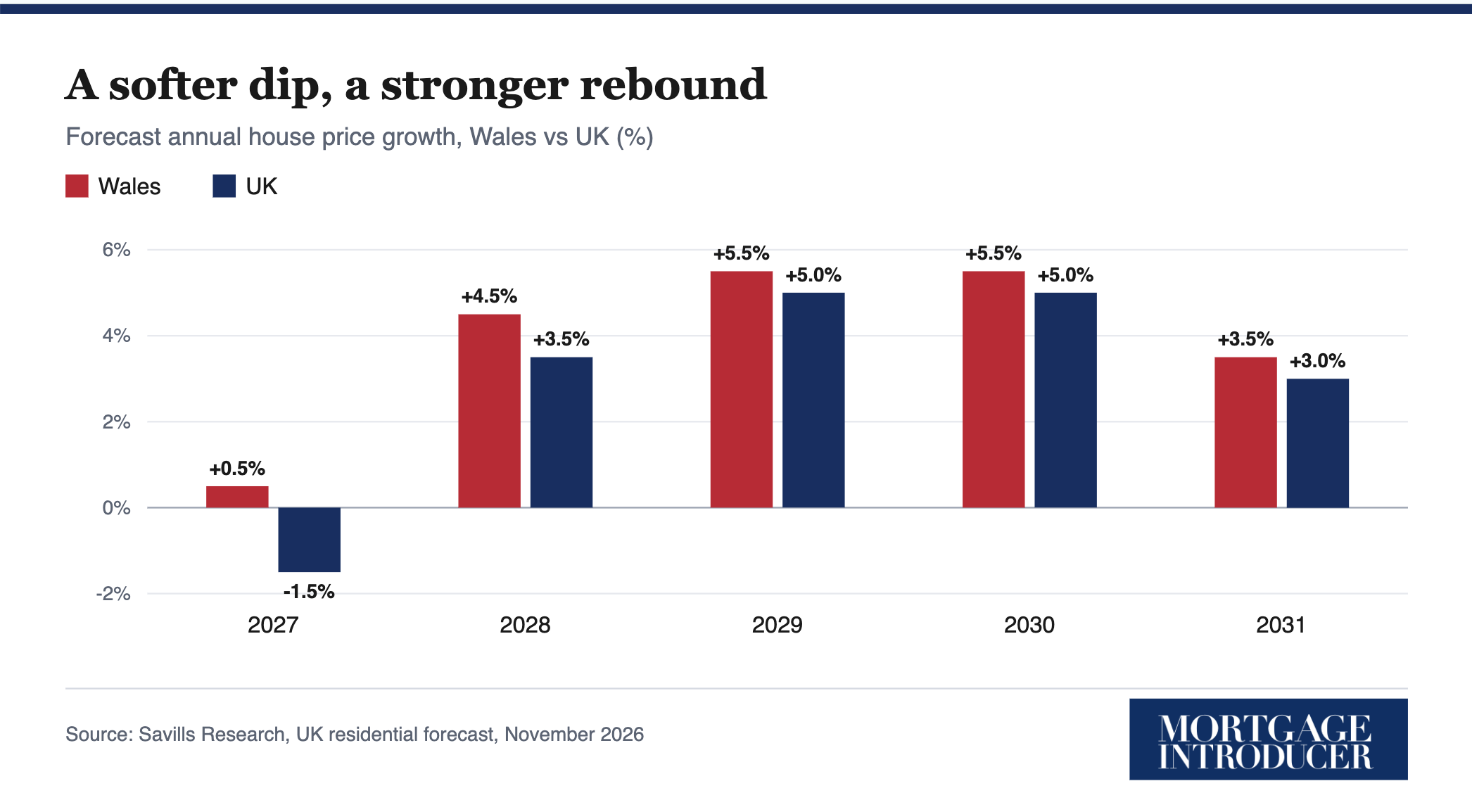
Savills’ national numbers show UK prices falling a further 1.5% in 2027 as the conflict in the Middle East keeps mortgage rates stubbornly high. Wales is expected to rise 0.5% next year, while London and the South East fall 3.5%.
Savills puts this down to affordability. Welsh buyers borrow less, so higher rates hurt less. Savills’ wider research makes the same point across the country: in the North of England average prices are still under six times average earnings, against 11.3 times in London, which leaves more room for values to rise once borrowing gets cheaper.
From 2028 the forecast picks up speed in Wales – 4.5% that year, 5.5% in each of 2029 and 2030 and 3.5% in 2031. That matches Yorkshire and the Humber. Scotland, the North East and the North West are forecast to do slightly better.
Savills has scaled back its outlook. Its November 2025 Welsh market update put five-year growth at 27.6%, before the rate outlook worsened.
Rates still the swing factor
Borrowing costs will shape the next 18 months. Savills now assumes the average mortgage rate will not dip below 5% until early 2028, easing to about 4% by 2029. Its central case has Bank Rate ending this year at 4% and rising to 4.25% in 2027 before falling.
Other data points the same way. Nationwide recorded annual growth of just 0.5% in October, its weakest reading in more than two years, with money markets pricing in further Bank Rate rises into 2027. Zoopla, meanwhile, has highlighted how higher mortgage rates are splitting the market north from south, with pricier southern markets feeling the squeeze most. Savills’ regional table shows the same split.
Savills expects first-time buyers to lead the recovery from 2028, helped by deposit affordability at its best level since 2008, looser stress testing, more high loan-to-value lending and the government’s Your First Home scheme. In a cheaper market like Wales, that could mean more first-time buyer cases once rates fall.
Read next: Nationwide chief economist: fundamentals in place for house price recovery
The pipeline problem
The supply figures are less encouraging.
Housebuilding in Wales has picked up, with Savills finding completions running about 10% higher year on year by the third quarter of 2026. But that still leaves output roughly 12% short of estimated annual need – and the forward indicators suggest the recent improvement may not last. Planning consents are running close to a third below what is required, while new starts are about a fifth lower than completions, meaning fewer homes are entering the pipeline than leaving it.
That matters for lenders who rely on new-build stock for first-time buyer business. A shortage of new homes also supports prices, which helps explain why Welsh values are expected to rise while borrowing stays expensive.
Read next: UK house price forecasts trimmed as Middle East war reshapes rate expectations
Affordable delivery is at a record high
Wales delivered 3,865 additional affordable homes in 2025/26 – up 6% on the year and the highest total since records began in 2007/08, according to official Welsh Government statistics.
The Welsh Government has committed to 20,000 additional social homes by March 2030, covering social and intermediate rent. Savills calculates that net delivery would need to rise by almost half to hit that goal, and that the 4,034 homes planned for 2026/27 fall around a fifth short of the required annual run rate.
The previous government’s 20,000-home target for 2021 to 2026 was missed, closing at 17,236 homes including empty properties brought back into use.
Caroline O’Flaherty, partner and head of social housing at Hugh James, called the price outlook “very encouraging”, but said the supply figures showed how much work was still needed to meet targets while the development pipeline is under pressure.
Caroline Jones, a director at Savills, said the five-year outlook for Welsh prices was stronger than for the UK overall, but that delivery remained under real pressure, with planning consents still lagging estimated need.
For brokers in Wales, Savills’ numbers point to a slow 2027 followed by stronger growth as rates ease. With Welsh values tipped to hold up while much of southern England slips, down-valuations on purchases and remortgages should be less of a problem than in the South, and the supply squeeze points to sustained demand for new-build, shared ownership and first-time buyer products once affordability improves.
The main risk is inflation and what the Bank of England does next. With some economists now arguing for Bank Rate to rise as high as 5%, Savills itself cautions that geopolitical shocks or a 2027 general election could delay the recovery further.
Read next: UK house prices rise 0.8% as mortgage rates split north from south