
But geopolitical uncertainty is already affecting borrowing behaviour

Gross lending to small and medium-sized enterprises (SMEs) rose 16% year-on-year in the first quarter of 2026, reaching £5.3 billion — the highest quarterly total since the end of the COVID loan schemes in 2021, according to UK Finance's latest Business Finance Review.
The figures represent an acceleration from the 6% annual growth recorded in each of the two preceding quarters, and are consistent with the strength of new loan approvals reported throughout 2025. Data from the Bank of England, covering a broader range of lenders, pointed to similarly strong growth across the wider SME market in Q1.
Gross lending to SMEs 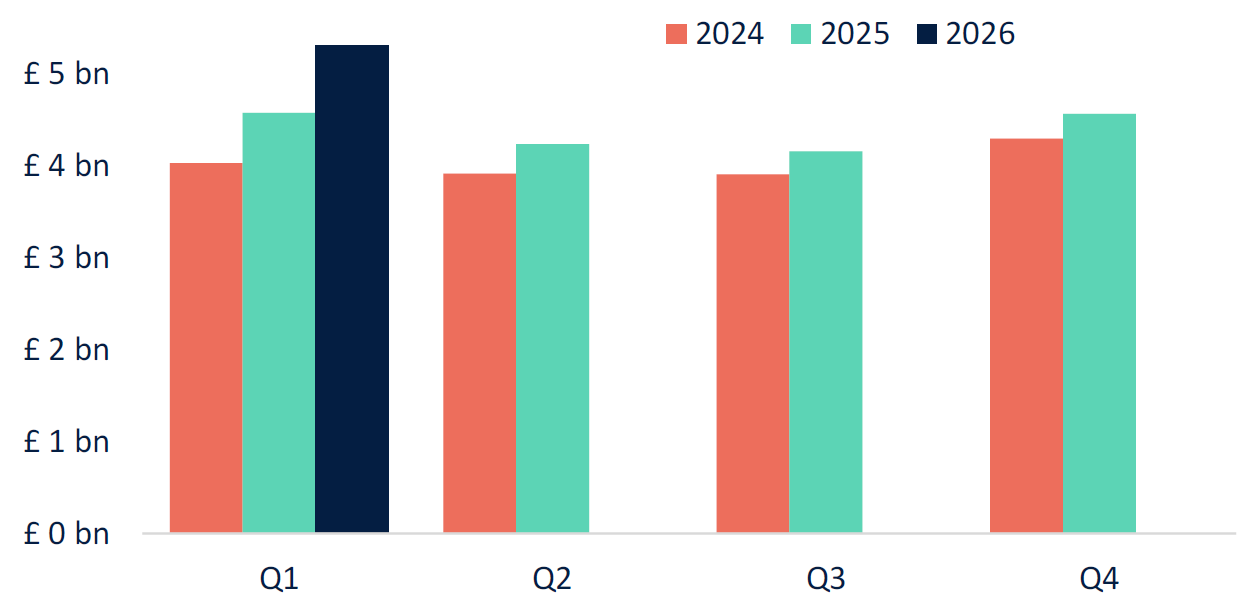 Source: UK Finance
Lending to the smallest businesses rose 51% year-on-year in Q1, taking quarterly gross lending to the highest level since 2018 Q1, excluding COVID-era lending schemes. UK Finance recorded seven consecutive quarters of double-digit annual growth in lending to the smallest companies, a trend supported by the Bank of England's Credit Conditions Survey, which noted sustained positive balances on credit supply to small firms.
Medium-sized businesses saw a more modest 4% year-on-year increase, though this was described as the fastest growth rate in a year for that cohort.
By sector, lending to recreation and personal services rose 66% year-on-year, though the UK Finance report noted that quarterly lending levels in the sector are not unusual and have followed an erratic pattern in recent years.
Real estate lending was up by just over a third on a year ago, accounting for nearly three-fifths of the total increase in lending across all sectors in the year to Q1. Agriculture saw gross lending rise by nearly a quarter.
The only sectors to record year-on-year declines were manufacturing and accommodation and food activities, both down modestly for a second consecutive quarter.
Gross lending growth by sector, annual percentage change 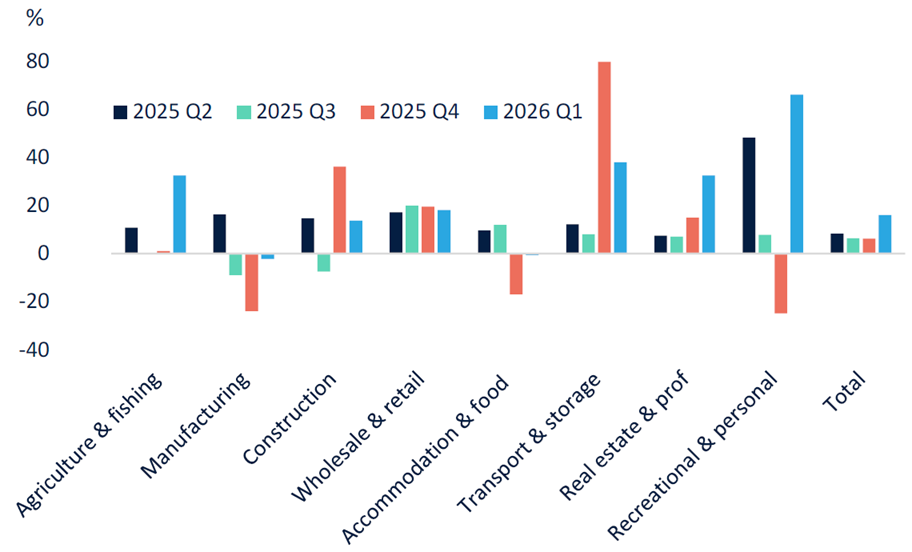 Source: UK Finance
The value and volume of new loan approvals rose by 36% and 42% respectively compared with Q1 2025, a slight acceleration on the previous quarter. Overdraft approvals also recovered following a contraction at the end of 2025, rising 15% by value and 20% by volume year-on-year.
Across all sectors, the volume of new loan approvals was higher than a year earlier, with real estate and construction seeing particularly notable gains. For manufacturing and transport and storage, however, approvals fell in value terms.
UK Finance cautioned that approved facilities do not guarantee future drawdowns. The SME Finance Monitor has consistently found that businesses regard the economic climate as one of the top three barriers to growth, particularly for those with borrowing plans, suggesting that confidence in investment decisions may be vulnerable to renewed uncertainty from the Middle East conflict.
Loan applications dipped in March following a strong start to the year, while overdraft applications picked up — a pattern UK Finance said echoed developments seen in early 2022 following the invasion of Ukraine. The shift was most pronounced among smaller firms. UK Finance cautioned that a single month's data does not constitute a trend, and that other forthcoming cost pressures — including higher Business Rates and a minimum wage increase from April — may also be influencing behaviour.
Survey data from the Decision Maker Panel indicated that businesses expect to respond to higher energy costs primarily through price increases and margin compression, with more than half of firms surveyed anticipating a negative impact on sales volumes over the next 12 months.
SME loan repayments have held steady at approximately £5.4 billion per quarter over the past three years. UK Finance noted that many SMEs entering the current period of uncertainty carry lower outstanding debt than they did before the Ukraine war. Department for Business and Trade data showed that nearly 18% of Bounce Back Loan facilities had been fully repaid as of December 2025, while ONS Business Conditions survey data indicated that around four in five businesses with outstanding debt remained confident in their ability to meet current obligations.
Looking ahead, UK Finance warned that Q2 data pointed to a deterioration in business confidence. The services sector purchasing managers' index signalled the sharpest fall in activity in more than five years. Continued disruption to shipping through the Strait of Hormuz was expected to weigh on energy-intensive sectors including transport and storage, manufacturing, and agriculture. Markets were pricing in at least one 25 basis point increase in Bank Rate before the end of the year.
 “Given everything that has been going on in the world over the past few months, we should be hugely encouraged by today’s figures," commented Gary Thompson (pictured right), sales director at SME funder Asset Advantage.
"SMEs continue to demonstrate real resilience and ambition to invest in growth despite a challenging operating environment. It certainly mirrors what we are seeing on the ground in terms of business volumes and what we are hearing from our broker partners.
“As businesses continue to navigate economic uncertainty and the impact of geopolitical tensions on supply chains, trade, costs and confidence, access to finance will remain absolutely critical. While uncertainty doesn’t eliminate opportunity, it does force us to be disciplined and to think more strategically – particularly when it comes to funding needs.
"Lenders have to be willing to provide that opportunity, looking beyond ever-tightening risk appetites and lending criteria to really understand the story behind the application and ensure good businesses get the fair hearing they deserve. This remains a key strength of more specialist funders, who are able to offer a more flexible and pragmatic approach to work with brokers in support of their SME clients.”
Want to be regularly updated with mortgage news and features? Get exclusive interviews, breaking news, and industry events in your inbox – subscribe to our FREE daily newsletter. You can also follow us on Facebook, X (formerly Twitter), and LinkedIn.


