Savills expects completions to stay weak into 2027 with the Bank of England tipped to raise rates again in February

Mortgage rates have hit 6 per cent and approvals have been below 60,000 for five months – and Savills doesn’t see a recovery before 2028.
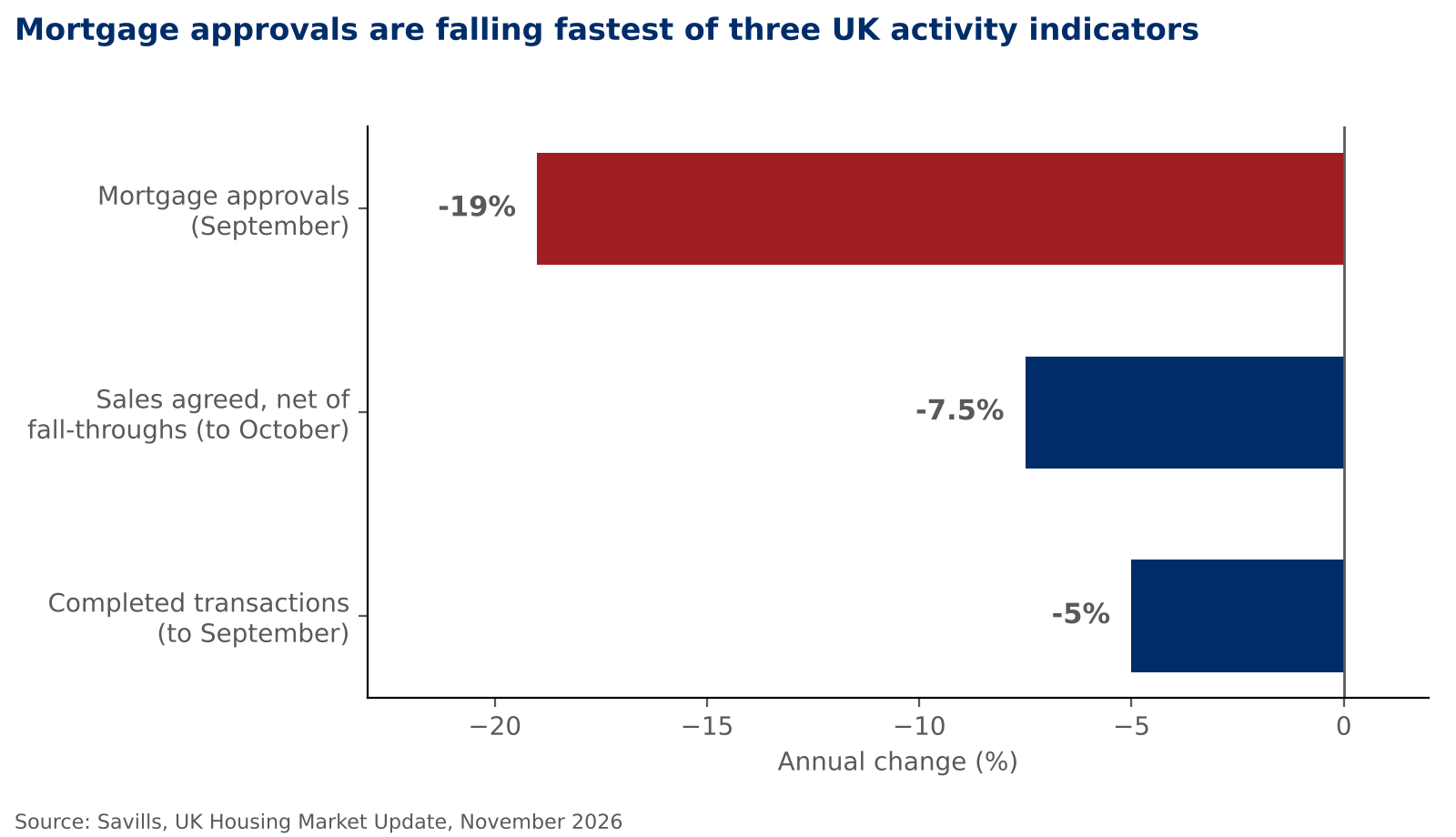
The agency’s UK Housing Market Update for November 2026 has approvals down 19 per cent year on year in September. Completions were 5 per cent lower in the year to September, and sales agreed, net of fall-throughs, are down 7.5 per cent in the year to October. Savills pins the slowdown on mortgage rates, which it blames on the Iran war.
Priced in, mostly
The average two- and five-year fixed rate is 6 per cent, up from 4.9 per cent in January. Moneyfacts has the two-year at 5.97 per cent and the five-year at 6.00 per cent, figures Mortgage Introducer reported as lenders repriced aggressively ahead of the base rate rise. The five-year mortgage rate also reached 6 per cent for the first time in three years.
The Bank of England lifted its Bank Rate to 4 per cent on 5 November, the first rise since August 2023, and Savills expects another in February. Inflation reached 3.5 per cent in September and is expected to peak at 4 per cent in early 2027. Lenders have largely priced that in, so mortgage costs may not climb much further.
Don’t expect a quick reversal either. Rachel Springall, finance expert at Moneyfacts, said before the Bank’s decision that most of the damage “is unlikely to unwind entirely”.
Mortgage approvals first, completions later
Completions trail approvals by four to six months, so five months of weak approvals mean transactions stay suppressed into the first half of 2027. September’s 97,940 completions, based on HM Revenue and Customs data, were 4 per cent below the 2017–19 average for the month.
Average mortgage product shelf life is down to 16 days, the lowest since 2023. Nouran Moustafa, executive financial and mortgage adviser at Roxton Wealth, said the reality on the ground is even more pressured.
“Products can go in two or three days, so they are being very generous at 16 days.” She added that the burden falls on both brokers and clients. “Every time you move applications, you have got the admin cost to do, and you have got your time cost. We can’t be getting hard credit searches on client files like it’s some sort of candy.”
Prices and the north-south divide
Savills forecasts house prices falling 1.5 per cent in 2027 and rising 3.5 per cent in 2028 once rates start to come down. Prices are at their lowest relative to incomes in a decade, the labour market is robust and first-time buyer numbers are strong, so the fall should stay shallow. Nationwide had October flat, with annual growth at 0.5 per cent against 0.8 per cent in September.
The national figures hide a wide gap. Local data to July has Scotland and the North West leading, with South Ayrshire up 11.6 per cent on the year, East Dunbartonshire up 10.0 per cent and East Ayrshire up 8.7 per cent. Central London is where the falls sit: Kensington and Chelsea is down 9.2 per cent, Camden 8.5 per cent and Westminster 8.4 per cent. Those are Savills’ six-month smoothed figures, built on HM Land Registry and Registers of Scotland data.
The forecast keeps the gap open. London, the South East and the East of England are each expected to fall 3.5 per cent in 2027, while the North West, North East and Scotland are tipped to rise 1.0 per cent and Wales and Yorkshire and the Humber 0.5 per cent. Over the five years to 2031, Savills has the North West up 23.3 per cent and London up 8.1 per cent, the north–south divide set out in its regional forecast for 2027–31.
Those forecasts apply to second-hand homes, and new-build values may not follow. A 3.5 per cent fall also bites harder on a southern borrower with a high loan-to-value mortgage than the 1.5 per cent national figure suggests.