New rental market report shows supply shortage keeping upward pressure on rents across every UK region

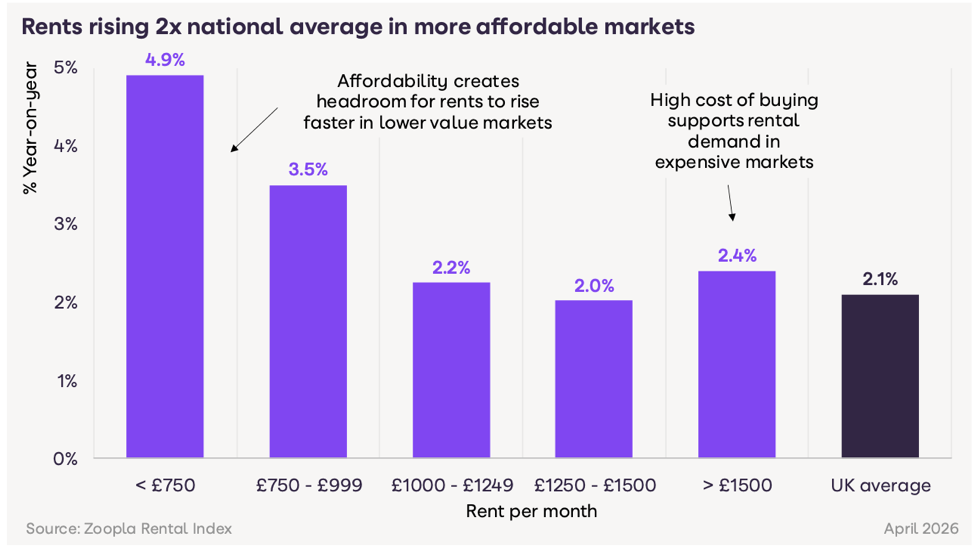
UK rents for new lets rose by 2.1% in the year to April 2026, down from 2.6% a year earlier, according to Zoopla's latest Rental Market Report. The national figure, however, obscures significant regional variation, with renters in more affordable areas facing considerably sharper increases.
In markets where average rents are below £750 per calendar month, annual growth is running at close to 5% — more than double the UK average. By contrast, areas where rents exceed £1,250 pcm are seeing growth at or below the 2.1% national rate. Zoopla attributes this divergence to affordability constraints in higher-cost markets, where rents have less room to rise.
At city level, Belfast recorded the steepest annual increase at 10.8%, with average rents of £907 pcm. Northern Ireland as a region was close behind at 9.9%. At the other end of the scale, Nottingham saw rents fall by 1.5%, Birmingham by 0.1%, and Bournemouth by 1.7%.
Demand for rental homes is declining nationally, with an average of 5.6 enquiries per listing recorded in May 2026, down sharply from a peak of 15.5 in 2022. Despite this, rents have not fallen because available supply remains 20–30% below pre-pandemic levels in every region.
London was the only region to record an increase in rental demand, up 6%, which Zoopla links to elevated mortgage rates continuing to deter would-be first-time buyers. London rental inflation rose to 2.2%, up from 1.9% a year earlier, against an average rent of £2,206 per calendar month.
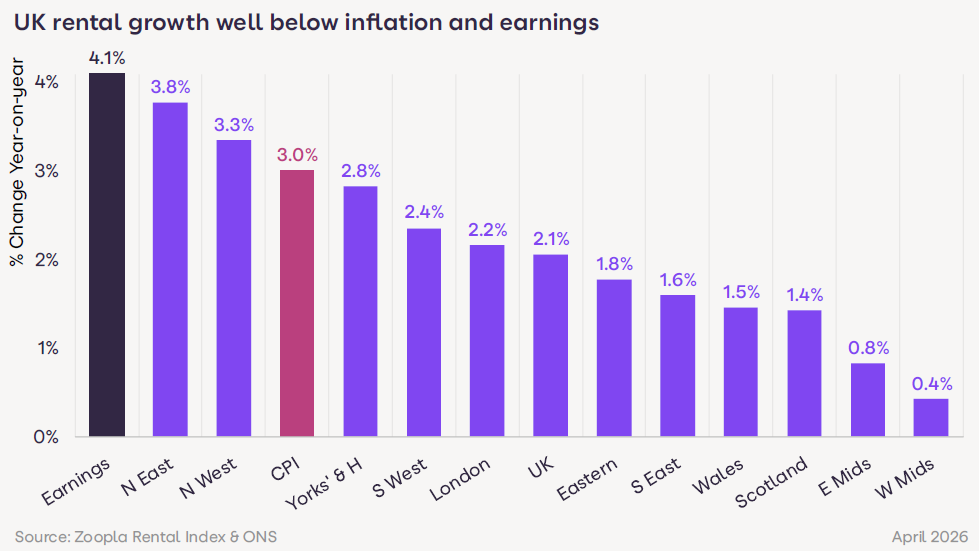
Average earnings are currently growing at approximately 4%, nearly twice the pace of rental inflation. Zoopla said this marks the third consecutive year in which wage growth has outstripped rent increases, offering gradual affordability relief for renters in full-time employment. Regional rental growth ranged from 0.4% in the West Midlands to 3.8% in the North East.
The report also notes the relevance of the Renters Rights Act, which came into force in England on 1 May. The legislation requires landlords and agents to give advance notice of proposed rent increases. Zoopla said its data on local rent trends can provide a factual basis for those negotiations.
"Rental inflation at 2.1% understates what most renters moving home are experiencing," said Richard Donnell (pictured right), executive director at Zoopla. "Three-quarters of rental areas are growing faster than the national average. There are 25% fewer homes to rent than pre-pandemic levels which is keeping rent inflation positive."
Zoopla forecasts rental inflation of 2–3% for the remainder of 2026. The report identifies growing the supply of rental homes as the most effective long-term measure to improve affordability, noting that the structural shortage of rental stock is present in every region of the UK.
Want to be regularly updated with mortgage news and features? Get exclusive interviews, breaking news, and industry events in your inbox – subscribe to our FREE daily newsletter. You can also follow us on Facebook, X (formerly Twitter), and LinkedIn.