

Jump to winners | Jump to methodology
Explore the workforce data behind 2026’s best UK mortgage companies to work for
Report at a glance
The most compelling data points from this year's Top Mortgage Employers report
of the mortgage workforce has 10+ years' tenure in 2026, down from 34% in 2024
MI surveyof staff are now fully office-based, up from just 6% in 2025
MI surveyforecast external remortgaging value in 2026, as 1.8m fixed-rate deals mature
UK Financecorrelation between career advancement and overall employee satisfaction, the strongest of any factor measured
MI surveyfall in compensation importance, 2024 to 2025, the only one of 8 pillars to decline
MI surveyfall in paternity leave importance from newer starters to 10+ year staff
MI surveyvacation leave is the most valued benefit at every career stage, regardless of tenure
MI survey
The UK mortgage industry has a retention problem, and 2026 is about to make it worse. The best mortgage companies to work for in the UK are entering the year facing a wave of refinancing activity just as their most experienced staff head for the door. According to UK Finance’s Mortgage Market Forecast 2026–2027, published in December 2025, around 1.8 million fixed-rate mortgages are due to mature this year, pushing external remortgaging up 10% to an estimated £77 billion.
That surge in workload is crashing into a workforce that is hollowing out from the top, exposing which firms can genuinely earn that title and which are coasting on it.
Third-party market data
Key figures from UK Finance's Mortgage Market Forecast 2026-2027, published December 2025
Lending growth by segment, 2025 vs 2026
House purchase lending
£176bn → £180bn
+2%External remortgaging
£71bn → £77bn
+10%Buy-to-let purchase lending
£11bn → £11bn
Flat
Mortgage Introducer’s Top Mortgage Employers 2026 are the elite companies rated highly by their employees for the positive workplace environments they have created.
This year’s winners were identified through a two-phase process: employer submissions followed by an anonymous employee survey, with any organisation achieving an overall satisfaction rating of 75% or higher earning the title.
The timing could hardly be more pointed. As lending volumes climb and the pool of experienced brokers thins, employers who retain and develop talent stand to gain a real competitive edge, while those who do not may struggle to keep pace with rising demand. This report examines what today’s leading UK mortgage employers are doing right and what the workforce data says about where the industry is headed next.
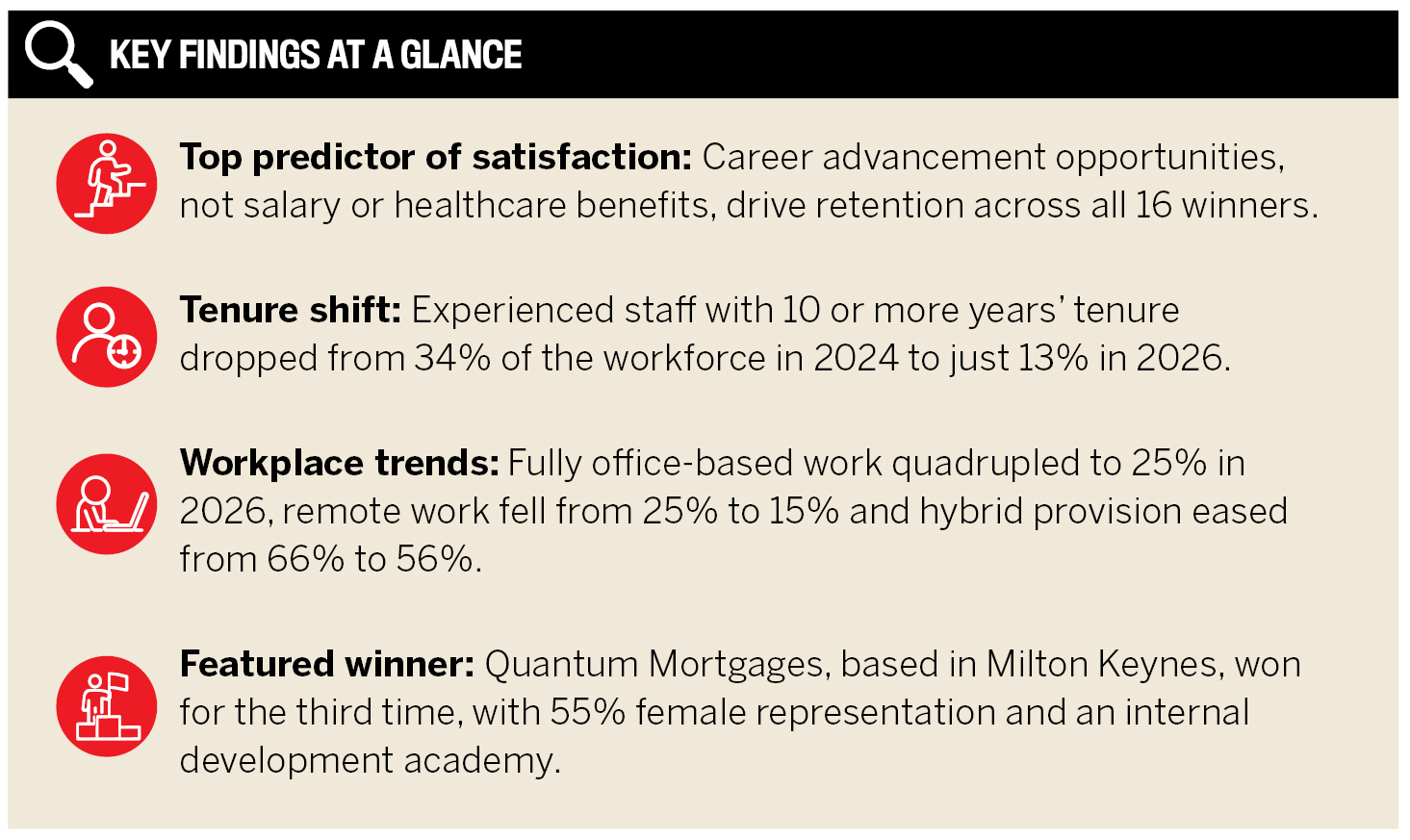
Mortgage employers are contending with a workforce transformation that shows no signs of slowing in 2026. According to MI’s Top Mortgage Employers survey, employees with 10 or more years’ tenure now make up just 13% of the workforce, down from 34% in 2024, while staff with under three years’ tenure have grown to 51% over the same period.
Three-year workforce trends
How workforce tenure, working arrangements, and retention risk have shifted across Mortgage Introducer's 2024, 2025 and 2026 Top Mortgage Employers surveys
The share of employees with 10 or more years' tenure has fallen from 34% in 2024 to just 13% in 2026, a two-thirds drop in two years. As veteran staff leave the workforce, mortgage sector employers face a fast-accelerating succession and institutional-knowledge challenge.
Employees with under 3 years' tenure, 2024 vs 2026
SOURCE Mortgage Introducer, Top Mortgage Employers survey, 2024 and 2026
Return-to-office accelerates in 2026
100% office-based arrangements quadrupled in a single year, from 6% in 2025 to 25% in 2026.
SOURCE Mortgage Introducer, Top Mortgage Employers survey
100% remote arrangements fell from 25% in 2025 to 15% in 2026, the sharpest single-year reversal tracked.
SOURCE Mortgage Introducer, Top Mortgage Employers survey
Retention risk keeps easing, despite the squeeze
Preference for hybrid work has climbed every year, from 46% in 2024 to 59% in 2026, even as actual hybrid provision eased slightly in the latest year.
SOURCE Mortgage Introducer, Top Mortgage Employers survey
Willingness to switch jobs for better working options has fallen every year, from 49% in 2024 to a three-year low of 45% in 2026.
SOURCE Mortgage Introducer, Top Mortgage Employers survey
Marcus Nanson, director at NRG Resourcing in Southampton, was asked what single change he would most like to see more UK mortgage employers make to their workplace culture and people practices.
“The one change would be more companies taking the time to bring in fresh people into the industry, and that means proper training and mentoring and giving them the best opportunity to be successful,” he says.
Nanson warns that without a substantial recruitment effort, the industry’s shrinking pool of experienced candidates will eventually dry out, a concern echoed in MI’s own reporting on the industry’s struggle to recruit new talent.
The shift in tenure coincides with a sharp swing back towards office-based work, which quadrupled from 6% to 25% between 2025 and 2026, while fully remote arrangements fell from 25% to 15% over the same period. A small share of employees, 4% in both years, set their own arrangement independent of employer policy. This mirrors the Chartered Institute of Personnel and Development’s analysis of employer return-to-office plans, which found large private employers are driving the push for more mandated office days.
Nanson says flexibility works best when tailored to seniority: junior brokers benefit from more time in the office, while senior staff need to be present to mentor them, a dynamic that may help explain 2026’s pull back towards office presence.
What employees value from a benefits package is shifting in parallel. MI also found paternity leave importance falls 12% between newer starters and staff with 10-plus years’ tenure, while retirement plan importance rises 3% over the same span. Vacation leave and flexible work options remain the two most consistently valued benefits regardless of tenure.
Workforce insights
How employees at nominated organisations rank the importance of different benefits, segmented by length of service
Paternity leave scores 3.56 out of 5 in importance among staff with less than 1 year of tenure but falls to 3.12 out of 5 among those with 10 or more years, a 12% difference. This most likely reflects shifting life-stage priorities rather than a decline in the benefit itself, family-forming benefits naturally matter more to employees earlier in their careers.
Biggest importance swing in the survey: sabbaticals
SOURCE Mortgage Introducer, Top Mortgage Employers 2026 employee survey
Sabbaticals shows an even steeper importance swing than paternity leave, the clearest sign that career stage reshapes what employees value across the whole benefits list, not just family-related ones.
Shifts by career stage
Maternity leave importance falls 5% across the same tenure range, reinforcing that family-forming benefits matter most to employees earlier in their careers.
SOURCE Mortgage Introducer, Top Mortgage Employers 2026 survey
Retirement plan importance rises 3% over the same tenure range, a natural shift as employees move closer to retirement and prioritise long-term financial planning.
SOURCE Mortgage Introducer, Top Mortgage Employers 2026 survey
Constant regardless of career stage
Vacation leave is the highest-rated benefit in importance at every tenure stage, holding above 4.6 out of 5 from new starters through 10+ year veterans.
SOURCE Mortgage Introducer, Top Mortgage Employers 2026 survey
Flexible work options rank second overall in importance at every tenure stage, though even this near-universal benefit eases slightly, from 4.45 to 4.23, as work-life needs evolve across a career.
SOURCE Mortgage Introducer, Top Mortgage Employers 2026 survey
Lending forecasts for the next two years diverge on scale but agree on direction. UK Finance expects gross mortgage lending to rise 4% to £300 billion in 2026, while the Intermediary Mortgage Lenders Association forecasts a steeper climb to £320 billion in 2026 and £350 billion in 2027, driven by improving affordability and eased loan-to-income lending rules.
Both forecasts predate August 2026’s swap rate rise, triggered by renewed conflict in the Middle East and the first uptick in fixed mortgage rates in months. The Bank of England has now held its base rate at 3.75% for a fifth consecutive meeting, leaving little near-term relief on borrowing costs, so the more optimistic scenarios may prove harder to reach if rate cuts stall further.
As succession pressures mount, expect more mortgage employers to lean harder into career progression as a retention strategy over the next 12–24 months. “One of the biggest retention tools is that people feel that they are growing in their career. It’s not just about money; it’s about feeling like you’re progressing,” says Nanson.
Technology will keep reshaping day-to-day roles, too. Nanson points to AI adoption in back-office functions freeing brokers from administrative work, giving them more time to build client relationships and understand what clients need. That shift lines up with separate research showing broker demand for mortgage technology has hit a new high in 2026.
Whether 2026’s swing towards office-based work continues or plateaus remains an open question. If the pattern holds, employers who pair in-office time with genuine mentoring, rather than treating it as a blanket mandate, will be best placed to close the widening gap between what employees want and what they are currently getting.
Top Mortgage Employers 2026 winner
Top 3 categories
For the third time, Quantum Mortgages returns as a Top Mortgage Employer in 2026, with employees again describing its culture as the best they have ever worked in. CEO Jason Neale traces that back to how the business started. He and his senior management team drew on years of working for banks and large corporates to build something different from the frustrations they experienced within these institutions.
“One of the reasons why Quantum exists was to build a good place to work for good people,” he says.
Neale says talent and hard work are simply the baseline at Quantum. What matters more, he says, is whether someone is “respectful,” “kind” and able to “operate without having a big ego.”
The company has regretfully parted ways with skilled staff who could not meet that standard. That trade-off, he believes, is what keeps the wider culture largely self-sustaining. None of the leadership team, himself included, has a private office. “We just sit in the team with everybody else, and anyone can pull up a chair, plonk themselves next to our desk, and just have a chat,” he says.
He says the team knows each other’s names, families and interests outside work, and that colleagues regularly become close friends, visiting each other’s homes and letting their kids play together.


Employees echo that assessment independently. One says there is “no room for egos” at Quantum, describing “a cooperative, team-feel where everyone in the business is working towards the same overarching goal.” Another simply calls it “genuinely the best lender I have ever worked for.”
Quantum’s culture is anchored to eight internal founding principles – distinct from the eight factors used to score this year’s winners – that Neale and his founding team drew up before the company launched. The first reads simply, “Create a workplace where people feel valued, appreciated, and fulfilled,” alongside commitments to being a commonsense mortgage lender and earning the trust of intermediaries.
Rather than treating them as background values, Neale says the company puts them up on the wall at every town hall meeting and works through them one by one, asking staff directly whether the business is still living up to each one.
The ritual delivers real results. During a recent town hall, staff feedback led the team to quickly realign how some of its underwriting had lost some common sense, addressing what Neale calls “process creep” and reinforcing customer service on the spot.
That same responsiveness improved the company’s holiday and maternity allowance, after staff feedback and market research showed room to do better. “No matter how big we get, we will always have to come back to these eight key principles that are not just a sticker on the wall,” he says.
That same standard extends to how Quantum develops its people. “Our preference is always internal recruitment because we want to deliver opportunities for our people,” Neale says.
The company runs two internal academies: one training case managers into mandated underwriters and the other moving broker support staff into external business development roles. At least four people have gone through the underwriting academy in the past 18 months, and all become exceptional underwriters, Neale says, while two more are currently progressing through the sales academy.
Not every employee wants that path, and Neale says the company values that, too: “You have to respect where people are in their life and what work-life balance means for them.”
The pattern lines up with a wider finding in this year’s report. Room for career advancement is the strongest single predictor of employee satisfaction across all 16 top mortgage employers.
Survey respondent feedback backs this up directly. One employee, who has been with the company since it began trading four years ago, says there have been “multiple promotions across many departments” in that time, with “every employee encouraged to increase their skill set if they wish to do so.”
Q: Diversity and inclusion was one of Quantum’s highest-scoring areas. What initiatives or decisions do you think are really driving that?
A: We don’t have any diversity incentives or targets; it’s just a natural state for us. We don’t need a poster or a mission statement to tell us that diverse opinions are good for the business.
We recruit the best, most talented people for the job, and when they’re with us, we value all their opinions. That said, we do notice diversity. We’re 55% female across the entire business, our C-suite is 50% female, and our heads of department are majority women. We’re also really strong on neurodiversity, again not because of a quota.
Q: How does your innovation mindset show up in the day-to-day employee experience?
A: We’re not a tech-driven company as such; we’ve never wanted to be a fintech, but that doesn’t mean we don’t use tech. We’re fundamentally a lending business, so the only tech we invest in is whatever helps us do lending better and quicker for our customers and our team.
We use a lot of robotic process automation to collect information and put it in front of the underwriter, automating things like basic admin tasks, which will be fully automated by the end of this year, and the risk assessment write-ups that used to take an underwriter an hour per case.
That frees them up to spend their time on what they enjoy, looking at cases and making underwriting decisions. Looking ahead, our process will be 95% automated, with the final 5% being a human being deciding whether it’s okay to lend.
Q: Quantum is based outside London, in Bletchley, Milton Keynes. How does that shape the day-to-day experience for your team?
A: We’re not based in London, and let’s be honest, who wants a long commute every day, adding hours to your journey? We work a hybrid model, and on the days people do come into the office, it’s an out-of-town site where they can park right outside. We’re also a nine-to-five business, where most other lenders work till 5:30, so a lot of our team who used to commute into London are now home before they would have even finished work in their last job.
Q: Quantum is preparing to launch into residential mortgages. What’s the thinking behind that move, and what does it mean for your team?
A: We were originally due to launch at the start of the year (2026), but global events pushed rates up, so it just wasn’t the right time. We’ll launch within the next month (September 2026). We’ve already recruited the team, and we’re ready to go.
It’s a completely new product set for us, and because the specialist residential market is around five times bigger than specialist buy-to-let, I’d expect that growth to outpace what we’ve done so far. We’ve done £1 billion of lending in under four and a half years, which I think is faster than any other non-bank lender, and I’d expect us to double our lending over the next 12 months. Hopefully that creates a lot more opportunities for our people, too.
Marcus Nanson is a director at NRG Resourcing in Southampton, where he works with hundreds of mortgage brokerages across the UK.

The best mortgage companies to work for in the UK are not the highest payers; they are the strongest career-builders. Across all 16 winners, room for career advancement tracks most closely with overall employee satisfaction, followed by loyalty and sabbatical structures and a sense of feeling inspired to meet goals. Healthcare and retirement benefits show the weakest association with a company’s overall ranking, functioning as baseline expectations rather than genuine differentiators.
The pattern echoes what Nanson told MI directly: the strongest retention tool is not money; it is the sense of progressing in a career. This year’s leading employers appear to have taken that lesson to heart, investing visibly in advancement, recognition and mentoring rather than competing purely on pay, a pattern also visible in MI’s coverage of the UK’s best women mortgage leaders, where winners repeatedly invest in mentoring schemes and training academies.
Cross-nominee analysis
Correlation between each survey question and overall employee satisfaction, across all 16 Top Mortgage Employers 2026 nominees
Of the 21 factors measured, room for career advancement tracks most closely with a nominee's overall employee satisfaction score, more closely than compensation, benefits, or culture. Loyalty and sabbatical structures and feeling inspired to meet goals follow just behind.
Strongest predictors of overall ranking
Weakest predictors of overall ranking
SOURCE Mortgage Introducer, Top Mortgage Employers 2026 survey, all 16 nominees




What is the Mortgage Introducer Top Mortgage Employers award?
The Top Mortgage Employers award identifies the best mortgage companies to work for in the UK, as rated by employees. Run by MI, nominated organisations complete an employer submission, after which staff take an anonymous survey scoring the business across eight factors: advancement, benefits, compensation, culture, diversity, equity and inclusion, innovation, reputation and sustainable programs.
How many employees were surveyed for the Top Mortgage Employers 2026 report?
Individual company response counts varied by size, with each nominee required to meet a minimum threshold based on its headcount.
Why are experienced mortgage professionals leaving the industry?
Experienced mortgage professionals are leaving, as staff with 10 or more years’ tenure fell from 34% to 13% since 2024. MI’s survey data confirms the decline. Marcus Nanson, director at NRG Resourcing in Southampton, points to a shrinking pool of experienced candidates and calls for greater investment in training and mentoring new entrants to the industry.
Is hybrid working still common among UK mortgage employers in 2026?
Yes, hybrid working remains the most common arrangement among UK mortgage employers, despite falling from 66% to 56%. Fully office-based arrangements quadrupled from 6% to 25% over the same period, while remote work fell from 25% to 15%.
What will shape the UK mortgage employer landscape in 2027?
Sustained lending demand and a shrinking pool of experienced staff will shape the UK mortgage employer landscape in 2027. UK Finance expects gross mortgage lending to reach £300 billion in 2026, driven largely by refinancing as 1.8 million fixed-rate mortgages mature. Employers who invest in career progression and mentoring are expected to be best placed to manage the increased workload.
The process of finding and recognising the best employers in the UK mortgage industry took place in two phases. First, Mortgage Introducer invited organisations to submit their details in a survey, in which they were able to describe their offerings and business practices. Second, employees from the nominated companies were asked to fill out an anonymous survey to rate their satisfaction with a number of key factors, such as compensation, employee development, culture and work environment.
Each company was required to meet a minimum number of employee responses based on its overall size. Any company that achieved a satisfaction rating of 75% or greater was named a Top Mortgage Employer.