A 17% monthly surge in housing starts offers brokers a cautious signal, but the pipeline remains constrained

Canada's residential construction sector showed signs of stabilisation in April.
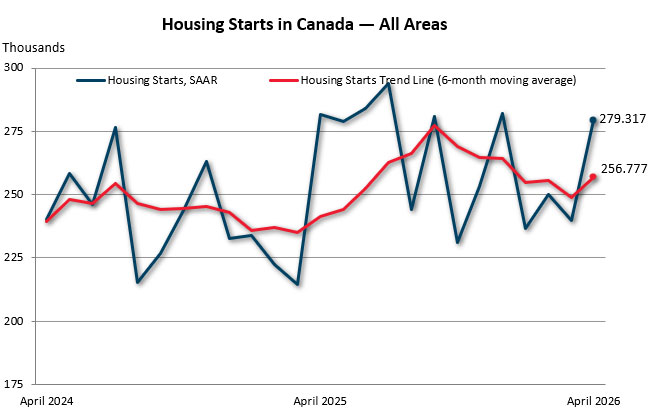
The seasonally adjusted annual rate (SAAR) of housing starts climbed 17% to 279,317 units, up from 239,747 in March, according to the latest figures from Canada Mortgage and Housing Corporation (CMHC).
The monthly gain — one of the sharper single-month rebounds in recent quarters — provided a measure of relief after several consecutive months of slippage in the broader trend, though economists cautioned against reading too much into a single data point.
The six-month trend, a smoother gauge that filters out month-to-month noise and is widely used by lenders and developers to assess pipeline momentum, rose 3.2% to 256,777 units.
While that marked a welcome reversal, CMHC was careful to note it followed a prolonged run of declines that has characterised much of the early-2026 construction environment.
"While the six-month trend in housing starts rose slightly in April, it follows several consecutive months of decline, underscoring the uneven nature of current construction activity, and month-to-month volatility," said Kevin Hughes, deputy chief economist at CMHC.
"Building permit data provides additional context for this pattern, pointing to a construction pipeline that remains subdued, in line with CMHC's Housing Market Outlook."
Year-to-date gains mask a mixed picture
Actual housing starts in centres with a population of 10,000 or more totalled 21,805 units in April, down 1% from 21,938 units recorded in the same month a year earlier.
However, the year-to-date tally of 71,011 units represented a 6% gain over the equivalent period in 2025, driven by stronger activity in British Columbia and Ontario — two markets that have otherwise been under considerable construction pressure due to high costs, weak pre-construction sales and softening demand.
Among Canada's three largest census metropolitan areas, Toronto posted a 34% year-over-year increase in actual housing starts, driven by higher multi-unit activity. Montréal followed with a 21% gain attributable to the same segment.
Vancouver, by contrast, recorded a 30% decline, weighed down by lower multi-unit and single-detached starts.
Rural starts, meanwhile, were estimated at an annualised rate of 13,694 units.
For mortgage brokers watching the pipeline for signals about future inventory and pricing pressure, the divergence between urban centres reinforces a fragmented national outlook.
CMHC's own forecasts have called for national starts to decline from 2026 through 2028, as high construction costs, financing constraints and softer demand push more projects to the sidelines.
A fuller view of the construction pipeline
In a new development accompanying the April release, CMHC began publishing building permit data alongside its Starts and Completions Survey figures, adding detail on approved units awaiting a start, units currently under construction and completions — all for centres with populations of 50,000 or more.
"Building permits provide an early signal of future residential construction activity, while housing starts capture construction that has begun and offer the best indication of future housing supply," said Mathieu Laberge, CMHC's chief economist and senior vice-president of Housing Insights.
"Together, these measures show how development intentions translate into real construction activity, providing a more complete picture of the residential construction market's trajectory. This is why CMHC is proactively releasing building permits data alongside Starts and Completions Survey data."
Canada’s homebuilding outlook faces mounting pressure as uncertainty deepens.
— Canadian Mortgage Professional Magazine (@CMPmagazine) April 30, 2026
Kevin Lee of the Canadian Home Builders’ Association said weakening demand, global instability, and delayed policy clarity are worsening an already fragile construction market.https://t.co/FGvwt9ifob
The expanded data set arrives at a moment when the gap between permitted and started projects has become a closely watched risk signal.
For lenders and brokers, that gap between permitted and started projects has become a key risk indicator as more developers delay launches or re-phase sites.
Building permit volumes, which rose in late 2025, have not yet translated into a commensurate lift in actual starts, a dynamic that underscores the barriers developers face in moving from approval to construction.
Those barriers include elevated financing costs, labour shortages and, in some markets, weak presale demand that makes lenders reluctant to advance construction draws.
The Canadian Home Builders' Association's Housing Market Index revealed near record-low confidence among builders focused on ownership housing, with the single-family index falling 5.5 points from the prior year to 20.9 in the first quarter. That's just 1.3 points above the all-time record low.
The April rebound, while encouraging, does little on its own to shift that underlying sentiment.
CMHC has already warned that Canada needs roughly 3.5 million additional homes by 2030 to restore affordability, a target its own economists acknowledged is increasingly difficult as construction costs, labour shortages and financing constraints bite into new supply.
Make sure to get all the latest news to your inbox on Canada's mortgage and housing markets by signing up for our free daily newsletter here.