Canada's mortgage arrears numbers look manageable, but analysts say that's not the full story

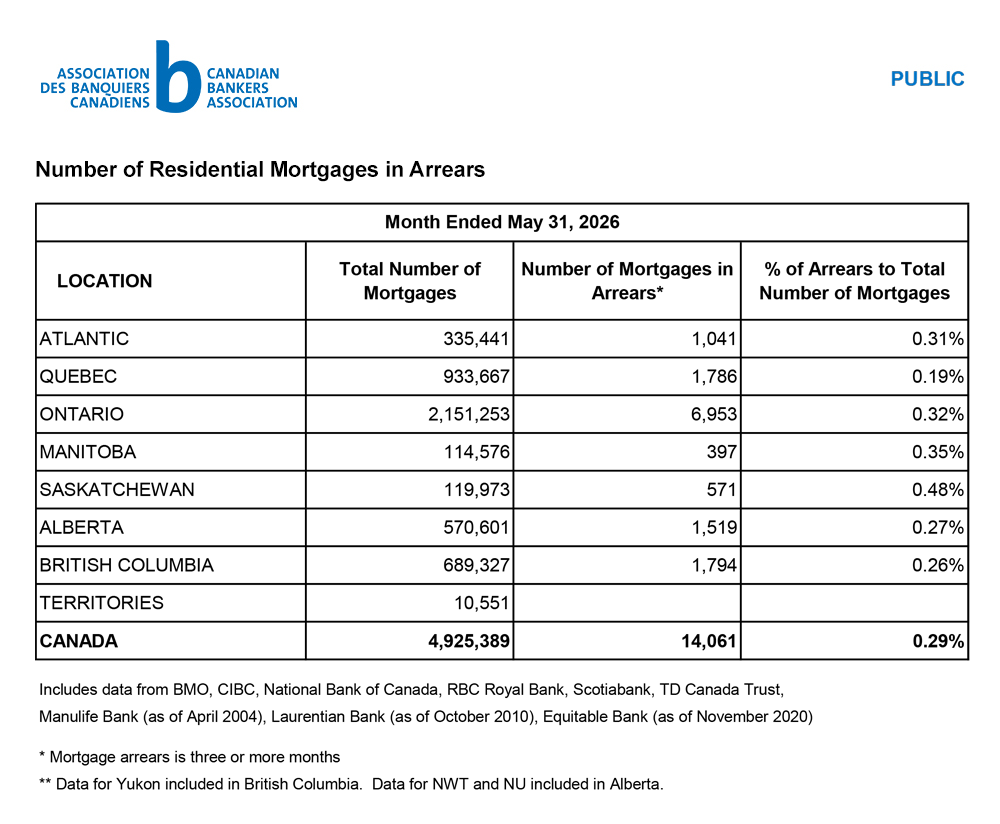
The number of Canadian bank mortgages at least 90 days past due reached 14,061 in May 2026, the highest count in more than a decade, according to the Canadian Bankers Association (CBA).
A combination of elevated unemployment, a historic renewal wave, and a structural gap in lender data raises questions about how much strain the official figures are actually capturing.
The national arrears rate edged up one basis point to 0.29% in May, adding seven basis points over the past year. Since hitting a record low of 0.14% in 2022, the rate has more than doubled to its highest level since August 2016.
Unlike a brief spike in 2016 that reversed quickly, the current rate is steadily climbing.
Year-over-year, the arrears count rose 27.2%, a pace of growth last consistently recorded between 2008 and 2010 and rare outside of a recession.
The unemployment connection
Bank of Canada research has long identified the labour market as the primary driver of mortgage arrears in Canada, estimating that a one percentage point increase in the unemployment rate leads to a 0.1 percentage point rise in the arrears rate, with a lag of approximately one year.
Canada's national unemployment rate stood at 6.7% in March 2026, higher than recent years, but still relatively low from a long-term perspective, according to Statistics Canada.
The CBA frames the current situation as manageable. The association defines arrears as mortgage payments overdue by three or more months, and notes that more than 99% of bank mortgage holders in Canada remain in good standing. Canada's arrears rate also continues to sit well below those of the United States and the United Kingdom.
The banking sector has maintained a consistent commitment to working with borrowers through difficulty, offering options that include amortization extensions, lump-sum payments, and rate conversions.
Victor Tran, a mortgage broker at Rates.ca, put the data in context earlier this year.
"At first glance, the increase sounds alarming, but the overall delinquency rate remains low," Tran said.
"It reflects the strain higher rates are putting on monthly payments at renewal, especially for homeowners who bought during the pandemic, rather than widespread foreclosure risk."
What the headline rate does not show
The picture grows more complicated beyond the chartered bank system. When borrowers accumulate a spotty repayment history, banks commonly decline to renew those mortgages or sell the debt to B lenders, a segment that operates with far less public reporting.
This means the CBA's headline figure is drawn from a pool that has already been filtered for quality, understating the true breadth of arrears exposure across the market.
Canada Mortgage and Housing Corporation (CMHC) analysis confirms that arrears are rising due to several converging factors: unemployment trends, interest rate patterns, and mortgage renewals at materially higher rates than when loans were first originated. The pressure is geographically concentrated.
Ontario's mortgage delinquency rate climbed to 0.23% in recent quarters, surpassing the national average for the first time since at least 2012, while Toronto's rate jumped roughly 60% year-over-year by mid-2025.
For brokers, understanding what distinguishes regulated alternative lenders from private mortgage lenders in Canada is increasingly important context when placing clients who may have been declined by chartered banks.
The total mortgage count at CBA member banks slipped to 4.93 million in May, the eighth consecutive monthly decline and the lowest figure since October 202. New originations continue to fail to offset outflows, reversing most of the low-rate growth recorded in 2020.
Desjardins Group's base case holds that arrears will plateau before a gradual decline through 2027 and 2028, provided the labour market stabilises. That window remains open, but the current trajectory suggests it is narrowing.
Make sure to get all the latest news to your inbox on Canada’s mortgage and housing markets by signing up for our free daily newsletter here.