Global real estate bubble report finds prices down 10% in a year, but a supply crunch looms

Toronto and Vancouver housing markets have sunk to the bottom of UBS's 2026 global real estate bubble rankings. Inflation-adjusted home prices in both cities fell by around 10% over the past year, the steepest declines among the 23 cities the Swiss bank tracks.
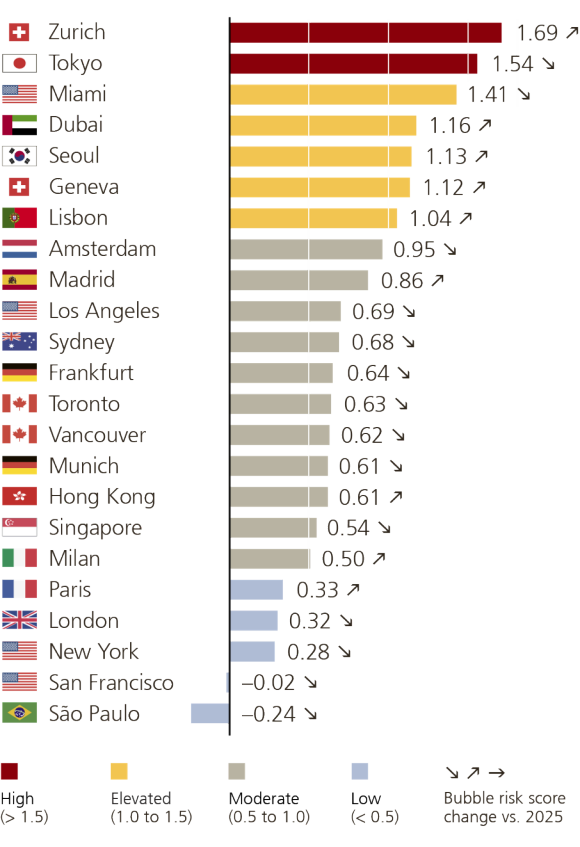
The UBS Global Real Estate Bubble Index was published by the Chief Investment Office of UBS Global Wealth Management. It scored Toronto at 0.63 and Vancouver at 0.62, which places both in the "moderate" bubble-risk band.
Zurich (1.69) and Tokyo (1.54) were the only markets flagged as high risk. Real prices across the full sample rose just 0.5% on average.
The slide is a sharp reversal for Toronto. UBS identified it as the strongest market in its study between 2014 and 2022, when real prices doubled, and the city now sits nearly 30% below that peak. Vancouver prices are 20% below their 2022 high, and sales there are at a 25-year low.
UBS pointed to three forces behind the correction: higher interest rates, the federal foreign-buyer ban and increased supply.
What does the UBS bubble index mean for borrowers?
On paper, the downturn makes Toronto look cheap by global standards. UBS estimates a skilled service worker needs less than five years of income to buy a 650-square-foot apartment near the city centre. That is the lowest ratio of any city studied, against about 15 years in Hong Kong and 11 in London.
The ownership math is less forgiving. UBS calculates the full cost of owning, including mortgage interest, maintenance, taxes and a risk premium.
By that measure, owning in Vancouver and Toronto costs well above the rent on a comparable unit, and the two cities rank behind only Hong Kong and Los Angeles for that gap.
Real rents also fell over the year, by 3.8% in Toronto and 5% in Vancouver.
Local benchmarks point the same way. The Greater Toronto Area's average selling price in August fell 2.7% annually to $993,410, dipping below the $1-million threshold for only the second time in 2026.
The MLS Home Price Index (HPI) Composite benchmark declined 4.5% year-over-year to approximately $931,200 on a seasonally adjusted basis.
Metro Vancouver's composite benchmark reached $1,081,900, down 5.6% from August 2025, as Vancouver and Fraser Valley home sales deepened the region's buyer's market.
Nationally, Vancouver (-6.5%), Hamilton (-6.2%) and Toronto (-6.1%) led annual losses as Canadian home prices slid to their lowest point since 2023.
Daren King of National Bank highlighted that while several major markets posted monthly declines in August, cities such as Quebec City, Montreal, and Toronto recorded gains, reflecting varied conditions across the country.https://t.co/rm5EMleWQd
— Canadian Mortgage Professional Magazine (@CMPmagazine) September 21, 2026
Foreign buyer ban and a looming supply gap
The federal ban on non-resident buyers is set to expire on January 1, 2027, with no indication yet of whether policymakers plan to extend or scrap it.
UBS said easing the restriction could support demand and new supply in Toronto, though economic uncertainty is likely to keep price growth subdued.
Sherry Cooper, chief economist at Dominion Lending Centres Group, told Canadian Mortgage Professional she favours relaxing the ban, as Ottawa weighs its looming decision on the foreign homebuyer ban.
"Look at the Americans that would be very interested in having a second property in Canada, particularly given how they feel about what's going on in the US," she said.
"Why shouldn't those people be able to buy a property in Toronto that's been listed on the market for 18 months?"
The bigger risk may be what isn't being built. The Canada Mortgage and Housing Corporation (CMHC) published its Fall 2026 Housing Supply Report with several warnings for Toronto:
- Toronto must lift annual housing starts by at least 50% over the next decade to return to 2019 affordability.
- Population-adjusted starts in the first half of 2026 were the lowest since 1996, excluding 2025.
- Only 156 condo units were started in the City of Toronto in the first half of 2026, against a decade average of 7,000 a year.
For brokers, that creates a narrow window. Prices are softer today, but the market could tighten again if demand recovers before supply does.
Make sure to get all the latest news to your inbox on Canada’s mortgage and housing markets by signing up for our free daily newsletter here.