Finance and property sectors among biggest AI bulls – but risks must be understood

Design and Diplomacy does bespoke. The Melbourne interior design and property services firm tailors every project around its clients – no templates, no shortcuts, no off-the-shelf solutions.
AI, it turns out, fits that model perfectly. The team deploys it on the tasks that drain time without adding value: summarising reports, reviewing contracts, drafting proposals, checking invoices.
"AI is a productivity and thinking accelerator – not a substitute for professional judgement," say director Timothy Gauci and Designer Nicole Langelier. It's a philosophy shared by a growing number of small businesses across Australia, as AI quietly embeds itself into the operations of businesses of every shape and size.
According to the new NAB SME Business Insights: Embracing AI report – which includes real-world case studies of AI adoption – 42% of small businesses are now using AI tools or platforms, with a further 14% planning to adopt AI soon. But the findings, drawn from around 670 non-farm SMEs surveyed in late 2025, show that 16% of SMEs believe AI will not help their business.
The degree of adoption varies dramatically across sectors:
-
Property services tops the list with a 69% adoption rate
-
Finance and insurance follows at 65%
-
Business services at 61%
-
Health sits at 56%
-
Accommodation, cafes and restaurants has emerged as a strong performer at 50%, driven by competitive pressure around customer engagement, pricing and efficiency.
At the other end of the spectrum:
-
Transport and storage sits at just 21%
-
Retail at 22% (and the highest share of non-users at 64%)
-
Manufacturing at 35%
The gap makes sense when you look at how these businesses operate. Finance, property and business services firms already work with large volumes of data. Their daily tasks – forecasting, compliance, process automation – map naturally onto what AI does well. For sectors managing physical goods or face-to-face service, the AI use case is less clear cut.
“Overall, the data reflects that sectors with strong digital foundations or analytical workflows are best positioned to integrate and benefit from AI, so their leadership in adoption aligns well with expectations set by their operational models and industry needs,” says the report.
Where SMEs see the opportunity
When asked where AI could help them most, SMEs gave a clear answer: automating repetitive tasks, with 35% of businesses nominating this as the top opportunity.
Marketing and sales optimisation came second at 31%, followed by improving decision-making (23%), enhancing customer experience (22%) and cutting costs and boosting efficiency (18%).
The appetite for automation is strongest in finance and insurance and business services, where 52% of firms in each sector see it as a priority. Both deal with heavy administrative and compliance workloads where AI can save real time.
Customer-facing sectors tell a different story. Accommodation, cafes and restaurants (33%) and retail (22%) are less interested in back-office automation. They want AI to help them sell more and serve customers better. Accommodation leads on marketing and sales optimisation at 44%, followed by wholesale at 38% and retail at 31%.
Decision-making support follows a similar pattern. Finance & insurance (35%) and business services (30%) see strong potential here. Construction (14%), retail (16%) and property services (15%) are more modest – reflecting either greater reliance on human judgement or less developed data infrastructure.
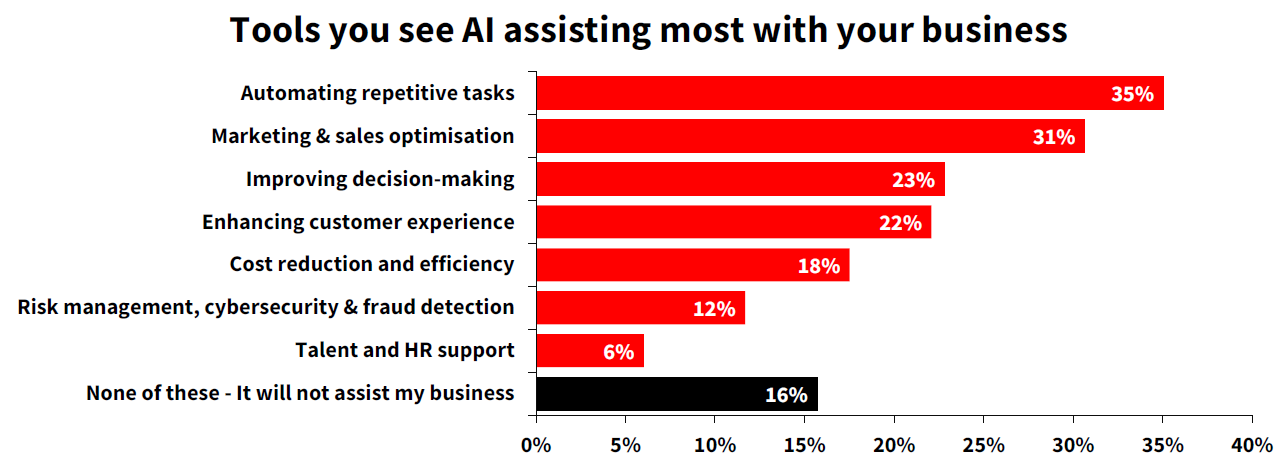
Image credit: NAB
One area is consistently overlooked across all sectors: talent and HR. Just 6% of SMEs see AI as a tool for recruitment, workforce planning or performance analytics, which came as a surprise to NAB analysts.
The report says: “It is somewhat surprising that AI adoption for HR and recruitment tools is so low among Australian SMEs, given the increasing capabilities of AI in automating recruitment processes, streamlining workforce planning, and delivering data-driven performance analytics.
“AI-powered recruitment tools can help businesses quickly identify and attract top talent by efficiently screening resumes, reducing unconscious bias, and predicting candidate suitability based on advanced analytics.
“Automation can also ease the administrative burden on HR teams, freeing up staff to focus on more strategic initiatives and employee engagement.”
Among businesses already using AI, marketing and sales is the most common application – 51% overall. In accommodation, cafes and restaurants that rises to 89%. Wholesale sits at 70%, retail at 68% and property services at 61%. Transport and storage, by contrast, reports zero usage in this area, while finance & insurance comes in at just 10%.
Customer service tools – including chatbots – sit at 24% overall. There is one interesting outlier here: transport and storage sits at 57%, well above the average. Managing complex billing, logistics and payment processes makes automation highly valuable in that sector.
HR and recruitment tools remain the least-used of all, at just 10% overall.
Finance sector moving fast
Finance and insurance SMEs, including brokers, are among the fastest AI adopters in the country.
For NAB's executive of commercial broker and equipment finance sales Chris Thomas (pictured), the reasons are clear.
"AI is already unlocking real efficiency gains for commercial brokers and it's no surprise finance and insurance SMEs are among the fastest adopters, using AI to reduce admin and support better decision-making," Thomas told MPA. "This is freeing brokers up to spend more time on analysis, strategy, and customer conversations."
But speed of adoption needs to be matched with strong safeguards.
"As more of the industry leans into AI and digital tools, it's just as important to strengthen guardrails around data so brokers can adopt these technologies with confidence," Thomas warned. “Strong cyber habits, including educating staff and customers and implementing security measures like multi-factor authentication, play a key role in protecting businesses and customers. It is critical to build a strong, cyber-aware culture so people know how to spot and respond to potential threats."
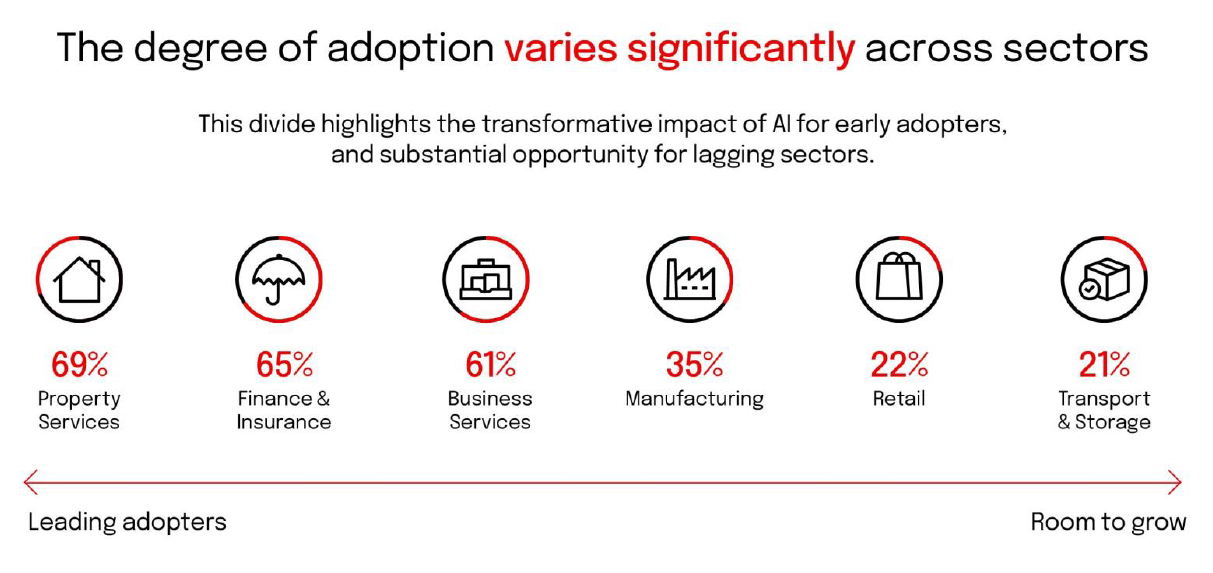
Image credit: NAB
Thomas’ comments echo those of corporate watchdog the Australian Prudential Regulation Authority (APRA), which recently sent an open letter to all APRA-regulated entities.
“The AI revolution presents tremendous opportunities for banks, insurers and superannuation trustees to deliver improved efficiency and enhanced customer services. We are already beginning to see these benefits materialise,” said APRA Board member Therese McCarthy Hockey. “But we cannot be blind to the risks of such powerful technology – whether in our own hands or the hands of those with malign intent.”
APRA has observed that as AI adoption continues apace, the systems and processes required to safely govern its use aren’t keeping up. “Likewise, the speed at which entities can identify and patch vulnerabilities needs to operate much faster, commensurate with the AI-accelerated threat,” said Hockey.