Demand for flexible funding between bank debt and development finance is surging, and Pallas Capital says it’s structural, not cyclical

Australia’s property finance market has always been drawn in two colours: mainstream bank debt on one end, specialist development finance on the other. Increasingly, neither colour is quite right for the deal in front of a broker.
Take Jason Arnold (pictured), group executive – origination at Pallas Capital’s word for it. Arnold is increasingly seeing a “missing middle” emerge out of the property market.
On the one hand, traditional bank lending is the forte of established assets, standard borrower profiles and vanilla lending scenarios. On the other, specialist development finance is the place to go for construction and development projects, often involving overly complex funding structures and delivery risks.
“The ‘missing middle’ sits between these two segments,” Arnold tells MPA. “It typically includes property-backed transactions that require greater flexibility than a traditional bank may offer, but do not warrant a dedicated development finance solution.”
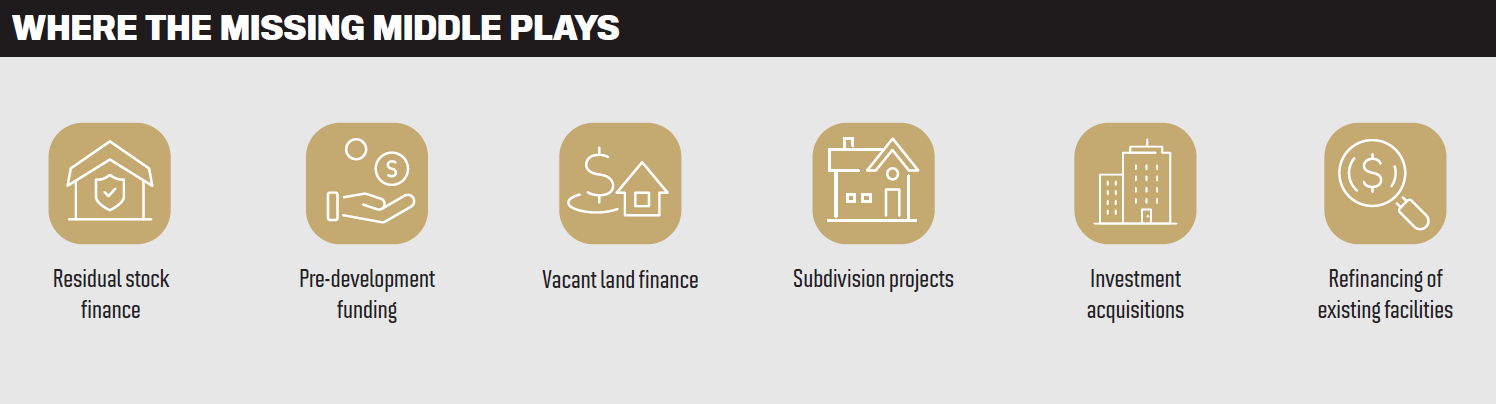
That gap covers more territory than the name suggests – residual stock facilities, pre-development funding, vacant land finance, subdivision projects, investment acquisitions and refinancing transactions.
And it’s not just Arnold seeing the missing middle grow. Australia’s 24,000-plus brokers are also noticing. They are demanding funding options with greater flexibility than conventional bank lending, without requiring the scale or complexity typically associated with specialist development finance.
“Many transactions sit between these two ends of the market, particularly where there are unique property characteristics, time-sensitive opportunities or more nuanced borrower circumstances,” says Arnold.
Where demand is concentrated
Value-wise, the missing middle covers a pretty broad spectrum, with particularly strong activity across transactions ranging from $1 million to $7.5 million. It spans both residential and commercial property, and multiple points of the property lifecycle – securing an asset, repositioning it, managing holding costs, or refinancing existing facilities.
The numbers back it up. “While construction remains our largest single loan category, pre-development, investment and residual stock facilities collectively account for more than 50% of our current loan book as at 14 September 2026, highlighting the depth of demand across these segments,” Arnold explains.
Refinancing is a significant part of that picture as borrowers reassess existing facilities and seek funding structures that better align with their current objectives, timelines and asset strategies.
Pre-development funding is another growth area. Arnold says, “We’re also seeing growing demand for pre-development funding. Developers often require capital well before a project reaches construction, whether for planning, approvals, design work or other early-stage costs. Access to funding at this stage can be critical in maintaining project momentum and progressing projects through key milestones."
“Borrowers are increasingly seeking funding solutions that can accommodate a wider range of property-backed transactions, while brokers are looking for greater choice when sourcing finance solutions for their clients” – Jason Arnold, Pallas Capital
Residual stock finance rounds out the picture, driven less by construction risk than by timing. The product refers to funding secured against a developer’s unsold, completed units once a project reaches practical completion.
“These opportunities often require lenders to take a more tailored approach to assessing the asset, borrower objectives and exit strategy,” he explains.
“Residual stock finance remains another active area of demand, particularly as developers seek greater flexibility around the timing of asset sales and project exits. In a market where selling conditions can vary significantly, these facilities can help borrowers manage residual inventory while preserving optionality.”
One trend ties everything together: flexibility. “The continued strength across pre-development, investment, residual stock and refinancing activity reflects a growing need for flexible funding solutions that support borrowers across multiple stages of the property lifecycle,” Arnold says.
Adapting the offering
Pallas’s response has been to widen what it can say yes to, without loosening how it says it.
The lender offers interest-only facilities for business purposes from $1 million to $7.5 million with loan-to-value ratios of up to 75% (depending on the loan type, and subject to credit assessment and lending criteria), covering residential and commercial investment, residual stock finance, pre-development funding, vacant land and subdivision opportunities, alongside support for SME and self-employed borrowers seeking property acquisition, refinancing, cash-out and debt consolidation.
“Our focus has been on providing lending solutions that address a broad range of property-backed funding requirements while maintaining a streamlined process for brokers and borrowers,” Arnold says.
“From a credit perspective, our approach focuses on understanding the individual transaction, security position and proposed exit strategy. This allows us to assess a broader range of lending opportunities, while continuing to apply disciplined credit assessment processes within our established framework.”
Fast turnaround times, flexible interest servicing options and a no-clawback broker proposition round out the offering.
Institutional muscle
None of that flexibility works without capital to back it, and Arnold points to institutional funding as the piece that’s changed most for Pallas over the past year.
“Institutional capital continues to play an increasingly important role in the growth and development of the non-bank lending sector,” he says.
“Greater institutional participation provides lenders with access to more diversified funding sources and additional capacity to support borrowers across a broader range of transaction types.”
“Greater institutional participation provides lenders with access to more diversified funding sources and additional capacity to support borrowers across a broader range of transaction types” – Jason Arnold, Pallas Capital
For Pallas specifically, that’s shown up as a $540.5 million lending facility backed by one of Australia’s banks, increasing available funding capacity and further supporting Pallas’s ability to deliver property-backed lending solutions to brokers and borrowers.
Arnold reads the broader trend of institutional interest in the sector as a vote of confidence.
“Ongoing institutional interest in the sector reflects growing confidence in the role non-bank lenders play in supporting segments of the market that may be underserved by traditional funding channels.”
Structural, not just cyclical
Part of what’s pushing brokers into this space is coming from outside it altogether, with higher interest rates, evolving bank credit policies and ongoing regulatory requirements creating challenges for many borrowers seeking traditional finance.
“At the same time, elevated construction costs and ongoing market uncertainty have increased the need for flexibility across various stages of the property lifecycle,” Arnold adds. The question is whether that’s a temporary reaction to current conditions or something more permanent. Arnold comes down on the side of structural.
“We believe a number of structural factors are contributing to the growth of this segment, although short-term market conditions also play a role. Borrowers are increasingly seeking funding solutions that can accommodate a wider range of property-backed transactions, while brokers are looking for greater choice when sourcing finance solutions for their clients,” he says.
That reading gets some independent support: the Reserve Bank of Australia’s March 2026 Financial Stability Review found that non-bank lending growth “has remained strong” even as non-banks still account for only around 6% of financial system assets.
“While interest rates, credit conditions and broader economic factors will continue to influence demand, we expect flexible funding solutions to remain an important part of the Australian property finance market,” says Arnold.
The missing middle, in other words, has stopped being a gap and started being a market.