Weaker sentiment signals pressure on new home delivery

Confidence in Australia’s property and construction industry has fallen sharply, raising concerns about the effect of weaker sentiment on housing delivery.
The latest Procore/Property Council Industry Sentiment Survey recorded a fall in national confidence from about 123 to 104 in the March quarter. It was the largest quarterly drop since 2022.
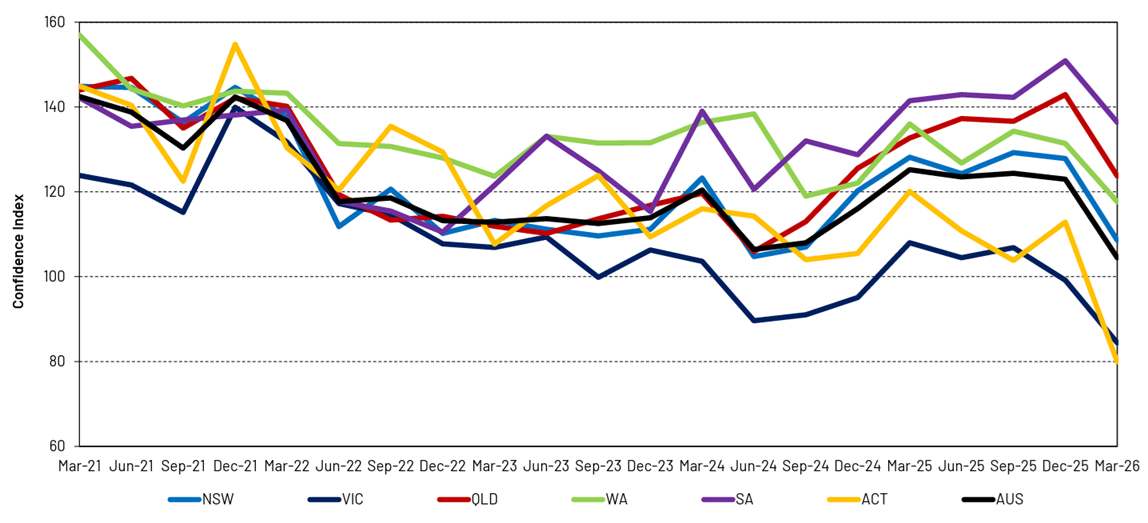 Source: Procore / Property Council Industry Sentiment Survey
The decline suggests expectations have weakened across development, building activity and investment. Higher construction and labour costs, supply chain issues and global uncertainty continued to affect project viability.
The survey, carried out between 9 and 27 March, captured views from across the sector at a time when many approved projects were still facing difficulty moving into construction.
 For Property Council chief executive Mike Zorbas (pictured right), the fall in confidence was significant given Australia’s housing supply shortage. “It would be a mistake to underplay such a sharp drop,” he said. “Whether industrial, commercial or living sector, projects need both investor and consumer confidence to get them out of the ground.”
The survey found a broad reduction in expectations. Economic management has become the industry’s second-largest concern, while forward work schedules fell in every jurisdiction. Sentiment towards construction activity also eased across all sectors.
Expectations for housing capital growth dropped to their lowest level since 2020, indicating weaker appetite for investment.
The findings point to the link between investor confidence and new housing supply. Investors fund about four in every 10 new homes, meaning changes in market certainty can affect whether projects proceed.
“With costs high and confidence fragile, even relatively small increases in uncertainty can delay or stall projects before construction begins,” Zorbas said, adding that housing should be treated as a long-term investment and that stable policy and market conditions were central to project decisions.
“Our cities are where housing, jobs and productivity meet and must be kept in balance. When potential changes to settings like capital gains tax increase uncertainty or reduce returns to investors, fewer projects stack up, and that ultimately means fewer new homes get built.”
Want to be regularly updated with mortgage news and features? Get exclusive interviews, breaking news, and industry events in your inbox – subscribe to our FREE daily newsletter. You can also follow us on Facebook, X (formerly Twitter), and LinkedIn.