ING built its entire home loan business by treating brokers not as a channel, but as the front door, explains industry veteran

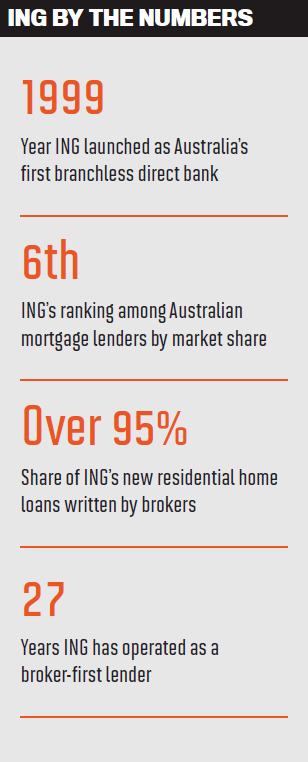
SINCE LAUNCHING in Australia in 1999 as the country's first branchless direct bank, ING has built one of the nation's largest home loan books without a high-street presence.
But that hasn't stopped the Dutch multinational from becoming a powerhouse in mortgage lending. In fact, it cemented its spot as Australia's sixth-largest mortgage lender in 2025. The secret ingredient? Brokers.
Today, virtually all of ING's business is sourced through brokers, which means that for most ING customers, the closest thing to walking into a branch has always been a broker's office.
To say the strategy has worked would be an understatement. Twenty-seven years later, ING writes more home loans in Australia than any other bank barring the big five.
Never an alternative
While ING never had the luxury of brick-and-mortar distribution, national sales manager and 25-year industry veteran Sergio Delvescovo (pictured, above) believes that absence shaped the successes that followed.
"Being branchless meant brokers were never an alternative channel for ING, they are the channel," he tells MPA. "From the beginning, our success depended on understanding broker needs and creating a proposition that helped them serve customers successfully."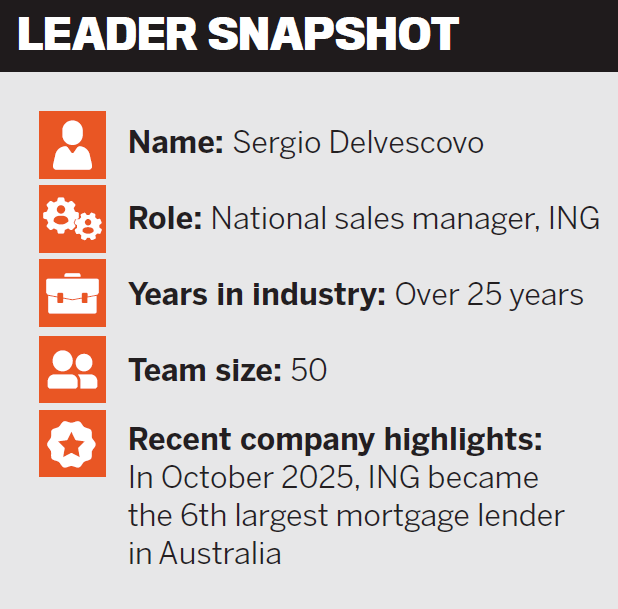
While ING serves customers through both direct and broker channels today, brokers continue to originate over 95% of the bank's home loans. That broker-first heritage has shaped the bank's approach to distribution and customer experience over more than two decades.
"We had to focus on what brokers value most: competitive products, clear policy, consistency, service and simplicity. That broker-first mindset still shapes the way we operate today. It influences everything from product development and technology investment through to how we support brokers and their customers," Delvescovo says.
"The result is a partnership model where brokers play a central role in both our growth strategy and customer experience."
From loan introducers to trusted advisers
Twenty-five years ago, the conversation ING had with brokers was often centred on products and pricing. "Today, they're genuine strategic partners who influence how we design products, improve processes and shape our lending proposition," Delvescovo says.
Take ING's investor lending momentum, which ran at 4.7-times system growth on a rolling 12-month basis in May. Delvescovo says, "A key part of our strategy over recent years has been evolving our policy and lending capability to expand into new segments and support a broader range of customers. We've worked hard to strengthen our proposition for self-employed borrowers and investors, while continuing to deliver the simplicity and consistency brokers expect from ING."
It's a shift he attributes to the changing expectations of customers – they want guidance and confidence in a complex decision, not just a comparison of numbers. It's a shift that has also changed the expectations placed on lenders like ING.
 "Success is no longer determined solely by pricing or product features," says Delvescovo. "Today, brokers expect clear policy, fast and consistent decision-making, strong service and technology that helps them run their businesses more efficiently… The focus has moved from simply offering competitive products to helping brokers deliver better customer outcomes."
What Delvescovo didn't anticipate was how far that shift would eventually carry the broker channel as a whole. Brokers now write more than eight in every 10 new residential home loans in Australia, marking a record 81% market share as of the March 2026 quarter.
Did Delvescovo expect to see such overwhelming dominance of the broker channel? "No," he concedes. "While brokers were already an important part of the market when I started, few people would have predicted the level of influence they have today.
"Brokers have earned the right to be the channel of choice for customers through the service they provide, the trusted relationships they've built and the innovation they have driven across the mortgage market."
He's not alone in that admission.
Greg Russell, ING's state manager for NSW, echoes the sentiment from the front lines. "While I always believed the broker channel would continue to grow, I don't think many people would have predicted it would reach the point where brokers are now facilitating 81% of all new residential home loans," he says.
Sam Panucci, broker at Personal Finance Services in Leichhardt, goes further still: "It has evolved far beyond my expectations," he says, crediting lender complacency and the rise of aggregators for accelerating the shift.
NSW-based ING business development manager (BDM) Clem Marcocci is less surprised at the broking industry's meteoric rise.
"Given the value brokers provide to customers, it's no surprise to see more Australians choosing the broker channel. Broker penetration reaching 81% reflects the growing trust consumers place in brokers," he says. "It was just a matter of time and patience in doing all the right things."
"From the beginning, our success depended on understanding broker needs and creating a proposition that helped them serve customers successfully" – Sergio Delvescovo, ING
The BDM's changing brief
The importance BDMs and state managers have played in ING's – and the broking industry's – successes shouldn't be underestimated. Yet the role has changed almost as dramatically as the broking profession itself.
Russell recalls a role that was largely centred on building relationships. "It was all about getting out on the road, meeting brokers face-to-face, growing accreditations, and being the go-to person between the broker and the bank," he says.
Today, while trust and credibility remain, the relationship between brokers and BDMs has evolved into genuine partnership. BDMs play a broader role in helping brokers identify opportunities, solve challenges and grow their businesses. They are part strategist, part advocate and part problem-solver, supported by technology that delivers in moments what once took days of research and analysis.
"I can have a meeting with a broker in Dubbo, jump onto a team call with colleagues across the country and review portfolio trends all within the same hour," he says.
For Marcocci, the shift is best captured in what a broker needs from a BDM today versus what they once did.
"The BDM and broker relationship has evolved from giving a simple response to a question to now developing a deeper relationship of trust, reliability and source of truth," he says – a role that, in a market shifting daily on economic conditions and lender policy, sometimes means delivering an honest "we cannot assist" rather than a false yes.
Panucci agrees the stakes have risen: BDMs who simply say "lodge the application and see what happens" are the exact BDMs that brokers should avoid.
"A key part of our strategy over recent years has been evolving our policy and lending capability to expand into new segments and support a broader range of customers. We've worked hard to strengthen our proposition for self-employed borrowers and investors, while continuing to deliver the simplicity and consistency brokers expect from ING" – Sergio Delvescovo, ING
Stronger foundations
Regulation has left the broking industry better off, not worse, in Delvescovo's eyes.
"The industry is stronger because of it," he says of reforms such as the National Consumer Credit Protection Act and the best interests duty.
While Delvescovo acknowledges the added complexity, he argues it's been outweighed by improved transparency and professionalism across the channel – with BID in particular "reinforcing the value brokers provide by putting customer outcomes at the centre of the lending process".
As for the ever-evolving face of technology, the shift from manual, paper-based lending to digital workflows stands out as the single most transformative change Delvescovo has navigated.
"It has fundamentally changed the speed, transparency and efficiency of the lending process for brokers, customers and lenders alike," he says. "What once took days or weeks can now happen much faster through digital tools, automation and better access to information."
He sees the next wave – AI, automation, real-time data – following the same trajectory rather than upending it. "The opportunity isn't to replace people but to reduce manual administration, streamline decision-making and give brokers more time to focus on customer relationships and advice," he says.
Looking ahead, Delvescovo expects the industry to keep moving towards a more connected, data-driven lending experience – one that will require lenders, aggregators, regulators and brokers to collaborate rather than compete on the fundamentals.
"The future isn't about replacing the broker," he says. "It's about using technology to make brokers more effective."
Twenty-seven years on from its branchless launch, ING's trajectory is an exemplar in what a broker-first strategy can do for a lender. Here's hoping there's another 27 in the tank.