Cotality data shows higher repayments have largely cancelled out falling home values, leaving borrowing capacity stretched for most buyers

Falling home prices have done little to make buying easier, with a new mortgage on the median-priced Australian home still taking almost half of household income, according to the latest Cotality Housing Affordability Report.
Repayments on a new loan required 49.5% of median household income in the September 2026 quarter. That is down from a record 50.6% in June but still well above the 20-year average of 34.8%.
Why falling prices haven't helped buyers
The main reason is interest rates. Capital city house values fell 7.3% between March and September, and unit values fell 5.1%, after the federal government's tax changes in the May Budget and a run of rate hikes from the Reserve Bank of Australia (RBA).
Those hikes have kept coming. The RBA lifted the cash rate for the fifth time this year on 3 November, taking it to 4.85% – its highest level since 2008, as outlined in the RBA's November 2026 Statement on Monetary Policy.
Cotality Australia head of research Gerard Burg said: "Higher mortgage rates have offset much of the benefit of falling property prices." Buyers can now negotiate harder on price than they could six months ago, but that has not given them more purchasing power.
A simple example shows how this plays out. Take a $1 million home bought in March with a 20% deposit. At an assumed variable rate of 6%, an $800,000 loan over 30 years costs about $4,800 a month. If that home is now 7.3% cheaper, the loan drops to about $742,000. But with rates 0.75 percentage points higher after the May, September and November hikes, the monthly repayment is still about $4,800 (MPA calculations).
Incomes have also fallen behind. Over the five years to September, the cost of the median dwelling rose 33% and rents rose 49%, while household incomes grew about 22%. The national dwelling value-to-income ratio now sits at 8.2, and saving a 20% deposit takes almost 11 years – both the fifth-highest readings on record.
The findings line up with earlier analysis of how rate hikes and price falls have put buyers in a bind this year.
Where buyers are under the most pressure
Adelaide has overtaken Sydney as Australia's least affordable capital on all four of Cotality's measures. A new mortgage on the city's median dwelling would take 57.5% of household income, ahead of Sydney, Brisbane and Perth.
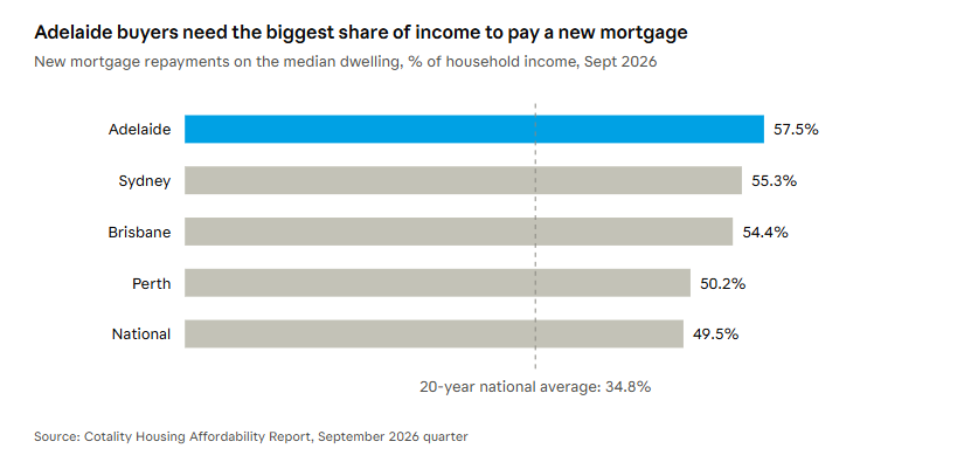
Adelaide's median dwelling value is now close to $930,000, up almost 60% in five years. Burg said the city's post-pandemic affordability advantage has gone after years of strong growth and a deeper downturn in Sydney.
Sydney is still the hardest market for houses, where repayments take about 68% of their household income. Meanwhile, Melbourne is moving the other way. Its median dwelling is worth 6.5 times household income, the lowest ratio since 2013 March. Melbourne units were the most affordable property type across the five largest capitals, needing about 32% of income to service a new loan and about seven years to save a deposit.
Regional dwelling costs rose about 40% over five years, compared with 28% in the capitals, and regional housing is now less affordable than the combined capitals relative to local incomes. Burg said regional property can still be good value for buyers who keep a city income, but not for those on a local wage.
Renters face the hardest path. The median rent takes 33.7% of household income nationally, just below June's record, and close to 40% in regional Queensland. Burg said lower prices may shrink the deposit renters need, but that does not help them save it any faster.
The main hurdle for mortgage brokers' clients
The report confirms that serviceability and not price is what is holding most buyers back. Clients may see lower prices and expect to afford more, but in most markets their borrowing capacity has fallen by as much or more. Brokers who have that conversation early, before clients start making offers, can save them from chasing homes they can't finance.
Recent analysis of the overlooked factors quietly cutting borrowers' borrowing capacity shows how debts, dependants and HELP loans can shrink loan sizes further.
Relief is unlikely to come quickly. Burg said November's fifth rate rise could limit further gains in mortgage affordability in the December quarter, even if property values keep falling.
The gap between markets is also widening, so advice needs to be local. A Melbourne unit buyer faces very different numbers from someone buying a house in Adelaide or Sydney. Clients moving to regional areas on a local wage may also find those markets are no longer the cheaper option.
First home buyers who rent are the most squeezed. With rents near record highs, many will take longer to save a deposit even as the deposit they need gets smaller. That puts more weight on low-deposit options, guarantor loans and government schemes. Those pressures follow record-low housing affordability figures from realestate.com.au earlier this year.
Burg also warned that a deeper downturn could hold back new housing supply in markets where high construction costs and labour shortages already make projects hard to stack up. He said lasting improvement will depend on building enough homes where people want to live, and on incomes growing faster than housing costs.
Our daily newsletter is FREE and keeps you up to date with the world of mortgage. Please complete the form below and click on SIGN UP to receive daily e-newsletters from Mortgage Professional Australia.