Cotality data shows regional values fell 2% in three months to October, with areas that grew fastest falling furthest

Regional property values across Australia fell 2% in the three months to October 2026, and several of the biggest drops came in markets that had posted the strongest gains in recent years.
The figures come from Cotality’s Regional Market Update, published on November 18, which covers the 50 largest regional centres (Significant Urban Areas).
Regional markets are still doing better than the cities. Combined capital city values fell 4.5% over the same three months, more than double the regional fall.
“Regional markets have held up better than the capitals, but they’re not immune to the same pressures,” said Gerard Burg, head of research at Cotality Australia. These pressures include rising interest rates, economic uncertainty and the cost of living. The Reserve Bank of Australia (RBA) has raised the cash rate five times this year, most recently on November 3 to 4.85%, and that last increase falls after the period the report covers.
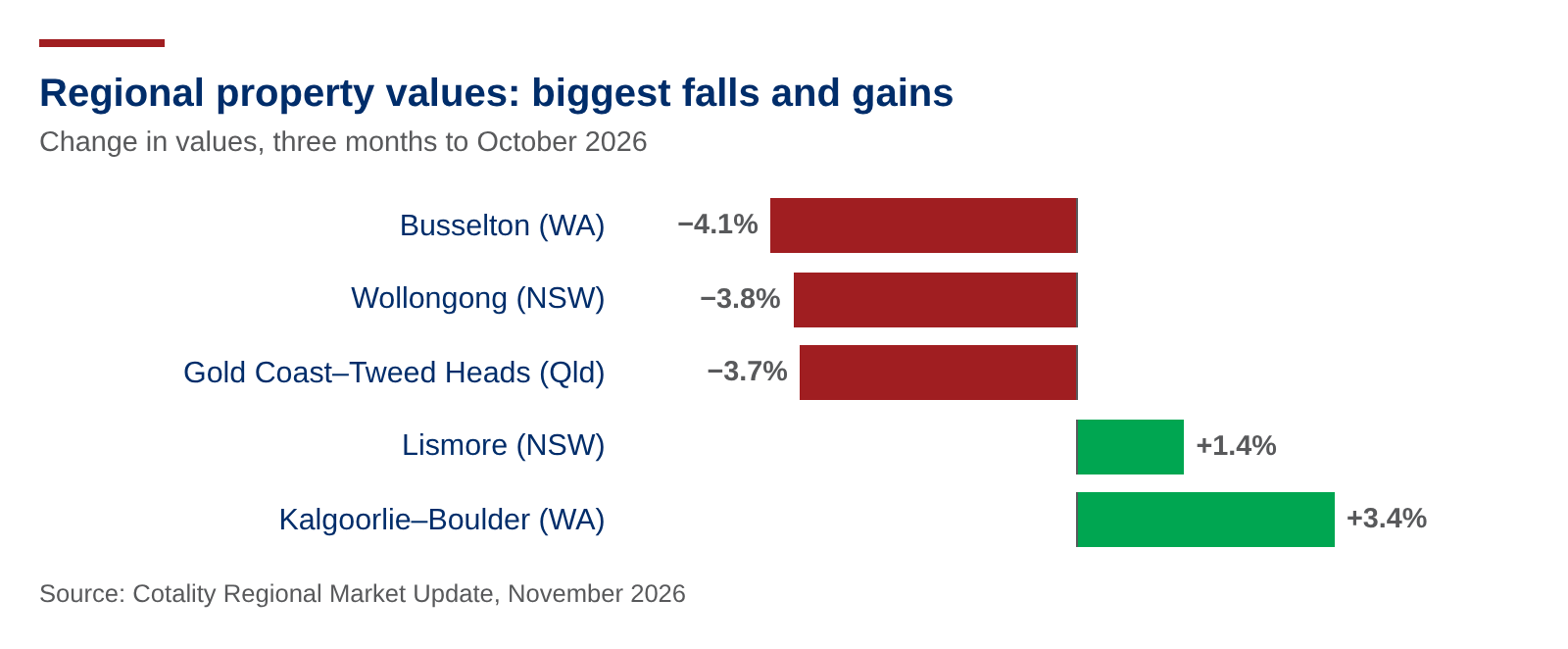
The regional result hides a wide split. Prices fell most in the places where they had risen fastest and held up where homes were still relatively cheap.
Burg said the split follows how far prices had already climbed. In regional Queensland, he said, years of strong growth have used up much of the affordability advantage that drew buyers in. In cheaper centres with stronger local economies, such as the mining hub of Kalgoorlie–Boulder, demand is holding.
Buyers have more bargaining power
The upside of a cooling market is that buyers now hold more of the negotiating power. When fewer buyers are willing to pay current prices, homes stay on the market longer. Sellers who need to sell then have to compete for the attention of fewer buyers, usually by cutting their asking price or accepting terms they would have refused in a hotter market.
Cotality’s data shows this happening across most of regional Australia: time on market rose in 40 of the 50 largest centres.
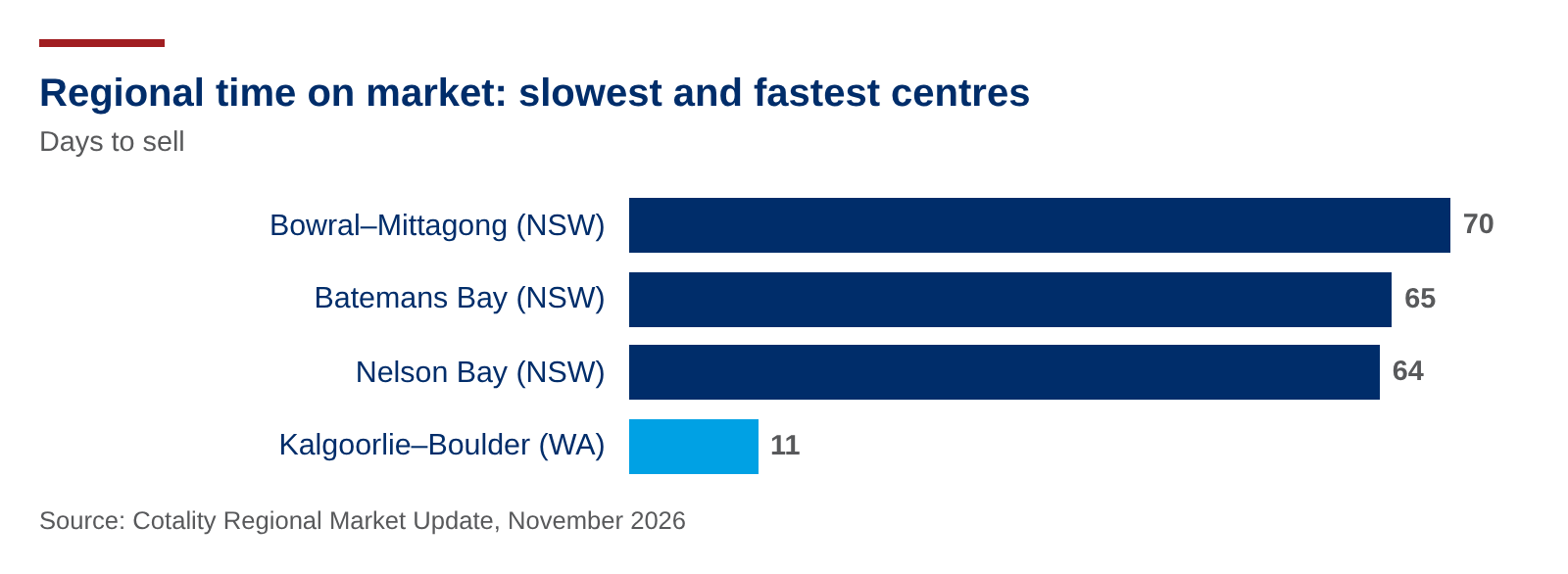
In practice, the buyer’s advantage is time. Burg said buyers are more cautious and there is “little urgency to buy”, which means clients can take longer to decide, negotiate on price and conditions, and avoid competing against several offers at once. The advantage is not equal everywhere. In Kalgoorlie–Boulder, homes still sell in 11 days, so buyers there have little leverage.
There is also a limit. Cotality estimates that after five rate rises a median-income household can borrow about $88,000, or 12%, less than at the start of the year. That is a national figure, but it points to a trade-off: buyers can negotiate a lower price yet may qualify for a smaller loan.
Uncertainty: what is booming now may fall later
The harder question is which markets will hold up. Kalgoorlie–Boulder grew 3.4% over the quarter, but that follows growth of 24% over the past year and 65% over five years. Western Australia’s south-west also had a very strong run before it turned down. Burg said some of the strongest performers of recent years are now recording substantial declines, which shows that strong growth has not protected them.
Cotality does not forecast a fall in centres such as Kalgoorlie–Boulder, and it credits their local economies and confidence in the outlook for their resilience. Still, the pattern elsewhere raises the question of whether markets that are growing now are also exposed once higher rates and lower borrowing capacity reach them.
Cotality expects regional conditions to stay softer in the short term and says higher interest rates will likely narrow the gap between the regions and the capitals. Burg said local jobs, economic confidence and affordability will decide which markets hold up best.