Sharp rifts and common ground between men and women emerge in new research from peak broker association

New research conducted by the Mortgage and Finance Association of Australia (MFAA) exposes a sharp rift between male and female mortgage brokers' views on gender diversity in the broking industry.
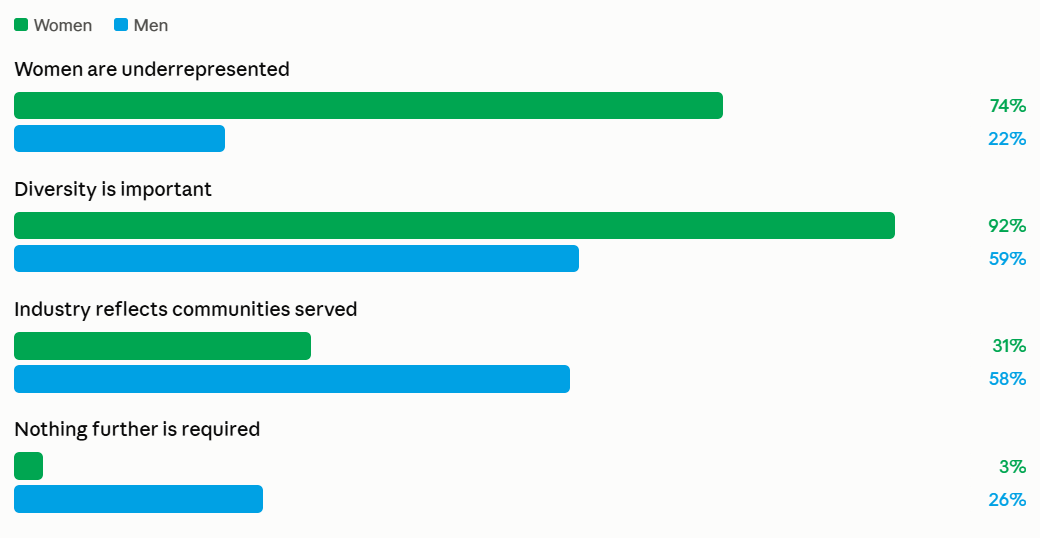
In a survey of 442 brokers and industry professionals nationally, 74% of female respondents said women are underrepresented in the industry – yet just 22% of male respondents agreed. The divide was just as stark on whether diversity matters at all: 92% of women said it was important, against 59% of men.
The findings come amid a global backlash against 'wokeism' following US president Donald Trump's reelection in 2024, which "opened the floodgates" for criticism against workplace inclusion initiatives.
Presenting the findings at the 2026 MFAA DEI Summit on Tuesday, MFAA chief executive Anja Pannek (pictured) called the results "a massive divide in terms of the lens through which you see the world".
The gap wasn't confined to one question. Just 31% of women said the industry broadly reflects the communities it serves, against 58% of men, and on whether anything further needs to be done, 26% of men said no – nothing more is required – against just 3% of women.
Underrepresentation, where respondents saw it, clustered in specific corners of the business: 80% pointed to the broker population itself, 60% to business ownership, and 56% each to senior leadership and commercial or asset finance. That tracks with MFAA figures putting women at around 27% of all brokers, a share that has barely shifted in years.
Finding common ground
Despite the divide, the survey uncovered more agreement than the headline numbers suggest. Respondents who said diversity wasn't important were 1.8 times more likely to leave a written comment explaining their position than those who supported it – yet both groups converged on the same underlying values, seeing merit and equal opportunity, capability and professional standards, ethical conduct, and better client outcomes as essential pillars of the industry.
Read more: Fixing the broking gender imbalance requires genuine leadership
Beyond that common ground, the two camps diverged on emphasis. Supporters of DEI initiatives valued broader representation, culturally capable client service, mentoring and clearer pathways, and leadership accountability. Sceptics, meanwhile, valued selecting the right person for the role, opposition to quotas or tokenism, a preference for equal treatment, and a stronger MFAA focus on advocacy.
Pannek was careful to separate acknowledging the industry's barriers from lowering the bar to entry. "I'm not in any way advocating that we should make it easier, [that] we need to compromise on standards or education pathways," she said, "but there's something in this ... around how do we build better frameworks to bring that talent into our industry."
Men were also considerably more likely than women to say they could contribute without fitting an established mould – 79%, against 57% – a gap Pannek pointed to as evidence that access to the industry and comfort within it are two separate problems. "There's a bit of a gap between access and influence," she said, noting that while 82% of respondents said they had fair access to networks, development and opportunities, only around two-thirds felt their views were genuinely valued once they were in the room.
Economic boundaries
More than half of all respondents (54%) pointed to variable or commission-based income as a major barrier to entering and succeeding in broking, particularly in the early years without an established client base. Half cited the time and support needed to build that client base, and 24% pointed to qualification or accreditation requirements.
"If you think about it, brokers open doors. They open the first door for a homeowner,” Panek told the room. "(But) If we're really good at opening doors for Australians, are we equally as good at opening doors for people into this industry? Do they feel welcome? Do they feel respected? Do they feel their perspective is also valued and they can contribute and be wholly themselves?"
She was clear that no single part of the channel – whether that’s business leaders, aggregators, licensees of individuals – can move the needle alone
The MFAA has identified six priority areas for action arising from the survey – reducing economic barriers; strengthening mentoring and networks; supporting small businesses; improving representation and pathways for women; building inclusive leadership; and equipping brokers to serve clients with different needs.
Read more: Pilot program lifts leadership skills for women in broking
Pannek closed her presentation on a personal note, reflecting on the story she first shared at the MFAA's inaugural DEI summit two years ago: growing up in a family where neither parent finished high school, and not speaking English when she started school in Australia.
"I think about that and the journey I've had from a career perspective and the opportunity that's been presented to me. That has come about because someone saw something in me and provided me with an opportunity and opened a door for me," she said. "And importantly, once I was in the room, they supported me."