Sales drop 11.6% while every South price index rises

New Zealand’s housing market split sharply along island lines in September, with every South Island price index rising over the year while all North Island measures fell, according to the latest data from the Real Estate Institute of New Zealand (REINZ).
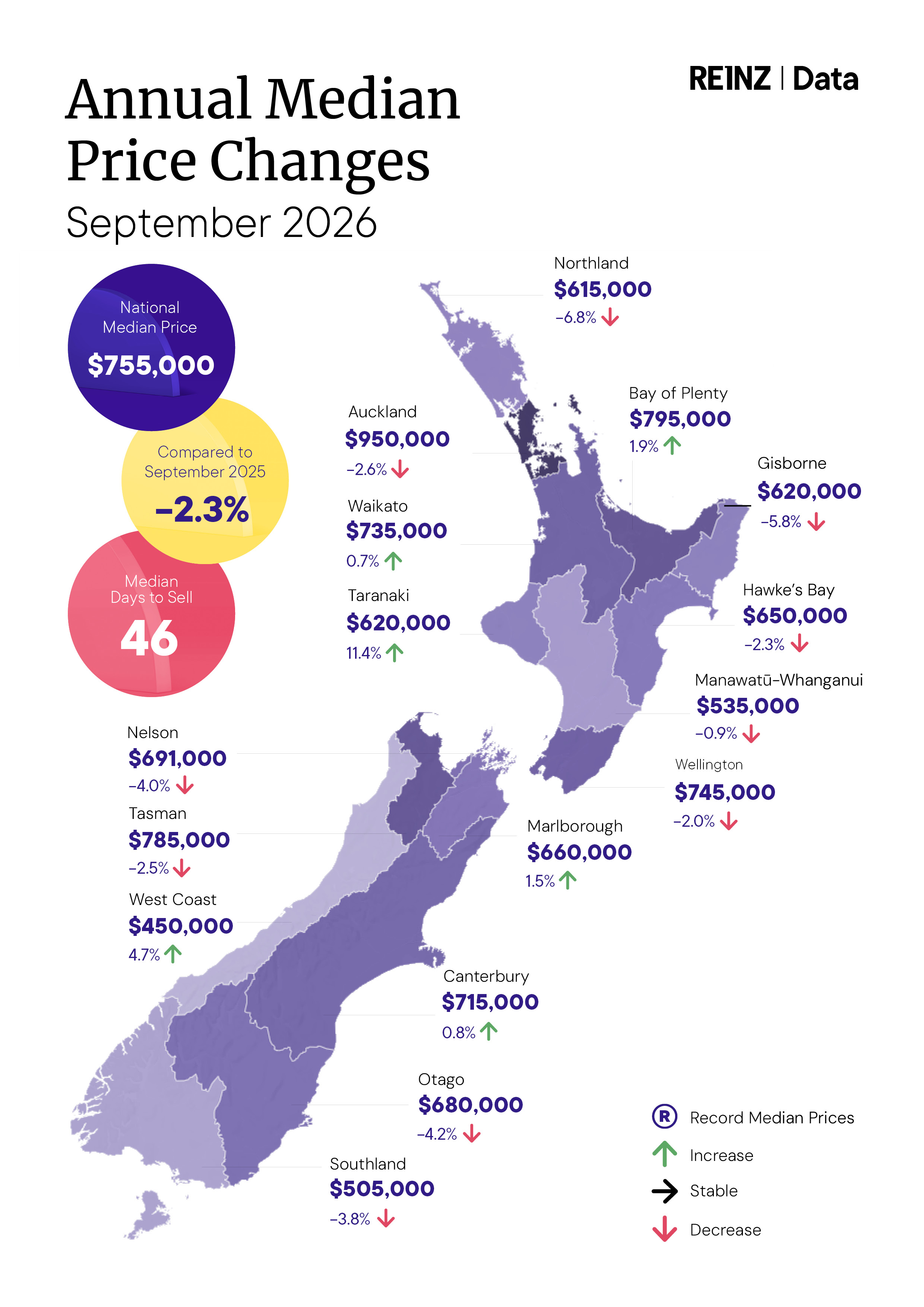
Nationally, the market stayed subdued. Sales fell 11.6% year-on-year to 5,752, and the House Price Index (HPI) slipped 1.5%. The national median price eased 2.3% to $755,000, although outside Auckland it was essentially flat at $691,200.
“Activity is continuing, but decisions are not being rushed,” said REINZ chief executive Lizzy Ryley (pictured).
The figures follow Westpac’s decision last week to cut its 2026 forecast, with the bank now expecting national values to fall 1.4% this year rather than rise.
A tale of two islands
Southland led annual HPI growth for the 14th month in a row, up 7.5%, followed by Canterbury at 3.1% and Otago at 2.8%. Central Otago District and Invercargill City both set record median prices.
Auckland, by contrast, recorded a 2.6% fall in its median price and accounted for more than half of the national drop in sales. Wellington remained the weakest HPI series over the year, down 4.5%, despite a 1.1% gain in September.
“Conditions are not moving in one direction,” Ryley said.
At a regional level, six of 16 regions recorded higher median prices, led by Taranaki with an 11.4% climb to $620,000.
Buyers have more choice
Supply continues to build. Inventory lifted 10.7% to 34,001 properties, its 14th consecutive month of annual growth, while new listings edged up 0.8%. Auckland and Wellington have now recorded 32 straight months of growing inventory. Southland was the exception, with stock falling 8.4%.
Homes took a median 46 days to sell, three days longer than a year earlier but six fewer than in August. Seasonally adjusted sales dipped 4.3% from August, suggesting the seasonal spring boost hadn’t yet shown up.
“Where buyers have more choice, some are taking time to research their options,” she added.
Rates and the election weigh
The Reserve Bank lifted the OCR by 25 basis points to 2.75% on 2 September. Banks raised floating rates by the full amount, though fixed-rate changes were more mixed, REINZ said. ASB is tipping two further hikes to take the OCR to 3.25% by December, while Westpac expects a pause in October before a rise to 3% in December.
Cost-of-living pressures, job worries, and global uncertainty also kept some buyers cautious, and agents reported some buyers and vendors were waiting until after the November election.
Even so, REINZ members expect a stable market in the near term, with the possibility of more activity before the summer break.
Stay informed with the latest housing market trends and mortgage insights — subscribe to our free daily newsletter.