QV's May index reveals a patchwork market with southern centres leading the charge

New Zealand's housing market moved little in the three months to the end of May, but that national figure masks a growing divide between cities forging ahead and those still stuck well below their 2022 highs.
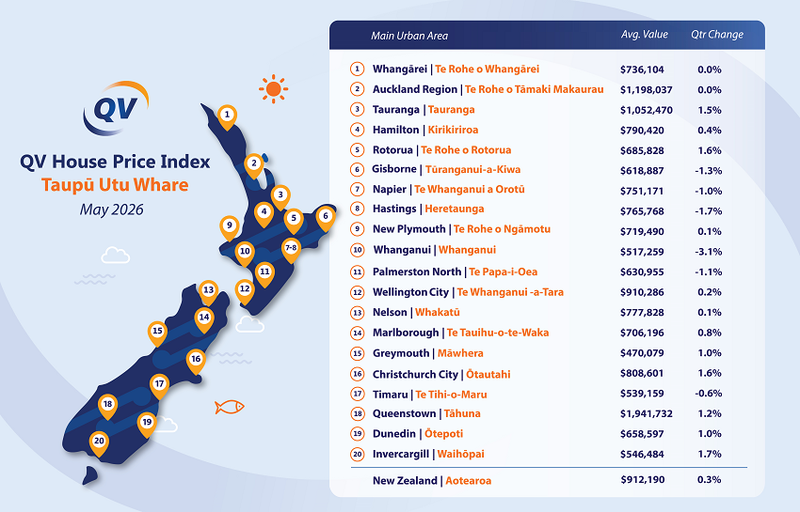
QV's latest House Price Index shows average home values rose just 0.3% nationally over the quarter — the average New Zealand home is now worth $912,190, sitting 0.2% below year-earlier levels and 14.2% below the market's previous peak.
QV spokesperson Simon Petersen (pictured) described the conditions as broadly stable but increasingly uneven.
"Residential property values continue to hold steady for the most part across Aotearoa. There's a steady supply of houses for sale and enough buyers to meet the market, but not nearly enough competition to drive prices upward in any major way," Petersen said.
Christchurch leads the recovery
The standout story in the May data is Christchurch. The Garden City's average home value rose 1.6% over the quarter to $808,601 — pushing it 0.9% above its previous 2022 peak. It joins a short list of markets that have fully recovered, including Invercargill, Queenstown, and Greymouth.
Petersen said the city had benefited from a relatively balanced supply-demand dynamic that helped it avoid the sharpest swings of the boom-bust cycle — and that its affordability relative to the main centres had been a further key driver.
"Part of Christchurch's resilience comes down to affordability. It remains more than $100,000 cheaper to buy the average home there than in the capital city, and considerably cheaper than in Auckland," he said.
Invercargill and Southland continued to gain ground on the back of relative affordability and a strong local economy, while Queenstown's average home value is now within $58,000 of the $2 million mark after four consecutive months of modest growth.
Auckland and Wellington lag behind
The contrast with the main northern centres is stark. Auckland's average home value was unchanged over the quarter at $1,198,037 — still 22.3% below its previous peak. Wellington edged up just 0.2% to $910,286, remaining 27.6% below its high.
"Auckland and Wellington experienced much sharper home value growth during the pandemic period,” Petersen said. “They also have a lot more lost ground to recover as a result. Both markets appear to be stable now, but neither is showing any sort of consistent momentum like we're seeing in Christchurch."
In Wellington, local QV valuer David Cornford pointed to rising interest rate expectations and public sector job uncertainty as twin headwinds.
"Buyers are taking a cautious approach with higher interest rates now expected, and weaker job security expectations following recent announcements of further cuts to the public service," Cornford said.
REINZ April data reinforces the picture — Auckland sales volumes fell 14.8% year-on-year, with national inventory near multi-year highs. Cotality chief property economist Kelvin Davidson warned that "there now seems to be a pretty good chance that the mini-upturn will peter out soon or even go into reverse."
Stay informed with the latest housing market trends and mortgage insights — subscribe to our free daily newsletter.