
Jump to winners | Jump to methodology
|
Turnaround times bounce back as ANZ and Vincent Capital top New Zealand mortgage advisers’ 2026 lender rankings |
Source: NZ Adviser Advisers on Lenders 2026
Who are the best lenders for mortgages in New Zealand in 2026? |
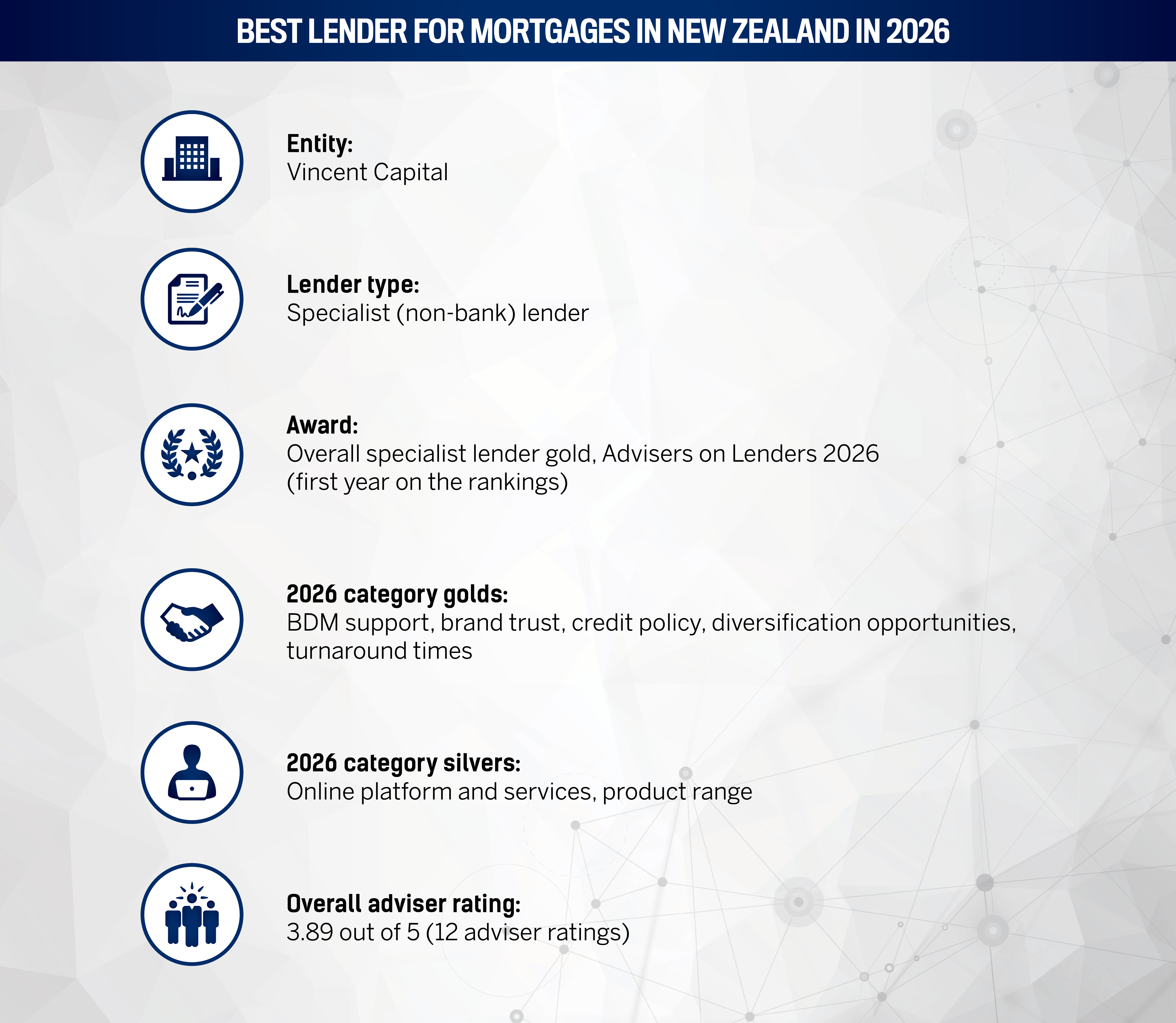
ANZ Bank of New Zealand and Vincent Capital have been crowned among the best lenders for mortgages in New Zealand, taking overall gold among banks and specialist lenders in NZ Adviser’s Advisers on Lenders 2026 report.
This year’s biggest story is a reversal: bank turnaround times, the problem that dominated last year’s results, are now advisers’ biggest win:
51.14% say service improved, up from just 2.24% in 2025.
Channel conflict is also easing:
37.65% call it a major problem, down from 57.47%.
Pricing went the other way:
31.52% say product range and pricing worsened, more than double the 2025 figure.
ASB and Kiwibank complete the bank podium behind ANZ Bank of New Zealand, while Avanti Finance and Go Lend take silver and bronze behind Vincent Capital among specialist lenders, the non-bank lenders that often fund borrowers and deals outside mainstream bank criteria.
NZ Adviser’s second annual Advisers on Lenders survey asked mortgage advisers across New Zealand to rate the banks and specialist lenders they work with across 10 categories, from turnaround times and credit policy to product range and online platform and services, and 117 advisers responded between 14 June and 12 July 2026. This year’s survey ran with the same methodology as last year’s best lenders for mortgages in New Zealand report.
Ask advisers what earns their trust and the answers are blunt. For Laura te Kaat, mobile mortgage adviser at The Mortgage Girls in Christchurch, it comes down to consistency. “Advisers need to know what to expect, how long an application is likely to take and whether the lender’s policy is going to work for the client,” she says.
Dan Bailey, a mortgage adviser at LifeDirect in Wellington, wants a level playing field. “What is good enough for a bank staff member to do is good enough for a mortgage adviser to have access to,” he says.
Susie Signal, residential mortgage adviser at Vega in Auckland, wants speed and respect, and won’t let lenders skip the basics. “I value quick turnaround times with genuine respect for the role I offer as a mortgage adviser in providing expert advice to customers. The lenders must provide competitive rates, and cashback offers for my customers.”
What changed since last year’s survey? |
The survey drew responses from advisers across New Zealand, including Auckland, Canterbury, Wellington, Waikato, Hawke’s Bay, Otago and Northland. Last year’s survey set the benchmark on three criteria:
what advisers value in a lender
which banks and specialist lenders lead each category
how advisers feel about turnaround times specifically, the one factor they rank above everything else
Priorities held firm: the top five factors that advisers value most landed in the same order. The medal tables didn’t – category golds changed hands again and again. And turnaround times flipped completely. Last year’s biggest frustration is this year’s biggest win.
None of it happened in a calm market. The Reserve Bank of New Zealand ended nearly two years of rate cuts. Advisers also wrote a growing share of new home lending, part of a broader shift reshaping New Zealand’s mortgage market. Impressing advisers in a settled year is one thing. Doing it while the ground shifts underneath is another.
The winners managed it. They delivered faster decisions when speed mattered most, fairer policy when clients needed flexibility and the kind of consistency that turns a single transaction into a real partnership, through a year that saw rates fall, lending surge and then start turning the other way. Here’s how.
What matters most to New Zealand mortgage advisers? |
Advisers rank turnaround times, credit policy, business development manager (BDM) support, interest rates and product range as the five factors that matter most, in that order. Their comments show why.
Turnaround times: “Set expectations with clients. New clients, no issue. Return clients have a higher expectation if their last mortgage was in the days of two-to-three-day turnaround.”
Credit policy: “ANZ has good policies, fewer forms to fill when finalising structure. Easy to deal with as knowledgeable lenders.”
Business development manager (BDM) support: “Strong BDM and credit teams working harder to approve complex deals.”
Interest rates: “The lower the interest rates, the more motivated customers are to borrow, and the more customers would meet servicing.”
Product range: “Have the most flexibility to allow customers to increase or decrease regular payments of all the banks.”
One Auckland-based survey respondent spells out what consistency and speed are worth to a lender. “In our game, consistency and speed are everything. We’re sending more business to the lenders who actually have their systems sorted,” the respondent says. “When the market is moving fast, a bank with a slick digital portal that hands us an unconditional approval in three to five days is going to get the deal over a bank that offers a tiny discount but makes our families wait in a 14-day queue. We also back the lenders who are being flexible with their test rates to give families a fair go.”
Test rates are the higher, hypothetical interest rates lenders use to check that a borrower could still afford repayments if rates rose.
How did adviser priorities change in 2026? |
Diversification opportunities moved more than anything else this year, up 0.756 points, more than three times the next-largest gain, yet it’s still ranked last.
One plausible explanation sits elsewhere in the survey. As turnaround times stopped dominating every complaint, adviser attention had room to land on diversification, brand trust and commission structure – criteria that get no airtime while speed is the only thing anyone’s talking about.
Turnaround times tell a more complicated story. Its importance score dipped slightly, even as adviser sentiment on speed reversed for the better, one of only two criteria, alongside BDM support, to score lower than in 2025.
Communications, training and development moved in two directions at once. Its score rose from 3.817 to 3.937, but its rank fell from sixth to eighth. Commission structure and brand trust both grew faster and overtook it.
First, a look at who these advisers are.
Average importance rating out of 5, 2026. Tap a row to compare with 2025.
No change in rank. Still the single most important criterion to advisers, both years.
No change in rank. A steady, small gain in importance.
No change in rank, but the largest decline of any top-five criterion.
No change in rank. A modest rise in importance.
No change in rank, rounding out a top five in the same order both years.
Up one place, from seventh to sixth.
Up one place, from eighth to seventh.
Down two places, from sixth to eighth, even though its own rating rose. Other criteria simply grew faster.
No change in rank. Still the second-least important criterion to advisers.
Still last, but by far the biggest mover on the list – up 0.756 points, more than three times the next-largest gain.
| 2026 rank | Criterion | 2026 rating | 2025 rating | 2025 rank | Change (points) |
|---|---|---|---|---|---|
| 1 | Turnaround times | 4.634 | 4.677 | 1 | −0.043 |
| 2 | Credit policy | 4.518 | 4.479 | 2 | +0.039 |
| 3 | BDM support | 4.319 | 4.427 | 3 | −0.108 |
| 4 | Interest rates | 4.301 | 4.219 | 4 | +0.082 |
| 5 | Product range | 4.265 | 4.149 | 5 | +0.116 |
| 6 | Commission structure | 3.973 | 3.737 | 7 | +0.236 |
| 7 | Brand trust | 3.956 | 3.705 | 8 | +0.251 |
| 8 | Communications, training and development | 3.937 | 3.817 | 6 | +0.120 |
| 9 | Online platform and services | 3.694 | 3.615 | 9 | +0.079 |
| 10 | Diversification opportunities | 3.431 | 2.675 | 10 | +0.756 |
Who is the typical New Zealand mortgage adviser in 2026? |
Just over half (51%) of the typical adviser in the 2026 Advisers on Lenders survey write $40 million or more in mortgages a year.
Nearly all (95%) cover residential lending, but most also work across more specialised areas, from development and construction finance (59%) to business (54%) and commercial lending (46%), the kind of workload that shapes what these advisers need most from the lenders they rate.
Who took part in the Advisers on Lenders 2026 survey
More than one could be chosen
| Measure | Share |
|---|---|
| Age: 25 or under | 1.22% |
| Age: 26 to 35 | 15.85% |
| Age: 36 to 45 | 19.51% |
| Age: 46 to 55 | 34.15% |
| Age: 56 or over | 29.27% |
| Years as an adviser: Less than 2 | 12.20% |
| Years as an adviser: 3 to 5 | 26.83% |
| Years as an adviser: 6 to 15 | 32.93% |
| Years as an adviser: Over 15 | 28.05% |
| Annual mortgage volume: $10 million or less | 8.54% |
| Annual mortgage volume: $10–20 million | 13.41% |
| Annual mortgage volume: $20–30 million | 13.41% |
| Annual mortgage volume: $30–40 million | 13.41% |
| Annual mortgage volume: $40–60 million | 19.51% |
| Annual mortgage volume: Over $60 million | 31.71% |
| Areas covered: Residential | 95.06% |
| Areas covered: Development and construction | 59.26% |
| Areas covered: Business | 54.32% |
| Areas covered: Commercial and industrial | 45.68% |
| Areas covered: Asset finance | 38.27% |
| Areas covered: Other | 3.70% |
Which mortgage lenders win on products and pricing in 2026? |
Advisers soured on products and pricing in 2026, and the medal tables were reshuffled almost completely: gold changed hands in seven of the eight rankings below.
ANZ, Bank of China and Westpac lead the 2026 bank rankings for products and pricing, taking gold for credit policy and diversification opportunities, interest rates, and product range respectively. Among specialist lenders, Vincent Capital, CFML Loans and Avanti Finance take the gold.
Product range climbed slightly in importance to advisers, from 4.149 to 4.265, still ranked fifth of 10 categories both years. Satisfaction with it moved the opposite way. The share of advisers who said product range and pricing had improved fell from 40.45% to 21.74%. The share who said it had worsened more than doubled from 13.48% to 31.52%.
31.52%
of advisers said product range and pricing worsened in 2026 (up from 13.48% in 2025)
The movement isn’t evenly spread. The share of those who felt strongly in either direction barely changed, and the share who noticed no difference at all held almost steady at 46.07% to 46.74%. Nearly the entire shift sits in the moderate “improved” and “worsened” responses either side of it, an 18.71-point fall in “improved” against an 18.04-point rise in “worsened,” a shift in the overall balance of opinion, not evidence that any individual adviser changed their mind.
Credit policy |
Credit policy changed hands. ANZ takes gold, up from silver in 2025. Westpac, last year’s gold medallist, drops to silver. ASB holds bronze both years.
Among specialist lenders, Vincent Capital takes gold in its debut year on these rankings, ahead of Avanti Finance in silver. Bizcap NZ and ASAP Finance share bronze. Pepper Money NZ, 2025’s gold medallist, does not place this year.
Diversification opportunities |
The same handover happened here. ANZ takes gold from Westpac, who held it in 2025 and now holds bronze. Kiwibank moves from bronze to silver.
Vincent Capital repeats its credit policy result, taking gold for diversification opportunities too. Go Lend claims silver. Avanti Finance drops from silver to bronze. Xceda Finance, last year’s winner, falls out of the medals entirely.
Interest rates |
This category holds a genuine surprise. Bank of China takes gold, unseating ANZ, last year’s gold medallist, which does not place in the top three. ASB moves up to silver and BNZ takes bronze.
Among specialist lenders, CFML Loans takes gold for interest rates. First Mortgage Trust moves up to silver and Go Lend claims bronze. Pepper Money NZ, last year’s winner, misses out this time.
Product range |
Westpac defends its gold medal for product range for a second year running. BNZ holds silver both years. Kiwibank holds bronze both years too, the one category on this page with no movement at all in its medal table.
Among specialist lenders, Avanti Finance takes gold, up from silver in 2025. Vincent Capital takes silver and Go Lend takes bronze. Pepper Money NZ, which won this category in 2025, falls out of the medals.
Vega’s Signal sees this as consistent with how advisers weigh price against everything else a lender offers. “Price and product range are often consistently comparable among the providers,” she says. “What stands out is a provider’s support for the adviser network and customers and flexibility with policy to better support customer scenarios.”
The Mortgage Girls’ te Kaat makes a similar case for why price alone rarely decides a deal. “It shows that advisers are focused on the overall client outcome, not simply the lowest advertised rate,” she says. “A sharp rate has little value if the lender cannot assess the application within the finance timeframe or the policy is unclear.”
And LifeDirect’s Bailey points to a specific frustration behind some of this year’s softer numbers. “There are a few banks out there that limit product offerings, two-tier price, or just actively market against the mortgage industry,” he says.
The lenders and products New Zealand mortgage advisers prefer, 2026
Placings by share of adviser votes. Lenders with equal votes share a placing.
| Client segment | 1st | 2nd | 3rd |
|---|---|---|---|
| First home buyers | ANZ and Kiwibanktied | ASB | Westpac |
| Property investors | ANZ | ASB | Westpac |
| Commercial and industrial | ANZ | BNZ | ASB |
| Development and construction | ANZ and ASBtied | ASAP Finance | Westpac |
| Foreign non-residents | ANZ | Westpac | ASB |
The product advisers singled out at each lender, in their own words.
| Lender | Product | What advisers said |
|---|---|---|
| ANZ | Fixed rate home loan | “ANZ is quick, accurate and very good to deal with” |
| Westpac | Greater Choices Home Loan | “Zero per cent interest to double glaze dwelling windows” |
| BNZ | TotalMoney | “Flexibility of the product for customers who hold savings in multiple accounts” |
| ASB | Fixed rate | “Certainty on repayments” |
ANZ – Fixed-rate home loan |
Speed and precision decide plenty of deals, and advisers describe ANZ’s fixed-rate home loan as the product that gets out of their way and lets them work. “ANZ is quick, accurate and very good to deal with,” one adviser says, naming speed, the factor advisers ranked as their top priority in this year’s survey, in the same breath as ease of service.
The product also rewards clients who want to pay their loan down faster without locking themselves into rigid terms. “Can make a lump sum each year as a percentage of the total mortgage with no fee. Generally, have the best rates, as well,” another respondent says, describing a feature built for borrowers thinking beyond their next refix. A third adviser points to the same flexibility from a different angle. “Five per cent lump sum per year policy on a fixed-term loan with no penalty.”
Fast, reliable service paired with a product that rewards a client for getting ahead on repayments is a hard combination to beat, and it’s why advisers singled out ANZ’s fixed-rate home loan.
Westpac – Greater Choices Home Loan |
One comment in this year’s survey speaks to Westpac’s Greater Choices Home Loan, and it names something specific. “Zero per cent interest to double glaze dwelling windows,” one adviser says, describing a feature that folds an energy upgrade most homeowners would otherwise finance separately into the mortgage itself.
A second respondent, describing the same product in response to a different survey question, backs that up with figures. “If you want to see who is actually leading with a Pasifika-sized heart, it’s Westpac. Their Greater Choices loan gives you 0% interest for a full five years up to $50,000. No three-year sting in the tail, which means real, actual savings for families wanting warmer homes.”
Between interest-free financing for double glazing and a five-year, 0% term on up to $50,000, advisers see Westpac’s Greater Choices Home Loan as delivering real savings on sustainable upgrades, not a short-term discount that reverts after a year or two.
BNZ – TotalMoney |
Advisers describing BNZ’s TotalMoney product keep returning to the same idea, money that works harder without asking the client to think about it. “Total Money and best banking app,” one adviser says, crediting the product and the technology behind it in the same breath.
Others focus on what the structure does for a household’s finances. “Great partner for fixed rates. Customers can have separate accounts to hold emergency funds in, etc,” says another respondent. A third points to the same underlying strength from a different client’s situation. “Flexibility of the product for customers who hold savings in multiple accounts.”
ASB – Fixed rate |
For ASB, what wins advisers over is confidence, the ability to tell a client exactly what a fixed rate will do and know it’ll hold. “Certainty on repayments,” one adviser says, a three-word answer that captures what the product is meant to deliver.
Other advisers point to the service around the product. “Generally good turnaround times. Good communication,” another respondent notes, reinforcing a theme running through this entire survey, speed and clarity matter as much as the number on the rate. One adviser goes further still. “ASB is the only bank that will consider waiving the LEM [low equity margin] interest rate even when clients have fixed their home loan.” The LEM is the extra interest some lenders charge when a borrower has less than 20% equity in the property.
Gold, silver and bronze medallists for banks and specialist lenders, as rated by New Zealand mortgage advisers
| Category | Gold | Silver | Bronze |
|---|---|---|---|
| Credit policy | ANZ | Westpac | ASB |
| Diversification opportunities | ANZ | Kiwibank | Westpac |
| Interest rates | Bank of China | ASB | BNZ |
| Product range | Westpac | BNZ | Kiwibank |
| Category | Gold | Silver | Bronze |
|---|---|---|---|
| Credit policy | Vincent Capital | Avanti Finance | BIZCAP NZ and ASAP Financetied |
| Diversification opportunities | Vincent Capital | Go Lend | Avanti Finance |
| Interest rates | CFML Loans | First Mortgage Trust | Go Lend |
| Product range | Avanti Finance | Vincent Capital | Go Lend |
Which mortgage lenders win on adviser support in 2026? |
Commission, communication and brand trust sit lower on advisers’ priority list, but advisers still have sharp views on all three.
ANZ takes bank gold for brand trust and for communications, training and development in 2026, while Kiwibank takes gold for commission structure. Among specialist lenders, Avanti Finance wins two of the three gold medals and Vincent Capital takes brand trust.
Advisers placed turnaround times, credit policy and BDM support at the top of their priorities. The categories that reflect how lenders support advisers themselves sit further down the list. Commission structure in sixth, brand trust in seventh and communications and training in eighth, all three below the midpoint.
That doesn’t make them unimportant, as advisers’ comments on commission and communications show.
Brand trust |
ANZ takes gold, up from third in 2025. Kiwibank, last year’s gold medallist, drops to silver. ASB, which did not place last year, takes bronze. The Cooperative Bank, silver in 2025, does not place this year.
One respondent offers a reason. “ANZ, due entirely to their attitude on approving loans,” they say.
Among specialist lenders, Vincent Capital adds brand trust gold. Avanti Finance moves up to silver from bronze in 2025. ASAP Finance and First Mortgage Trust share bronze, First Mortgage Trust a sharp drop from gold last year.
Commission structure |
Kiwibank takes gold, up from silver in 2025. ANZ and Bank of China, neither of which placed last year, take silver and bronze. BNZ, 2025’s gold medallist, and Westpac, last year’s bronze medallist, both drop out of the top three entirely.
Vega’s Signal frames the balance as one of transparency and shared responsibility. “As a professional industry, we are judged on how standards of compliance are maintained,” she says. “A transparent regime encourages consumer respect and trust. It is beholden on all parties within the industry to work together to retain the trust of the community we serve.”
The Mortgage Girls’ te Kaat pushes further on what that transparency needs to protect. “Commission arrangements need to be easy to understand, properly governed and structured so they do not encourage unsuitable recommendations or create avoidable conflicts,” she says. “However, they should also fairly reflect the work advisers do. Removing or reducing commission while advisers are constantly being expected to do more does not make us feel valued by lenders. Sustainable remuneration recognises the work we do.”
Not every adviser’s view lines up with the medal table. One names BNZ, which didn’t place in this category, as getting that balance right. “BNZ. First, UX for clients. Second, competitive rates. Third, commission structure suits our ongoing service model. They are our preferred lender for owner-occupied borrowers,” they say.
Among specialist lenders, Avanti Finance takes gold, up from third in 2025. Southern Cross Partners and BIZCAP NZ, both new entrants to this category’s medals, take silver and bronze. Basecorp Finance, which took gold in 2025, doesn’t place.
Communications, training and development |
ANZ holds gold for a second year running. ASB, which did not place last year, takes silver. Kiwibank drops to bronze after holding silver in 2025.
Two respondents speak to the communication and training side. “Communicate with brokers to always bring good outcomes to customers,” one adviser says. Another credits a lender for getting this right. “Kiwibank, KO FHL (Kāinga Ora First Home Loan), and they have provided extra training and support,” they say.
Among specialist lenders, Avanti Finance repeats the exact move it made in commission structure, third to gold. Bizcap NZ and Go Lend share silver, and Prospa NZ, 2025’s gold medallist, drops to bronze.
Gold, silver and bronze medallists for banks and specialist lenders, as rated by New Zealand mortgage advisers
| Category | Gold | Silver | Bronze |
|---|---|---|---|
| Brand trust | ANZ | Kiwibank | ASB |
| Commission structure | Kiwibank | ANZ | Bank of China |
| Communications, training and development | ANZ | ASB | Kiwibank |
| Category | Gold | Silver | Bronze |
|---|---|---|---|
| Brand trust | Vincent Capital | Avanti Finance | ASAP Finance and First Mortgage Trusttied |
| Commission structure | Avanti Finance | Southern Cross Partners | BIZCAP NZ |
| Communications, training and development | Avanti Finance | BIZCAP NZ and Go Lendtied | Prospa NZ |

Meet the lenders New Zealand advisers rated highest in 2026 |
Every category produced a podium, for banks and specialist lenders alike. Vincent Capital, the overall specialist lender gold medallist, took five category golds and two silvers in its first year on these rankings. Three winners – ANZ Bank of New Zealand, CFML Loans and Go Lend – open up here about what it took.
Vincent Capital |
ANZ Bank of New Zealand
|
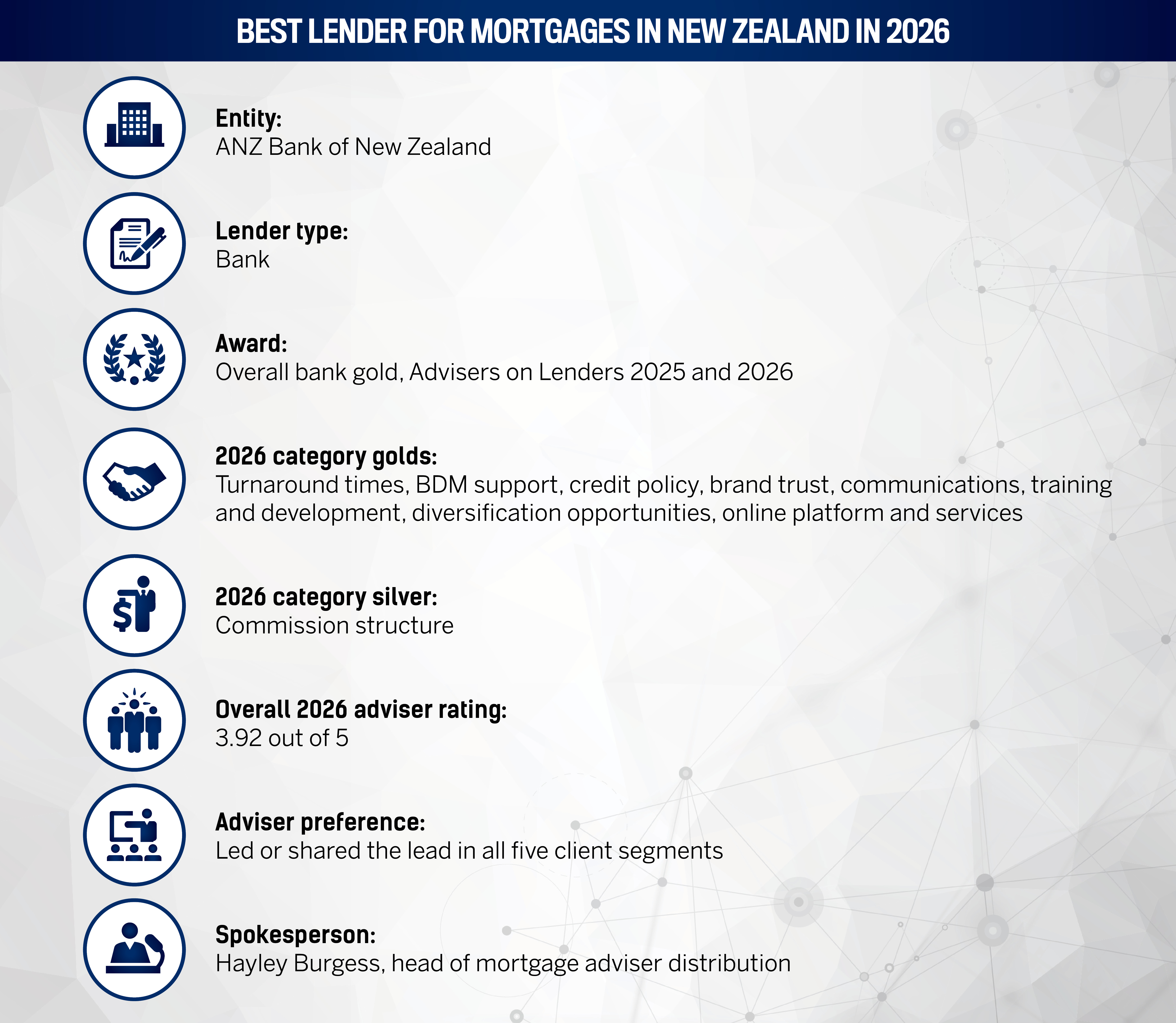
ANZ Bank of New Zealand didn’t just hold on to its overall gold in the second year of NZ Adviser’s Advisers on Lenders survey. It raised its game. The bank medalled in eight of the 10 categories, and its overall adviser rating climbed from 3.52 to 3.92, an unusually large jump for a single year.
That result lands on top of this report’s biggest story, the turnaround reversal, and ANZ topped that category outright.
Hayley Burgess, head of mortgage adviser distribution at Auckland-headquartered ANZ Bank of New Zealand, says last year’s feedback landed squarely. “Last year, we heard from advisers that our turnaround times weren’t where they needed to be,” she says.
The bank responded with more resourcing across assessment and BDM teams, deeper assessor training to improve capability and reviewing its processes to understand where friction was slowing applications down.
Burgess describes the eight category wins not as separate projects but as one experience. “Turnaround times, credit policy, communication, they’re actually just part of the ANZ experience,” she says, crediting continuous adviser feedback, gathered through surveys, BDMs in the field and direct conversations, as the thread tying every team’s work together.
NZ Adviser Advisers on Lenders 2026 · winner highlights
Overall gold medallist for a second year running
What advisers said
“ANZ, pure turnaround times. Quick answers.”
“ANZ, Reno Loan and Blueprint to build. Strong assessment timeframes and product guide, with some flexibility in criteria.”


Q&A with Hayley Burgess |
Q: Diversification opportunities is the category advisers rate lowest industry-wide, yet ANZ won it. What specifically are you offering there?
A: We’ve brought some genuinely innovative solutions to market over the last couple of years. This year, we launched the ANZ Reno Loan, the first offering of its kind, designed to help homeowners renovate. This builds on products such as our Blueprint to Build package, which offers discounts for customers building a home, and the ANZ Good Energy Home Loan, supporting investment in energy-efficient upgrades. We also listen to adviser feedback and act. One example is our decision to extend interest-only lending for residential investors to 10 years, which came directly from conversations with advisers around what clients needed.
Q: Advisers said product range and pricing satisfaction dipped industry-wide this year even as turnaround times improved. What’s ANZ’s read on that?
A: I think this reflects the broader environment we’re in. Kiwi households have been doing it tough the last couple of years, ongoing cost-of-living pressures, more recently fuel prices, and alongside that, we’re in a rising-rate environment.
Q: What’s next for ANZ?
A: We will keep lifting the bar. We’ve made good progress, but continuous improvement is an ongoing focus as we look for ways to better support advisers and homeowners.
CFML Loans
|
Non-bank lenders have an image problem, and it starts before a single application lands.
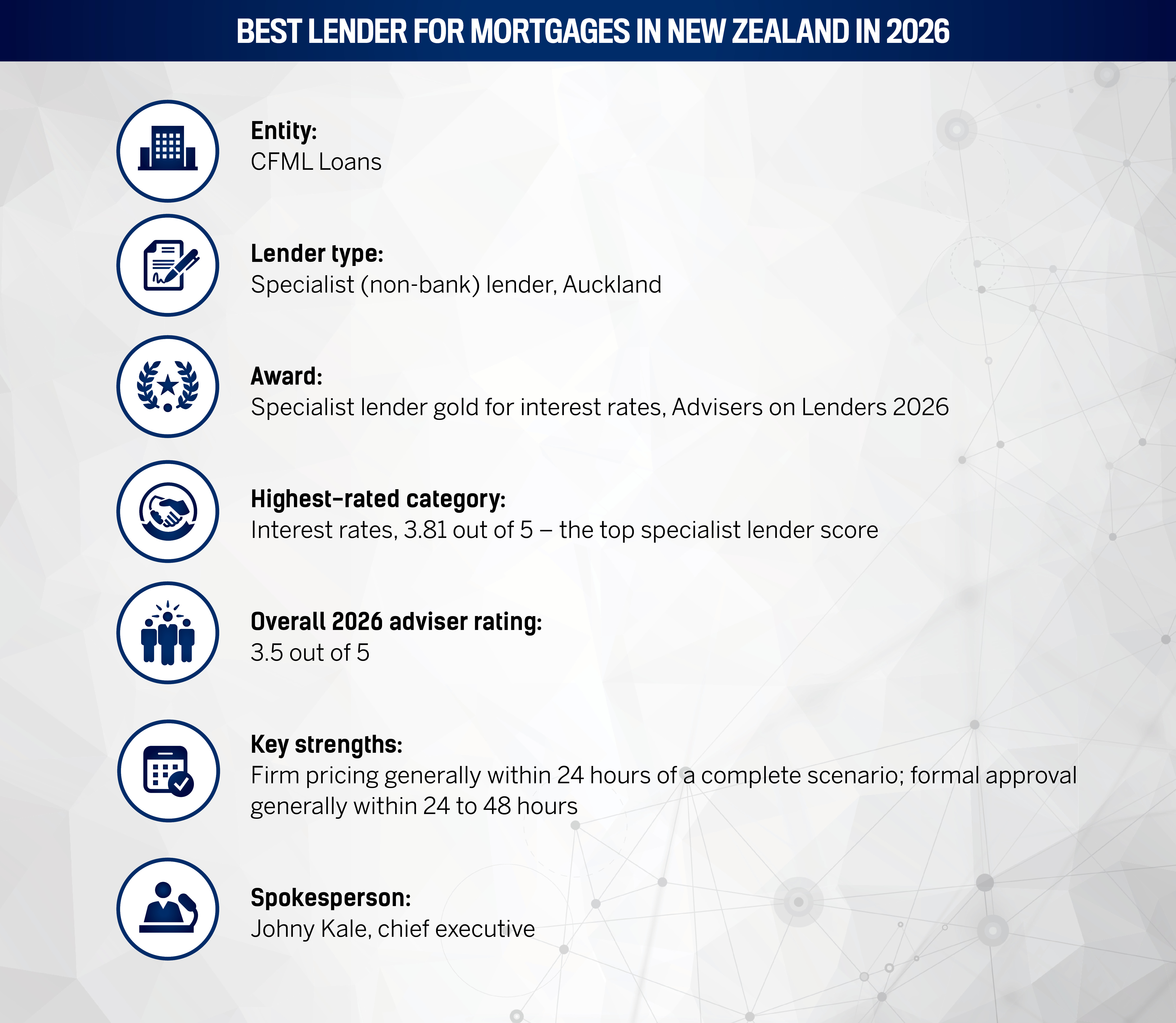
“Non-bank lenders can sometimes get a bad reputation when it comes to pricing, with the perception that non-banks are expensive or, at the extreme, loan sharks,” says Johny Kale, chief executive of Auckland-based CFML Loans. “In my experience, that is not representative of the vast majority of the non-bank market.” CFML Loans took gold for interest rates among specialist lenders this year.
“Our approach to pricing is simple: we aim to be fair, transparent and consistent with our clients,” he adds.
The number of advisers rating CFML Loans increased more than three-fold this year, as its overall adviser score settled at 3.5/5. CFML’s dedicated BDM team has only existed for two years, and Kale traces much of this year’s shift to a decision made partway through that period.
It started with a specific complaint advisers raised early on, lenders quoting one rate, then adding to it as a deal progressed. “We deliberately wanted to take a different approach,” he says.
An adviser now supplies the scenario, the security property details and the client declaration, and CFML can generally come back within 24 hours with firm pricing, together with an indication of what else is required for formal approval.
NZ Adviser Advisers on Lenders 2026 · winner highlights
Gold medallist for interest rates among specialist lenders
Overall score eased slightly even as adviser engagement with CFML tripled this year.
What advisers said
“CFML Loans, due to their simple products.”
“There are LVR restrictions, but CFML are good at workshopping to potentially use another one of their products.”

Q&A with Johny Kale |
Q: The number of advisers rating CFML Loans grew more than three-fold this year. What’s driving that engagement?
A: A significant part of our growth comes down to CFML making the decision to establish our own BDM team and take direct responsibility for driving origination. Prior to mid-2024, we used a third party to manage this function for us. Bringing it in-house has fundamentally changed the way we engage with the adviser market and brought us much closer to advisers and their businesses. That helps us understand how advisers operate, the types of transactions they are seeing and where there may be gaps in the market where CFML can provide a genuine solution. We’re also able to take that feedback, together with the data we’re collecting, back to our funders, to develop lending products that solve real problems for advisers and their clients, while supporting sustainable growth in CFML’s loan settlements. Our Asset Lend and Short-Form Refi initiatives are good examples of that approach. Two years ago, not many advisers knew who CFML Loans was. I would like to think that has changed considerably, but there is always room to improve. We need to continue building the CFML brand and, most importantly, keep listening to advisers.
Q: Interest rates was your strongest category; online platform and services was your lowest score. Is there a technology investment underway there?
A: We have taken that feedback on board and genuinely welcome the constructive criticism. It is important that we understand where we can improve and continue to evolve the service we provide to advisers. We’ve been working in the background on a number of improvements across both our service offering and technology, and we believe these will deliver a meaningful improvement in the adviser experience over the next 12 months, with several key deliverables scheduled for the final quarter of this year. There is still work to do, but we are confident the investment we are making will make it easier and more efficient for advisers to do business with CFML.
Q: Turnaround times is the number one thing advisers say they weigh most heavily. Where does CFML sit on that this year versus last?
A: We’ve made good progress in this area over the past 12 months. Where we receive a complete application, all the required supporting information and the application fee hold, we can generally provide formal approval within 24 to 48 hours, with settlement possible within three business days. These timeframes are highly dependent on the quality and completeness of the information we receive, and the client’s solicitor being ready to settle. From CFML’s perspective, we can control the efficiency of our own processes and, to a certain extent, the information we request, and we continue to review that with the objective of making things as straightforward as possible. Ultimately, though, achieving these turnaround times requires everyone involved in the transaction to play their part. If the requested information is provided promptly and accurately, and the solicitor is ready to settle, we’ve demonstrated that we can move from a complete application through to settlement very quickly.
Go Lend
|
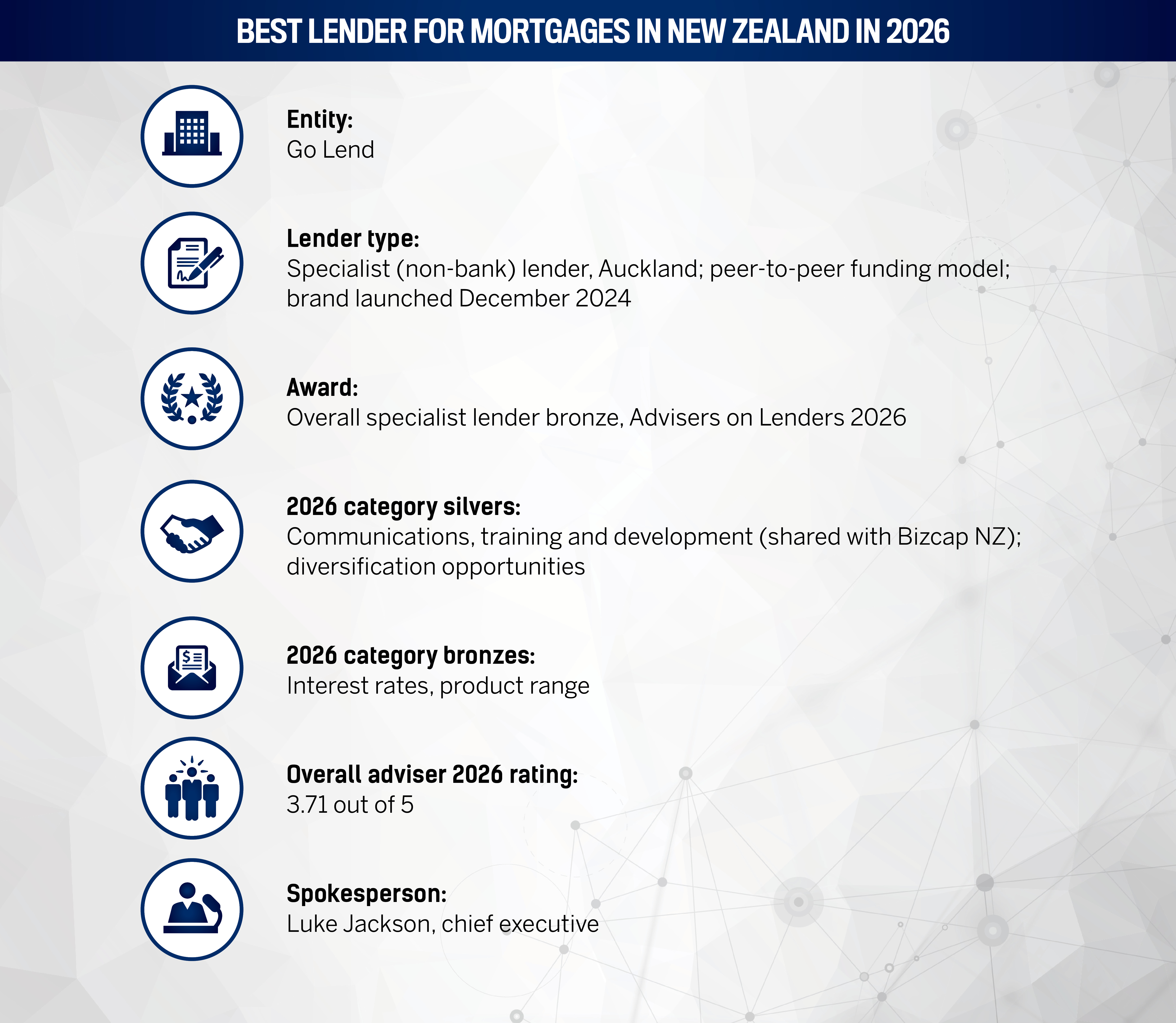
Two years ago, Go Lend didn’t exist. The brand launched in December 2024, spent 2025 building, and in 2026 went from a single adviser rating to a wave of them, finishing third overall among specialist lenders, with silver in communications, training and development, and in diversification opportunities, and bronze in interest rates and product range.
Luke Jackson, chief executive of Auckland-based Go Lend, says the timing looks dramatic from the outside, but the substance behind it isn’t new at all.
“Yes, the brand’s new, but we’re not,” he says. “I’m not new to running New Zealand specialist lending companies.” Go Lend’s head of credit is a long-standing member in the industry, and Jackson credits relationships built well before the brand existed.
“We’ve got good relationships with a lot of the market, with the aggregators, with many of the advisers, and these relationships span back many, many years,” he says. As more advisers have used the business, he says it’s just going from strength to strength.
The interest rates and product range results trace back to a deliberate choice made at launch. “When we launched, we were looking at different models and different ways of structuring a specialist lender, and different funding models,” Jackson says.
Go Lend settled on a peer-to-peer mortgage platform specifically for the flexibility it allows in commercial decision-making, particularly in the short-term, non-regulated space covering residential, commercial property and development.
“That was intentional, because we know that funding model works really well for funding those types of loans,” he says. “And it’s been proven as advisers have used us and experienced that as well.”
NZ Adviser Advisers on Lenders 2026 · winner highlights
Overall bronze medallist in its first full year on these rankings
In their own words
“The important thing is to do what you say you're going to do, and that's what we've done and that's what we'll continue to do.” Luke Jackson, chief executive, Go Lend

Q&A with Luke Jackson |
Q: Turnaround times matter most to advisers. How has Go Lend kept up on speed as things have gotten busier?
A: That’s always going to be an ongoing challenge. It’s not just one thing, there’s two things, it’s speed and skill. You’re able to assess things faster, I’ll be bluntly honest, when you’ve got a higher level of skill, and because we’ve got Ross here, he’s been in this market for a long, long time, he’s kind of an old head at doing this, so we can get to the decision quickly. What’s more, we can explain things commercially when there are files or reasons we don’t want to be as aggressive as requested, or we want to structure something differently, or we don’t want to participate at all, we can give good commercial reasons why. We don’t really believe in just saying this isn’t our appetite. It’s not just the speed, it’s giving advisers clear reasoning to either go back to their client or understand where our appetite is.
Q: What kind of deals are advisers bringing you now that they weren’t a year ago?
A: I don’t think it’s changed, honestly. I think for us it’s just that more advisers have used the facility and have appreciated it. We’ve gone with the structure we have because we can look at a wider range of properties or deals. But I think it’s just a case of as more have used Go Lend, they’ve just appreciated what it is.
Which mortgage lenders win on technology, turnaround times and service in 2026? |
Turnaround times went from advisers’ biggest complaint to their biggest win, and the medal tables show who delivered it.
ANZ takes bank gold for turnaround times, BDM support and online platform and services in 2026. Among specialist lenders, Vincent Capital takes gold for turnaround times and BDM support, and Prospa NZ for online platform and services.
Turnaround times |
The reversal here is the sharpest of any measure in this entire survey. In 2025, 85.40% of advisers said bank turnaround times had worsened, with 58.43% calling it a significant worsening. This year, 51.14% said turnaround times had improved, up from just 2.24% a year ago. The share calling it worse fell just as sharply the other way, from 85.40% down to 22.73%, a swing of more than 62 percentage points on its own.
51.14%
of advisers reported bank turnaround times improved in 2026 (up from 2.24% in 2025)
ANZ takes gold, up from silver in 2025. ASB and Westpac, both new to this category’s medals, take silver and bronze. The Cooperative Bank, 2025’s gold medallist, and TSB, last year’s bronze medallist, both drop out of the top three.
Among specialist lenders, Vincent Capital takes another gold. BIZCAP NZ, a new entrant, takes silver. Basecorp Finance, 2025’s gold medallist, drops to bronze.
The Mortgage Girls’ te Kaat connects this improvement to what the growing adviser channel now demands. “With advisers now responsible for such a large share of new home loans, lenders need to make sure the channel is properly supported and that they are working with us, not against us,” she says. “That means having enough assessors, realistic turnaround times and BDMs who are available and able to help.”
Vega’s Signal makes the same point more directly. “Lenders need to adequately staff their adviser channels to provide appropriate service timeframe and quality to respond to the increasing workflow,” she says.
Improvement is not universal, though. More than one adviser in five, 22.73%, still says turnaround times have worsened, and advisers’ comments show how they’ve adapted either way.
How advisers have adapted |
“Balance client expectations. Times have improved to assess and pick up the loan, but reworks and conditions timeframes have decreased substantially. Still advising longer timeframes for assessment than what is being offered, to protect myself, as it can also be assessor dependent.”
With rates falling, market activation is back on, and application volumes have surged. Bank turnaround times have pushed out again; we’re regularly looking at up to 10 working days at some of the majors. We’ve had to adapt on two fronts. Extending finance clauses, telling clients the old 10-day clause won’t cut it, and pushing for three to four weeks in sale and purchase agreements. And front-loading clean files, tightening our systems so every application we lodge is a one-touch file.”
“If the turnaround is particularly bad at the time of submission, I will always look at other options. In this day and age, there is absolutely no reason for turnaround times to blow out as they do.”
“That’s a hard question, as they have fluctuated from bad to good to bad again. Currently, they aren’t good.”
BDM support |
ANZ takes gold, up from bronze in 2025. Westpac, last year’s winner, slips to silver, and Kiwibank falls from silver to bronze.
BDM support comes up in advisers’ comments as a reason to move business towards or away from a lender, but experiences vary widely. Some advisers describe a BDM with genuine authority, someone who can push a marginal deal through, negotiate on the spot and make a real case for a client.
Others describe the opposite, a BDM who can relay information but can’t actually advocate for anything, leaving the adviser to fight the lender’s own processes alone.
Among specialist lenders, Vincent Capital repeats its turnaround times result, going straight to gold. Avanti Finance holds silver both years. Southern Cross Partners, a new entrant, takes bronze. Prospa NZ and Basecorp Finance, 2025’s gold and bronze medallists, do not place this year.
Online platform and services |
ANZ keeps its online platform crown. ASB, a new entrant, takes silver. Kiwibank holds bronze both years.
Among specialist lenders, Prospa NZ holds gold for a second year running. Vincent Capital, a new entrant, takes silver. Pepper Money NZ holds bronze both years.
Some advisers now name digital capability as a reason to choose a lender, not just a background convenience. Not all of that praise goes to this year’s medallists. BNZ didn’t place here, but it draws two of the most specific comments.
“Outstanding banking app showing ERC costs, etc. TotalMoney is also a very good product,” one adviser says. Another makes a similar point. “BNZ has the best offer, with offsetting and systems online.” ERC refers to early repayment costs, the break fees charged when a fixed-rate loan is repaid or restructured early.
The Mortgage Girls’ te Kaat points to the friction that still holds the digital experience back. “There are still too many processes and forms, where we end up entering the same information more than once, uploading documents into different systems and chasing updates manually,” she says. “The biggest improvement would be getting the different systems to talk to each other.”
LifeDirect’s Bailey takes a longer view of the same friction. “The day there is no friction is probably the day where a client’s AI agent speaks directly to the AI banks and approves the loan. Our industry would look substantially different if that were to happen,” he says.
Vega’s Signal points to a specific technical fix. “Integration from the CRM tools will be a game changer,” she says. “Open banking adoption will also speed up processing and reduce fraud risk.”
Gold, silver and bronze medallists for banks and specialist lenders, as rated by New Zealand mortgage advisers
| Category | Gold | Silver | Bronze |
|---|---|---|---|
| BDM support | ANZ | Westpac | Kiwibank |
| Online platform and services | ANZ | ASB | Kiwibank |
| Turnaround times | ANZ | ASB | Westpac |
| Category | Gold | Silver | Bronze |
|---|---|---|---|
| BDM support | Vincent Capital | Avanti Finance | Southern Cross Partners |
| Online platform and services | Prospa NZ | Vincent Capital | Pepper Money NZ |
| Turnaround times | Vincent Capital | BIZCAP NZ | Basecorp Finance |
What New Zealand mortgage advisers are saying in 2026 |
Channel conflict, living expense checks and the gaps in green lending: advisers don’t hold back.
In 2026, advisers say channel conflict has eased but not disappeared, with 37.65% calling it a major problem, down from 57.47% in 2025. About 45% describe lenders’ living expense assessment positively, and many want green loans with longer terms, wider eligibility and simpler applications.
Channel conflict |
Channel conflict, when a lender’s own branch or direct channel offers a client a faster or better deal than its adviser channel, hasn’t gone away in 2026, but it’s stopped being the crisis it was. The share of advisers calling it a major problem fell almost 20 points, from 57.47% to 37.65%. That entire decline shows up elsewhere, split between advisers who now call it a minor problem instead, up 13.48 points, and advisers who now say it isn’t a problem at all, up 6.34 points, together accounting for the full 19.82-point shift.
37.65%
of advisers still consider channel conflict a major problem (down from 57.47% in 2025)
Combined, the number who say some version of the problem exists only dropped from 80.46% to 74.12%, a modest six points. The story isn’t disappearance. It’s advisers downgrading the same underlying frustration rather than losing it.
Do you believe channel conflict exists?
Major problem and minor problem nearly swapped places, the minor-problem share rose by almost the same amount the major-problem share fell. Advisers appear to be downgrading the same underlying frustration, not losing it.
The speed gap. The most common complaint by far is a bank’s own branch or direct channel turning an application around in a day or two while the adviser channel waits a week or more for the identical product.
“Sometimes a client will get a different answer in the branch from that which we get from the broker unit,” one adviser says. “Branches are able to turn a deal around in 24 hours, as opposed to broker units taking at least a week.”
Retention teams targeting adviser-originated clients. A second, more damaging pattern shows up repeatedly: a lender’s retention team contacting a client directly at the refinance or discharge stage, after the adviser has already done the work, to offer a deal better than what the adviser was given.
“What we’re seeing is an uneven playing field,” one adviser says. “An adviser does all the heavy lifting, structures a beautiful, clean refix or pre-approval and gets a competitive rate from the bank’s broker desk. But then, the bank’s internal retention team slides into the client’s DMs directly, bypassing the adviser completely to offer a sharper rate or a cash-back deal they refused to give us.”
Not every adviser experiences this as a problem. A meaningful minority describe it as manageable or simply not something they’ve encountered. “I believe the lenders are fully aware of possible conflicts, and there is enough business for all,” one respondent says.
The Mortgage Girls’ te Kaat describes what real progress on channel conflict would mean.
“It would mean clients receive the same service, pricing and turnaround times whether they go through an adviser or approach the lender directly,” she says. “If a client has chosen to work with an adviser, that relationship should be respected. Clients should not be approached by the lender and encouraged to bypass their adviser, especially after the adviser has done the work to introduce and support them. For me, progress would be when advisers no longer have to worry that their client could receive a faster decision or better offer simply by going directly to the lender. There is enough business for everyone.”
LifeDirect’s Bailey, who calls for parity between bank staff and advisers, gives examples of what he means. “The banks covering legal fees plus market cash contributions, being able to fund a transportable home via a specialised credit policy and special first home buyer projects that are in effect rent-to-own, run by local charitable groups,” he says. “To add to that, consistent pricing between all channels as well as consistent retention or cash contribution payments.”
Channel conflict remains a live issue, but its intensity has clearly eased. The pattern behind it is consistent, faster approvals through a bank’s own branch or direct channel, and retention offers that surface only after a client tries to leave, both put the adviser relationship at a structural disadvantage even when the adviser did the work to get the deal there.
Lenders’ assessment of living expenses |
Most advisers describe a workable relationship with lenders on living expense assessment. This year, about 45% describe the process positively, against roughly 26% who call it stricter or more inconsistent, a ratio of nearly two to one. Another 29% report no real change either way.
The removal of prescriptive affordability rules from the Credit Contracts and Consumer Finance Act (CCCFA) regulations in July 2024 moved lenders away from rigid, line-by-line expense scrutiny towards a more principled, judgement-based approach, and advisers’ comments reflect the change. It’s the quieter half of what makes a lender easy to work with, speed and pricing get the headlines, but how a lender assesses a client’s day-to-day finances shapes whether a deal gets over the line at all.
“The days of the banks acting like financial detectives, interrogating a Sunday family bucket of KFC or a Netflix subscription, have mostly settled down,” one adviser says. “The extreme CCCFA drama has moved on, thank goodness, and lenders are finally bringing a bit of common sense back to the table.”
Another describes a lender simply meeting a reasonable standard. “Have been reviewed, most are fairly similar to declared expenses from clients, as they are fairly aware of their costs having increased.”
Not every adviser sees that fairness applied evenly. “Poor. They are quick to raise the general expenses applied to everyone but won’t look at individuals like self-employed people who don’t have some of those expenses,” a third adviser says.
Sustainable and green loan options |
Advisers see value in green and sustainable loan products but view most current offerings as too narrow to reach their full potential.
The improvements advisers ask for share a common thread: longer terms, wider vehicle eligibility, higher loan-to-value ratio (LVR) allowances and simpler applications, all aimed at bringing these products within reach of more of the clients that advisers already work with.
The opportunity here is less about building something new and more about broadening what already exists.
One theme carries over from last year. In 2025, one adviser asked lenders to simplify the loan application, pointing out that a smaller top-up amount still requires a full application.
This year, another adviser makes a related point. “This lending has strong potential, but it needs to be easier to understand, easier to apply for and more relevant to everyday homeowners, not just those undertaking major renovations or buying new energy-efficient homes,” they say.
Vehicle eligibility and application complexity are the two themes that come up most. “Some should open to hybrids, not just limit to EVs,” one adviser says. Another wants the process itself rethought, not just widened. “Drop the red tape. Forcing families to get highly specific quotes from a tiny list of accredited installers within a tight 60-day window is a massive headache for everyday renovations,” they say. “Let’s see discounted green development margins for new builds hitting Homestar 6+ ratings from day dot.”
A third points to a gap that would meaningfully expand who these products reach. “Offer them to over 80% LVR clients for a start. Increase the maximum if the client is utilising green products, as it doesn’t take much to go through $70,000 nowadays.”
Other advisers raised two further, practical asks:
“Offer a simple assessment process, a quick form variant. Portability between banks should be required. Allow all PHEVs, hybrids and EVs.”
“Longer term, increase to five years for vehicles and 10 years for green renovation.”

Overall Winners |
| Banks | Specialist lenders | |
|---|---|---|
| ● Gold | ANZ | Vincent Capital |
| ● Silver | ASB | Avanti Finance |
| ● Bronze | Kiwibank | Go Lend |
Falling rates, record first home buyers and a turning cycle shaped this year’s market |
Key figures behind this year’s Industry Context section
| Metric | Key finding |
|---|---|
| OCR, January to September 2026 | 2.25% → 2.75% |
| Floating mortgage rates, September 2026 | 6.29% to 6.49% |
| Lowest fixed mortgage rates, 22 September 2026 | 4.69% (6 months) to 5.49% (5 years) |
| First home buyer share of purchases, June 2026 quarter | 28.3% (record) |
| Investor share of new mortgage commitments, July 2026 | 18.9% (update 24 Sept.) |
| Broker-originated lending share of new home loans | approaching 60% |
| Specialist lender sector loan obligations (KPMG, March 2026) | approximately $22 billion |
| Financial advisers in New Zealand, 2025 | 9,198 (up 8.4% on 2024) |
New Zealand mortgage advisers spent the 12 months to September 2026 navigating a market that changed direction more than once. The Reserve Bank of New Zealand lifted the official cash rate (OCR) from 2.25% at the start of the year to 2.75% by early September, a reversal after a long run of cuts.
Interest rates reverse course after two years of cuts |
Two consecutive 25-basis-point hikes, on 8 July and 2 September 2026, lifted the OCR to 2.75%, with the Reserve Bank’s updated forecasts pointing to one more increase before the end of 2026. All major banks passed the September rise straight through to floating home loan rates, which now sit between 6.25% and 6.49% depending on the lender and product, according to the banks’ rate announcements.
Fixed rates track wholesale funding costs and expectations for future OCR moves. As of 25 September 2026, the lowest advertised fixed rates across the major banks ranged from 4.75% for six months to 5.49% for five years, according to Opes Partners’ rate tracker, with banks repricing individual terms on their own timelines instead of moving uniformly – BNZ, for example, cut its two-year rate on 22 September while lifting most others. Read the Reserve Bank’s September 2026 Monetary Policy Statement for the full detail behind the decision.
Registered bank housing lending, New Zealand, June 2026
Total housing lending held by New Zealand’s registered banks, up 5.6% year on year, the base against which each bank’s share of the market is measured below.
First home buyers dominate a cooling housing market |
Even as overall lending volumes soften, first home buyers are taking a growing share of the market. Cotality data shows first home buyers took a record 28.3% of all New Zealand property purchases in the June 2026 quarter, up from 27.5% in the first three months of the year and well above the roughly 22% long-term average dating back to 2005. Kelvin Davidson, chief property economist at Cotality New Zealand, explained that “lower property values and reduced mortgage costs have made a real difference” to buyer activity this year.
That August uptick is one month’s movement, though. The longer trend runs the other way: Cotality’s buyer classification data shows mortgaged multiple property owners’ share of purchases fell for a second straight quarter in the June 2026 quarter, to 22.5%. Investor-heavy lending, which shaped previous cycles, has receded, leaving lenders and the advisers who work with them steering through a market increasingly weighted towards standard residential deals, low-deposit lending and first home buyer products.
The adviser channel keeps growing its share of the market |
As buyer composition shifts, mortgage advisers have become the dominant way New Zealanders get a home loan. NZ Adviser’s Top Advisers 2026 report put broker-originated lending at close to 60% of all new home loans, and the major banks’ own results show adviser-introduced lending rising.
In their results for the six months to 31 March 2026, Westpac attributed 58% of its mortgage portfolio to adviser introductions, up from 56.7% six months earlier, and BNZ said advisers had originated 40% of its home loan book, up from 38.9% a year earlier. ANZ’s adviser-originated share of its home loan book was 53% at March 2026, up from 52% a year earlier.
LifeDirect’s Bailey sees that growth as a client signal, not just a statistic. “I get the impression that we are reluctant business partners with a few different banks, not all, and with the clients choosing with their feet, now they have a clear signal that our industry adds something they can’t,” he says. “Like I say to many clients, not all banks suit your current situation, we are here to find the best one and advocate for you.”
Broker-introduced share of mortgage lending, by bank and overall market
Estimated share of all new home loans now originated through the adviser channel, more than half the market.
When more than half of all new lending flows through advisers, how a lender treats that channel is close to the whole game.
Specialist lenders find a tailwind |
A structural shift is reshaping the specialist lending sector. Finance company mortgage lending has risen more than 30% since New Zealand’s Depositor Compensation Scheme took effect in July 2025, according to the Reserve Bank’s May 2026 Financial Stability Report, potentially narrowing the funding cost gap between specialist lenders and the major banks. Even so, the report puts finance companies’ residential mortgage lending at around $550 million, against roughly $388 billion from registered banks.
KPMG’s Specialist Lenders Insights Report, published in March 2026, put total loan obligations across the sector at approximately $22 billion, with more than 80% of lenders reporting growth in lending volumes and 75% reporting higher net profit after tax.
Sector scale and growth, year on year
Total loan obligations across New Zealand’s specialist and non-bank lending sector, a scale that has grown alongside strong reported performance across the sector.
MB Private launched with $150 million in backing from Westpac NZ this year, a sign of how much confidence is flowing into specialist lending even as the wider market cools.
Regulators turn their attention to adviser conduct |
Lenders aren’t the only ones under scrutiny this year. In its Financial Conduct Report for 2026/27, published 30 June 2026, New Zealand’s Financial Markets Authority (FMA) named managing conflicts from commission-based remuneration as a priority, with mortgage and insurance advisers specifically in scope. FMA chief executive Samantha Barrass was direct about the boundaries of that focus, stating the regulator is “not opposed to commission, nor leading a review on the level of commissions”.
That scrutiny is landing on a profession that keeps growing. According to the FMA’s second annual Financial Advice Provider regulatory returns report, published 29 April 2026, the number of financial advisers in New Zealand grew 8.6% between 2024 and 2025, from 8,472 to 9,197. Add the 11,019 nominated representatives working alongside them, and about 20,200 individuals offered financial advice in New Zealand as of 2025, alongside 1,018 authorised bodies, evidence the advice profession is expanding even as regulatory attention on it intensifies.
What will shape New Zealand’s mortgage market in 2027? |
The gains advisers are celebrating now have to survive a turning rate cycle, sharper regulatory scrutiny and a fast-growing specialist sector.
On the evidence of 2026, the market is getting easier to work in. Turnaround times reversed. Channel conflict eased. The question now is whether it lasts.
Turnaround times improved against a falling-rate backdrop that drove a volume surge the industry couldn’t always match in real time. Rates are rising now, which should ease that specific pressure, for the moment. But the real test isn’t which way rates move next. It’s whether the changes lenders made, more assessors, deeper training, less friction in the process, built durable capacity or just solved this year’s conditions. If it was the latter, the next surge, whenever it comes, could look a lot like the last one.
Regulators are turning up scrutiny on how advisers manage conflicts tied to commission-based remuneration for 2026/27, right as advisers ask lenders for structures that are transparent and fairly reflect their work. Lenders who build that transparency in now are the ones best placed to keep winning this category next year.
Diversification opportunities are still building as it moved further than any other criterion in this year’s survey while still ranking last overall. If that rise continues, the lenders already investing here will have a head start, and next year’s survey will show whether it has.
What sets the best lenders for mortgages in New Zealand apart? |
What the best lenders for mortgages in New Zealand in 2026 share runs deeper than any single category. ANZ rebuilt its turnaround times around what advisers said was broken, then carried that same discipline across eight of the 10 categories, including diversification opportunities, the criterion advisers value least but which rose most in importance this year. CFML Loans topped every other specialist lender in interest rates, built on a commitment to firm, upfront pricing, generally within 24 hours of an adviser supplying the deal details. Go Lend, not yet two years old, proved that a new brand backed by seasoned people can earn a following fast, simply by doing what it says it will do.
Speed still tops what advisers want. But speed alone doesn’t win. Underneath it sits something sturdier: consistency, transparency and a willingness to build around what advisers are saying. The lenders that won in 2026 were the ones that listened.






What is the Advisers on Lenders survey of New Zealand mortgage lenders?
It’s NZ Adviser’s second annual survey of New Zealand mortgage advisers, rating the banks and specialist lenders they work with across 10 categories, from turnaround times and credit policy to product range and online platform and services. This is the second annual edition of this survey, building directly on NZ Adviser’s inaugural Advisers on Lenders 2025 report, which established the industry’s first benchmark for lender performance.
How are the best lenders for mortgages in New Zealand ranked?
Advisers rate each lender they’ve worked with on a one-to-five scale across the same 10 categories, and banks and specialist lenders are ranked separately rather than against each other. Gold, silver and bronze medals go to the top three lenders in each category and overall, for both banks and specialist lenders.
Have mortgage turnaround times for New Zealand banks improved in 2026?
Yes, dramatically. The share of advisers saying bank turnaround times had improved rose from 2.24% in 2025 to 51.14% in 2026, while the share saying they had worsened fell from 85.40% to 22.73%, the sharpest reversal recorded anywhere in this year’s survey.
Which bank is the best lender for mortgages in New Zealand in 2026?
ANZ Bank of New Zealand took the overall gold medal for the second year running, medalling in eight of the 10 measured categories and winning gold in seven of those outright, including turnaround times, the category advisers rank as their single highest priority.
Is channel conflict still a problem for mortgage advisers in New Zealand in 2026?
Yes, though it’s easing. Channel conflict happens when a bank’s branch or direct channel offers a client a faster or better deal than the adviser channel can, sometimes after the adviser has already done the work to bring that client in. The share of advisers calling it a major problem fell from 57.47% to 37.65% this year, but the share saying some version of the problem exists at all only dropped from 80.46% to 74.12%, suggesting advisers are downgrading the frustration rather than losing it entirely.
What will affect New Zealand mortgage lenders and advisers in 2027?
Two forces are already in motion. New Zealand’s rate cycle has turned from cutting to hiking, which will test whether this year’s turnaround-times gains reflect durable operational change or one-year conditions, and the Financial Markets Authority’s Financial Conduct Report has named managing adviser conflicts from commission-based remuneration a priority for 2026/27, which may sharpen what advisers expect from lenders on commission transparency.
What is the best specialist (non-bank) mortgage lender in New Zealand in 2026?
Vincent Capital took overall specialist lender gold in NZ Adviser’s Advisers on Lenders 2026 survey, in its first year on the rankings. It won gold for BDM support, brand trust, credit policy, diversification opportunities and turnaround times, and silver for online platform and services and product range. Avanti Finance took overall silver and Go Lend bronze.
What do New Zealand mortgage advisers look for in a lender?
Turnaround times rank first, with an importance score of 4.63 out of 5 in the 2026 survey, followed by credit policy (4.52), BDM support (4.32), interest rates (4.30) and product range (4.27). Diversification opportunities rank last, at 3.43, though its score rose more than any other criterion this year.
What is a specialist or non-bank lender in New Zealand?
Specialist lenders are non-bank lenders, such as finance companies and peer-to-peer lending platforms, that often fund borrowers or deals outside mainstream bank criteria. NZ Adviser’s Advisers on Lenders survey rates them separately from banks, and in 2026 it ranked 14 specialist lenders alongside 10 banks.
In NZ Adviser’s second Advisers on Lenders survey, advisers were asked to rank their lenders (banks and specialist lenders) across 10 categories: BDM support, brand trust, commission structure, communications, training and development, credit policy, diversification opportunities, interest rates, online platform and services, product range and turnaround times. Advisers could rate their lenders with a score out of five in each category.
For each lender they nominated, advisers were asked to assess the offerings provided on a scale of 1 (poor) to 5 (excellent).
NZA also asked advisers an additional question about their lender’s service and support, which did not impact the overall score.