MLS activity edges up as listings tighten and market equilibrium slowly returns

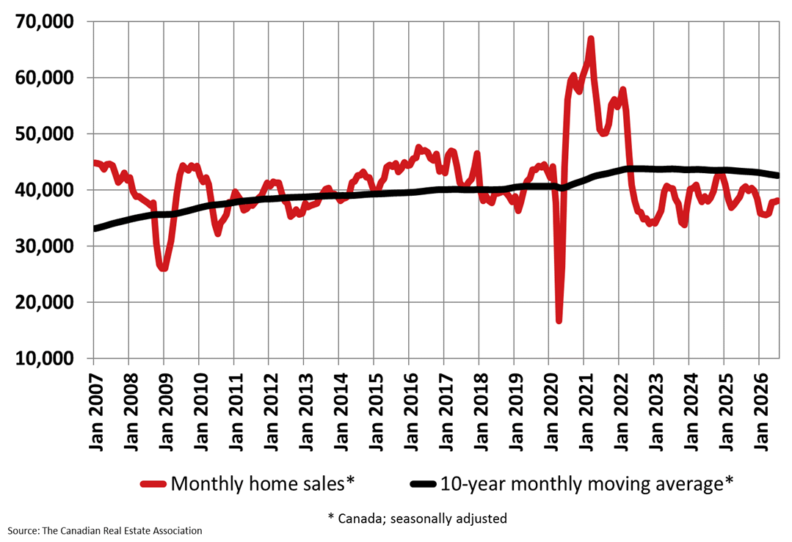
Canadian home sales extended their recovery in July, with the Canadian Real Estate Association (CREA) reporting a fourth consecutive monthly gain as tightening supply and stabilising prices nudge the national market closer to balance.
National MLS activity rose 0.5% on a seasonally adjusted month-over-month basis in July. On an unadjusted basis, 43,578 homes changed hands. That's down 5.3% from July 2025 but part of a quiet recovery that has lifted activity roughly 7% above March lows.
"At the national level, July's housing data was a carbon copy of the June numbers, with home sales edging up a little further, listings down, and prices remaining stable," said Shaun Cathcart, CREA's senior economist, in the association's August 2026 report.
The national average sale price came in at $674,819 in July, up 0.2% year-over-year. The MLS Home Price Index (HPI), which tracks typical home values, edged up 0.1% from June, its first monthly gain since November 2024.
The index remained down 3.3% on a year-over-year basis, though that gap has been narrowing steadily since January.
Markets move toward the middle
The bigger story, according to CREA, is the broad convergence underway beneath the national headline.
New listings declined 1.6% month-over-month in July, the third straight drop. It pushed the national sales-to-new-listings ratio to 51.3%, approaching the long-term average of 54.7% and squarely within the 45%–65% range consistent with balanced conditions.
National inventory sat at 4.7 months at the end of July, the lowest point in 2026 and slightly below the long-term average of five months.
With 205,388 properties listed across Canadian MLS Systems — up just 0.6% year-over-year and 1.5% above the historical average for that time of year — supply is neither abundant nor critically constrained.
Saskatchewan, New Brunswick, and Newfoundland and Labrador remain in borderline sellers' territory, but most other provinces have seen months of inventory converge toward long-run norms.
Ontario, which spent the first four months of 2026 in buyers' market territory, had pulled back to roughly half a standard deviation above its long-term inventory average by July.
A regional breakdown of which Canadian housing markets are outperforming in 2026 shows how divergent those conditions remain, with Prairie cities and smaller Atlantic centres tracking a very different trajectory from the country's two most expensive markets.
What balance means at the broker level
For brokers, a market edging toward equilibrium translates to fewer competing-offer situations, less pressure on appraisals, and more time for clients to make considered decisions. That said, the picture is far from uniform at the street level.
Elan Weintraub, co-founder and director at Mortgage Outlet in Toronto, described the market as "very cloudy and volatile" and "extremely micro-fragmented," noting that conditions can differ sharply by geography, property type, and price point.
Garry Bhaura, CREA chair, struck an optimistic tone. "No matter where you are in Canada, more moderate housing market conditions can be expected to continue to bring buyers off the sidelines going forward," he said in the report.
The next CREA statistics release is scheduled for Tuesday, September 15.
Make sure to get all the latest news to your inbox on Canada’s mortgage and housing markets by signing up for our free daily newsletter here.