Calgary's September housing data reveals contrasts the headline number alone doesn't capture

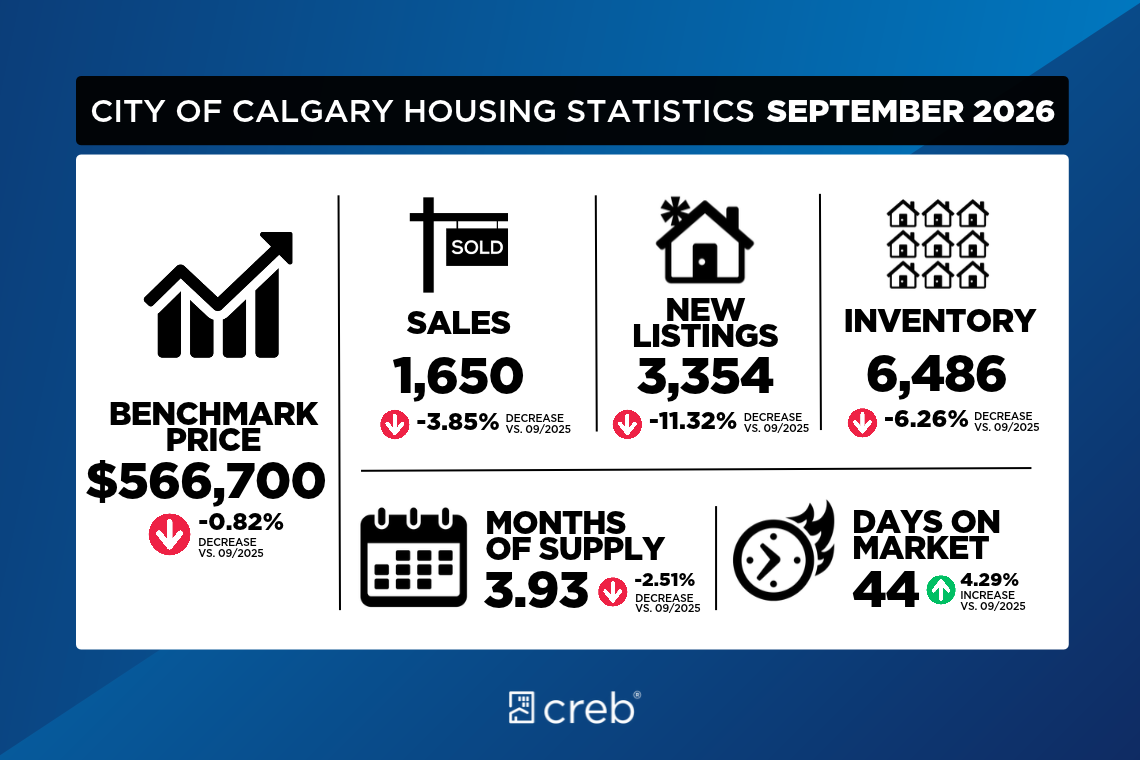
Calgary's residential market registered 1,650 sales in September, down 3.8% year-over-year, according to the Calgary Real Estate Board (CREB).
The overall figure masks a more telling story. The city's housing market is bifurcating sharply by property type, with detached homes holding their footing while higher-density segments absorb the cumulative weight of a prolonged construction surplus.
The residential benchmark price fell to $566,700, down roughly 1% from September 2025. New listings reached 3,354, an 11.3% annual decline, while total inventory stood at 6,486 homes, 6.3% below year-earlier levels.
The sales-to-new-listings ratio settled at 49%, with just under four months of supply, leaving overall conditions broadly stable relative to August.
Detached holds; high-density sags
Detached home sales rose to 896 units in September, up more than 4% year-over-year, while the benchmark price edged down 1% to $739,400.
A sales-to-new-listings ratio of 52% and just over three months of supply kept the segment broadly balanced, though district-level divergence persisted. The North East edged toward six months of supply while the North West, West, and South districts all remained below three months.
The apartment condominium segment offered a starkly different picture. Just 343 units changed hands, a 14% year-over-year decline. The benchmark price fell to $291,400, more than 8% below September 2025.
Months of supply sat just above five. Row homes also weakened, with the benchmark price declining nearly 6% to $412,400 and months of supply rising above four for the first time in 2026.
CREB chief economist Ann-Marie Lurie attributed the split to a construction cycle skewed toward higher density.
"The construction boom over the past three years was mostly driven by gains in higher-density sectors, significantly increasing the supply of apartment and row-style homes," Lurie said.
"Meanwhile, detached homes did not see the same boost in construction, preventing broad-based supply growth. Thanks to a stronger job market and slower but positive net migration, housing demand has remained strong enough to absorb some of the supply, but not enough to offset the high-density supply added to the market, resulting in a more significant impact on prices for higher-density homes."
What this means for brokers
The softening condo market carries practical financing risks for mortgage professionals.
Condo appraisal gaps have been testing deal closings across Calgary as thinning transaction volumes leave appraisers with fewer comparable sales to reference. Calgary broker Marko Gelo noted earlier in 2026 that appraisals coming in below purchase price had become increasingly common in the condo segment.
The pattern mirrors what Edmonton's housing market data revealed in May, where detached gains masked a deepening condo slump across Alberta's two largest centres simultaneously.
Brokers who were cautiously optimistic about Calgary's housing prospects heading into 2026 may now need to revisit appraisal assumptions and affordability buffers for high-density files ahead of Q4.
CREB noted that seasonally adjusted prices held relatively steady against August, suggesting a portion of September's declines reflects typical fall behaviour. However, year-over-year trends for apartments and row homes remain firmly negative.
Make sure to get all the latest news to your inbox on Canada’s mortgage and housing markets by signing up for our free daily newsletter here.