The numbers look strong, but not where brokers need them most

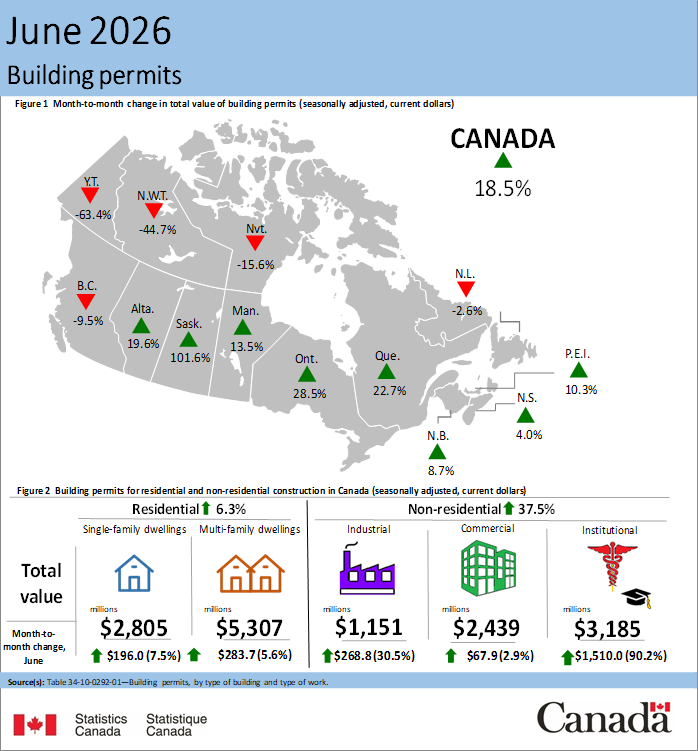
Canada's total value of building permits rebounded $2.3 billion to $14.9 billion in June. That's an 18.5% monthly increase that more than erased the combined declines recorded in April and May, according to Statistics Canada.
The reversal was driven overwhelmingly by the non-residential sector, which climbed $1.8 billion to $6.8 billion, while the residential sector contributed a more modest $479.7 million gain to reach $8.1 billion.
On a constant dollar basis (2023=100), the total value of building permits rose 18.0% from May and was up 18.6% year-over-year, a notable sign of strength for a segment of the construction pipeline that has otherwise sent mixed signals through the first half of the year.
Residential rebound masked by a soft second quarter
Residential construction intentions rose 6.3% in June to $8.1 billion, with the multi-unit component climbing $283.7 million to $5.3 billion. Quebec led multi-unit gains at $201.3 million, followed by Alberta at $143.4 million and Saskatchewan at $61.4 million.
Single-family permits added $196.0 million to reach $2.8 billion, with Alberta contributing the most at $110.8 million. British Columbia registered a $30.8 million decline across the single-family component.
The monthly bounce, however, sits against a weaker second-quarter picture. In Q2 2026, residential permits fell $944.2 million, or 4.3%, in constant dollars to $21.1 billion, with the multi-unit component accounting for most of the drop.
Nationwide, 80,000 housing units were authorized in the quarter, down from 82,200 during the same period in 2025.
Non-residential permits told a different story for the quarter. In constant dollars, they climbed $1.9 billion to $15.4 billion in Q2 2026, the largest quarterly increase in the series. The national institutional component reached a record high of $6.1 billion.
Analysis of modular and factory-built construction methods has highlighted the structural challenge of converting approved permits into completed housing supply at the pace Canada's affordability crisis demands.
Toronto medical project anchors institutional jump
The non-residential surge was led by the institutional component, which jumped $1.5 billion to $3.2 billion. Ontario accounted for $1.3 billion of that gain, with the increase concentrated in the Toronto census metropolitan area (CMA), where newly approved permits for a medical institution pushed the city's total to $4.01 billion. That's up 73.3% from May and 84.3% higher than June 2025.
The industrial component added $268.8 million to reach $1.2 billion, led by Saskatchewan at $189.5 million, followed by Ontario at $104.2 million.
For mortgage professionals tracking supply signals, Canada's housing starts continued to slide through the same period, raising questions about whether permitted projects will translate into actual construction activity — a gap that Canada Mortgage and Housing Corporation (CMHC) has flagged as a key forward risk.
Monthly housing starts data from CMHC underscores how the permit-to-start conversion rate has deteriorated as financing pressures, labour shortages, and weak presale demand weigh on the broader construction outlook.
Make sure to get all the latest news to your inbox on Canada’s mortgage and housing markets by signing up for our free daily newsletter here.