A year and a half of declining rents still hasn't solved Canada's rental problem

Average asking rents in Canada retreated to their lowest level for June in four years last month, according to a joint analysis by Rentals.ca and Urbanation. However, the pullback has done little to ease the affordability pressures renters continue to report on the ground.
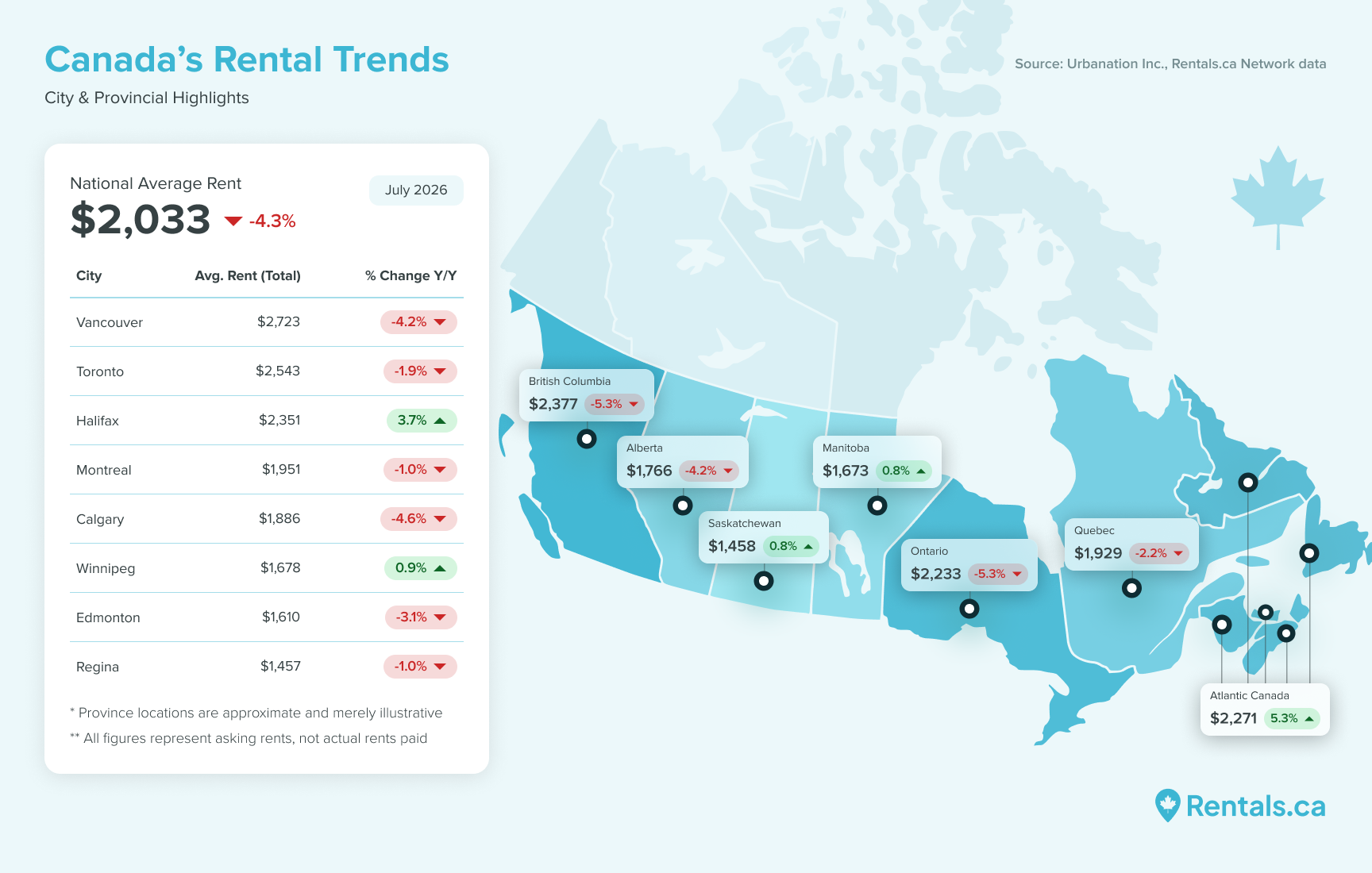
The national average asking rent reached $2,033 in June 2026, a 4.3% decline from June 2025, according to the Rentals.ca and Urbanation June 2026 National Rent Report.
The figure marks the 21st consecutive month of year-over-year declines and extends a two-year slide that has erased 6.9% from the national average. Month-over-month, rents edged up 0.2% from May 2026.
Despite the headline retreat, a spring 2026 renter survey conducted by Rentals.ca found that around 70% of respondents identified high rent prices as the biggest obstacle in their housing search. Concerns about unsuitable listings trailed at 11%, while low rental supply was cited by just 6%.
Mathieu Laberge, chief economist and senior vice-president of housing insights at Canada Mortgage and Housing Corporation (CMHC), previously made clear that the direction of asking rents does not wipe out the damage of recent years.
"Even with these improvements, we cannot overlook how much housing affordability has eroded in recent years, especially in Ottawa, Montréal and Halifax," Laberge said.
Provinces split as Atlantic Canada bucks the trend
The breakdown by property type showed purpose-built apartments falling 3.1% year-over-year to an average of $2,034 in June 2026, while condominium apartments dropped 6.8% to $2,058, according to the Rentals.ca and Urbanation report.
Secondary market units, including houses and townhouses, recorded the steepest annual decline, down 7.4% to $2,017.
At the provincial level, British Columbia and Ontario led the national retreat, each posting a 5.3% year-over-year decline to average asking rents of $2,377 and $2,233, respectively.
Alberta fell 4.2% to $1,766, while Quebec saw a 2.2% drop to $1,929. The sole regional exception was Atlantic Canada, where average asking prices rose 5.3% to $2,271.
Manitoba and Saskatchewan each posted a 0.8% month-over-month increase, reaching average asks of $1,673 and $1,458, respectively.
Affordability challenges remain and will take time to address
The broader supply picture helps explain why asking rent declines have not translated into a felt improvement. A CMHC mid-year rental market update released in June 2026 found that vacancy increases are concentrated in newer, more expensive buildings, with older stabilised stock and family-sized units remaining tight.
"Recent supply growth is improving choice in some segments — particularly newer, more expensive units," said Tania Bourassa-Ochoa, deputy chief economist at CMHC.
"However, persistently tight conditions in lower segments highlight that affordability challenges remain and will take time to address."
Make sure to get all the latest news to your inbox on Canada’s mortgage and housing markets by signing up for our free daily newsletter here.