Rising costs, payday super and a surcharging ban are eroding resilience – but brokers can help navigate the turbulent waters

Australian SMEs are losing confidence in their ability to stay cashflow positive, with a new report from Prospa and YouGov revealing a significant drop in optimism as rising costs and sweeping regulatory reforms converge.
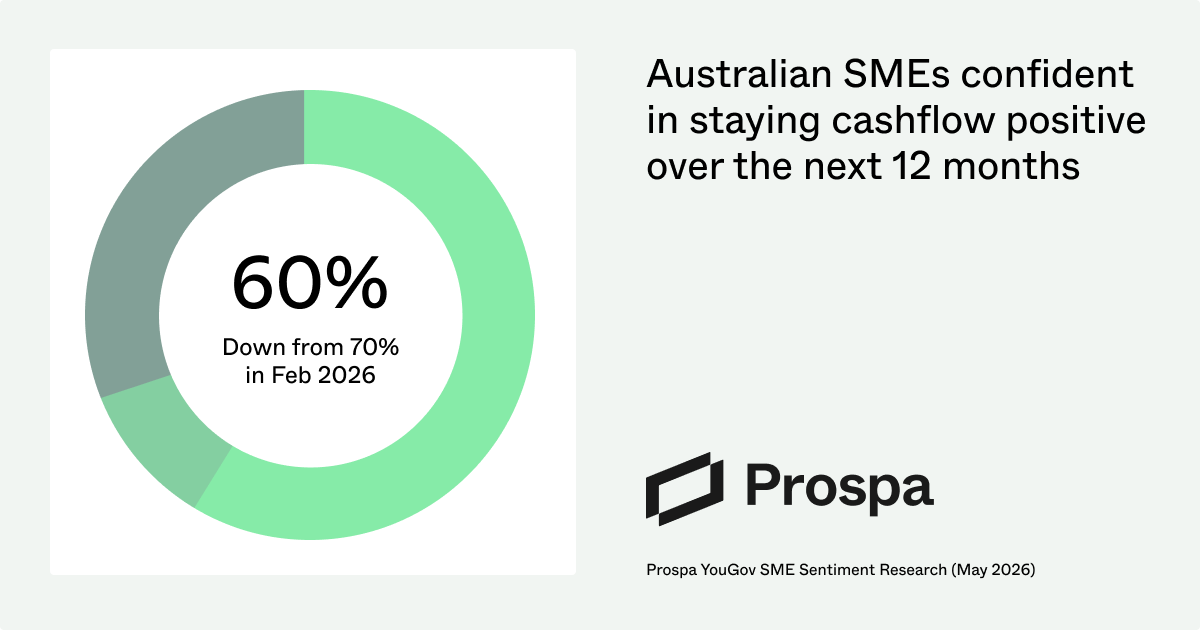
The Prospa SME Sentiment Report for May 2026 found that 60% of SMEs are confident they can remain cashflow positive over the next 12 months – down sharply from 70% in February. Among that group, the proportion feeling "very confident" fell from 32% to just 24%, signalling a meaningful erosion of business resilience across the sector.
The survey of 500 Australian business owners was conducted by YouGov between 30 April and 14 May. It found that nearly half of all SMEs have increased prices in the past three months to offset rising input costs, underlining how persistently inflation is biting into business margins. Sole traders are feeling the strain most acutely, with nearly one in five reporting they hold no cash reserves at all.
Three in ten SMEs expect to access external funding in the next 12 months, with the average amount sought sitting at approximately $23,000.
Roberto Sanz (pictured, top), general manager sales and partnerships at Prospa, said the data points to a clear opportunity for mortgage and finance brokers to step in as strategic advisers.
"What's interesting is the gap between sole traders and larger SMEs. Sole traders are less likely to seek funding, but they're also the ones with the thinnest buffers,” said Sanz. “There's an education opportunity there for brokers, helping those smaller operators understand that accessing the right funding at the right time is about protecting cashflow, not just filling a gap."
Payday super readiness a growing concern
As previously reported by MPA, upcoming payday super changes represent a major – yet not-fully-understood – cashflow headwind for SMEs.
Read more: SMEs are heading into payday super storm unprepared – how can brokers help?
From 1 July, all employers, including small business owners, will be required to pay employees’ super contributions at the same time as their wages. It will replace the current system of paying super contributions quarterly.
While the changes sound benign, “this is expected to substantially impact small business cashflow at a time many business owners are still feeling the pressure from higher inflation,” Prospa said in March.
Thankfully, awareness of the changes has improved since February, when 41% of SMEs lacked a full understanding of the reform, including 30% who were entirely unaware. By May, the unaware proportion had fallen to 25%, with a further 11% still not fully across the details.
But readiness has not kept pace. The share of SMEs reporting they are not prepared has risen from 19% in February to 23% in May, with a further 14% still unsure – meaning nearly four in ten are heading into the 1 July 2026 deadline unprepared.
"Payday super is one of the biggest compliance shifts for SMEs in years, and the data shows a lot of businesses still aren't ready," Sanz said. "Nearly four in ten aren't prepared or aren't sure, and one in five have already pulled back on investment because of it. That's a cashflow planning conversation brokers should be leading right now. The ones who get in front of it will strengthen those client relationships heading into the new financial year."
Surcharging ban adding uncertainty
A further layer of disruption is building ahead of the ban on card surcharging, set to take effect from 1 October. Among the 62% of SMEs that accept card payments through a merchant payment service, more than half expect the ban to affect how they price their goods and services. While 41% anticipate only slight price increases, 13% say they will need to raise prices significantly. Two in five plan to absorb the cost entirely.
"What we're seeing is a really deliberate approach," said Prospa co-founder and chief revenue officer Beau Bertoli. "Business owners are making practical decisions to protect cashflow, whether that's adjusting prices, holding off on investment, or reassessing how they manage upcoming changes like payday super and surcharging. The risk isn't just the rule changes themselves. It's the gap between awareness and readiness."
AI adoption rising, but unevenly
SMEs are increasingly turning to technology to stay competitive. Around half say they have used or implemented artificial intelligence tools in the past six months, most commonly AI-powered assistants (34%), to manage administration or predict cashflow gaps.
But that adoption is not uniform. Sole traders are significantly less likely to be using AI tools – 40% compared to 62% of larger SMEs – pointing to a deepening divide between more established businesses and the smallest operators.
"Half of all SMEs are now using AI tools to manage admin or forecast cashflow. That tells you these businesses are looking for smarter ways to operate," Sanz said. "Brokers who understand that shift and position themselves as strategic partners – not just transaction facilitators – are the ones who will win in this environment."
Bertoli summarised the mood among SMEs as less about expansion and more about “staying liquid, compliant and flexible”. He added: “The businesses that plan early, model their cashflow properly and get the right support will be in the strongest position heading into the new financial year.”