Net outflow from capital cities to regional areas reaches its highest level since the Regional Movers Index began

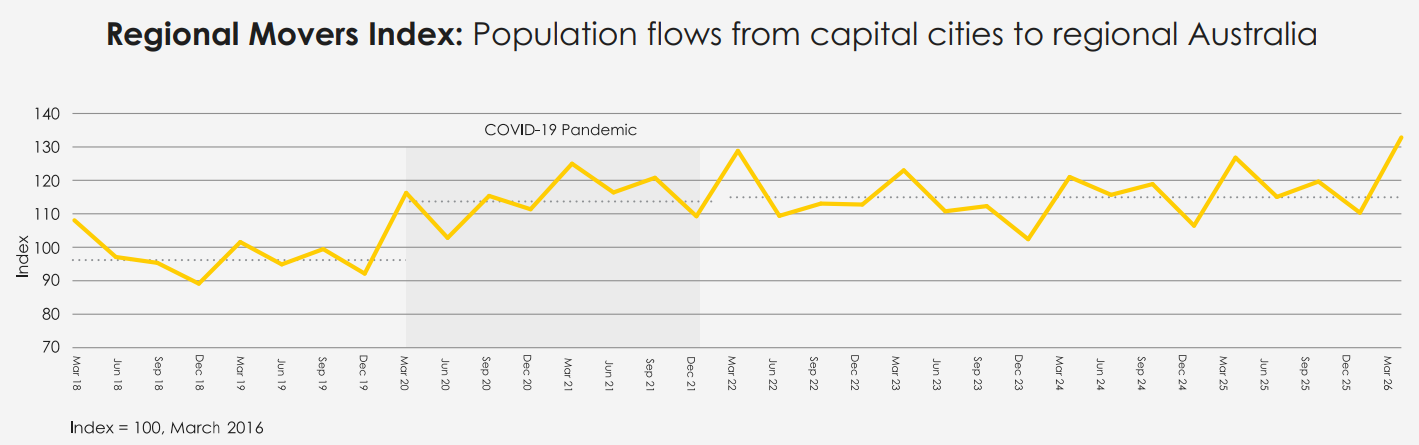
Australia's shift toward regional living has reached a record high, with the Regional Movers Index (RMI) for the March 2026 quarter registering its strongest result since the index was established.
The RMI, a joint initiative between Commonwealth Bank of Australia (CBA) and the Regional Australia Institute (RAI), tracks population flows between capital cities and regional areas. The index rose 20.1% from the December 2025 quarter and was 4.7% higher than the same period a year earlier. Capital city residents relocating to regional areas outnumbered those moving in the opposite direction by 29.7%.
"This is the highest level of capital to regional movement the RMI has ever recorded," said Liz Ritchie, chief executive of the Regional Australia Institute. "Australians are continuing to choose regional life in greater numbers, even as economic conditions shift.
"Across COVID, inflation, housing pressures and tight labour markets, the trend has been remarkably consistent - people are leaving capital cities for regions, and they're doing so at increasing rates."
Sydney and Melbourne accounted for 55% and 36% of net outflows respectively in the March quarter, though their combined share has declined from a year ago as Brisbane, Perth and Adelaide each recorded a larger proportion of net outflows — indicating that capital city departures are becoming more broadly distributed across the country.
The Sunshine Coast retained its position as the most popular regional destination, capturing 8.8% of total net migration. Greater Geelong (VIC) remained in the top five with a 5.3% share, while Fraser Coast (QLD), Moorabool (VIC) and Lake Macquarie (NSW) completed the five most sought-after destinations.
Growth hotspots spread across states
Data from the March quarter report points to population growth emerging across a wider range of regional communities. Toowoomba recorded the strongest year-on-year growth in net inflows from capital cities of any local government area in Australia, with the Queensland centre also attracting movement from other regional areas. Other destinations drawing city residents include Broome (WA), Townsville (QLD) and the Mid-Coast region of NSW. Meander Valley (TAS), Douglas (far-north QLD) and Central Goldfields (VIC) were among locations recording increased movement between regional communities.
 "This data is extremely valuable and underscores the original purpose of the RMI," Ritchie (pictured right) said. "We're not just tracking movement but providing early indications of where regional growth is emerging, so government, investors, industry and communities can respond before pressure builds. It helps identify the places that are emerging as hotspots that may need new thinking around housing and infrastructure."
Implications for regional business lending
Kylie Allen, executive general manager of regional and agribusiness banking at Commonwealth Bank of Australia, said the record result reflected sustained confidence in regional Australia among households and businesses alike.
"This is a significant milestone, and the data shows Australians are making long term, considered decisions to build their lives in regional communities," Allen said. "What stands out this quarter is the scale of movement we're seeing, both from capital cities and between regional communities. It reinforces the role that regional centres like Toowoomba play as important hubs, supporting surrounding towns through jobs, services and local business activity.
"For many regional businesses, this creates opportunities to respond to a larger and more diverse customer base. We're seeing that reflected in our business lending, with businesses investing to support larger populations and increased economic activity across their regions."
Want to be regularly updated with mortgage news and features? Get exclusive interviews, breaking news, and industry events in your inbox – subscribe to our FREE daily newsletter. You can also follow us on Facebook, X (formerly Twitter), and LinkedIn.