Roy Morgan models two more hikes taking the cash rate to 5.1%

Almost a third of Australian owner-occupier mortgage holders were at risk of mortgage stress in the three months to September 2026, according to new Roy Morgan research. The firm warns that further cash rate rises could push the figure close to its 2008 peak.
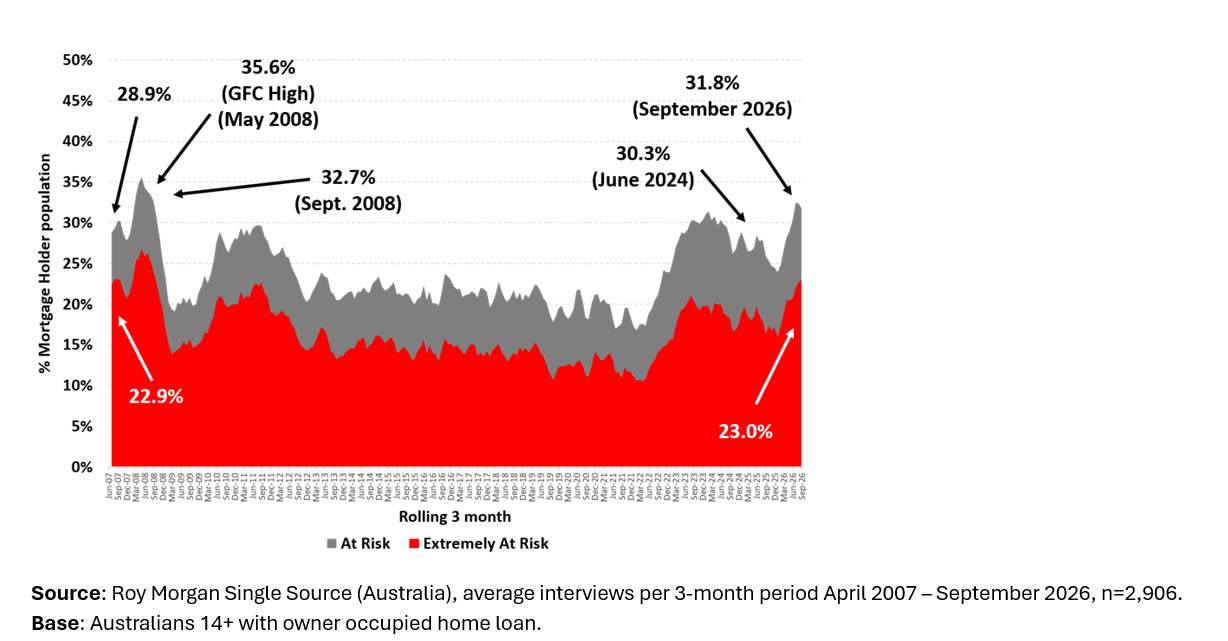
The share considered “at risk” was 31.8%, or about 1.75 million people. That was 0.5 percentage points lower than in August but 7.9 points higher than in January, after the Reserve Bank (RBA) lifted rates in February, March, and May. Its fourth increase, in late September, took the cash rate to 4.6%, which was too late to affect most of the survey period.
“Mortgage stress is just one indicator of the pressure Australians are under,” said Roy Morgan chief executive Michele Levine (pictured).
Incomes offer brief relief
Levine attributed the slight easing in September to higher household incomes among mortgage holders. However, she said rate rises, falling house prices in some key markets, and a smaller workforce had steadily added to the strain.
A record 1.26 million mortgage holders, or 23%, were “extremely at risk”, meaning even their interest-only repayments would take up a large share of their income. That is well above the two-decade average of 16.5%.
The RBA takes a more measured view. Its October 2026 Financial Stability Review found most mortgaged households remain well placed to handle tougher conditions, even if house prices fell sharply, though it flagged pockets of stress.
Modelling points higher
Annual inflation was 4% in the year to August 2026, above the RBA’s 2–3% target band. With that in mind, Roy Morgan modelled the effect of two further 0.25 percentage point hikes.
“Concerningly, inflation pressures in the Australian economy persist”, Levine said.
Inflation has since run hotter. Australian Bureau of Statistics figures show the consumer price index rose 4.3% in the year to September, with housing the largest contributor.
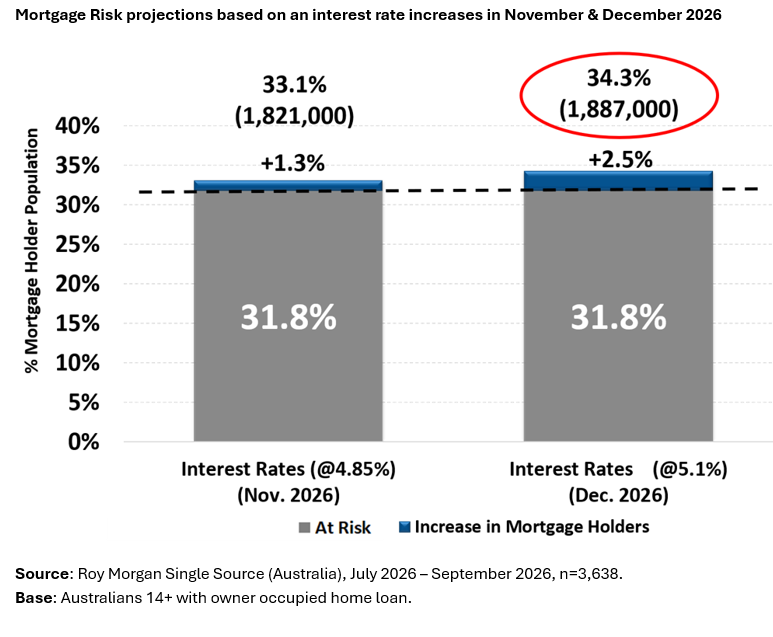
Under Roy Morgan’s modelling, a rise to 4.85% in early November would lift the at-risk share to 33.1%, or 1.82 million mortgage holders. A December move to 5.1% would take it to 34.3%, or 1.89 million. Both would be records in absolute numbers, though still below the 35.6% peak of 2008, when the cash rate reached 7.25%.
Levine said that in that scenario “the level of mortgage stress would be at its highest rate since June 2008”.
Jobs remain the bigger risk
Roy Morgan’s projections change only the cash rate, leaving incomes and jobs as they are. The firm estimates 3.04 million Australians, or 19.4% of the workforce, are unemployed or under-employed. It stresses that losing a job or main income source does more damage to a household’s ability to repay than any rate change.