…there’s a catch. It’s because established-home lending has collapsed, not because new-build lending has grown

The federal government wanted its negative gearing changes to push investors towards new housing. The latest lending data suggests the policy may be changing the mix of investor loans, but not yet the the important number – how many new homes are being financed.
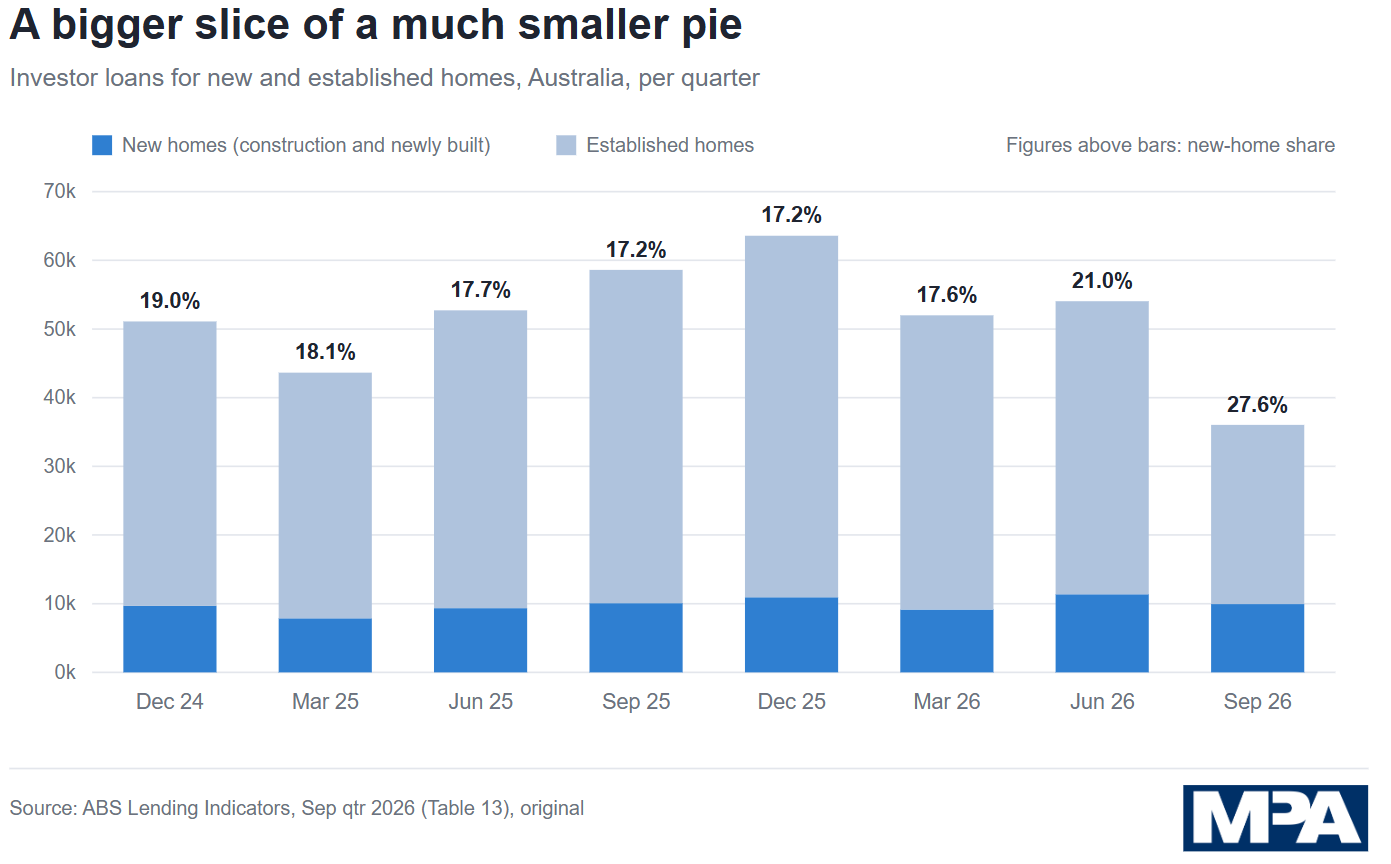
New homes made up 27.6% of investor loans for construction and dwelling purchases in the September quarter, according to figures in the Australian Bureau of Statistics lending indicators released on Wednesday. That is up from about 21% in June and 17.2% a year earlier, and is the highest share since the detailed series began in 2019. The previous high, 22.4%, came during the pandemic in the June quarter of 2020.
But the count of new-build investor loans actually fell. Investors took out 9,942 loans to build or buy a new home in the quarter, down 12.5% on a revised 11,368 in June. Construction loans fell 16.3% to 7,417, while loans to buy newly built dwellings were flat at 2,525.
The share jumped because lending for established homes went through the floor. Investor loans for existing dwellings dropped 38.8% to 26,098.
A record fall overall
The shift has come along with the biggest quarterly drop in investor lending the ABS has everrecorded. In seasonally adjusted terms, the number of new investor loans fell 30.6% to 35,301 and the value fell 32.3% to $24.7 billion, the third straight quarterly decline.
The pattern is consistent with what Ray White chief economist Nerida Conisbee found when the June quarter figures came out. Her analysis showed the rising new-home share was driven by investors leaving established property rather than a surge into new builds. As she put it then: “Redirecting investors towards new homes is not the same as getting more homes built.”
The September numbers make the same point more starkly.
Where the switch is strongest
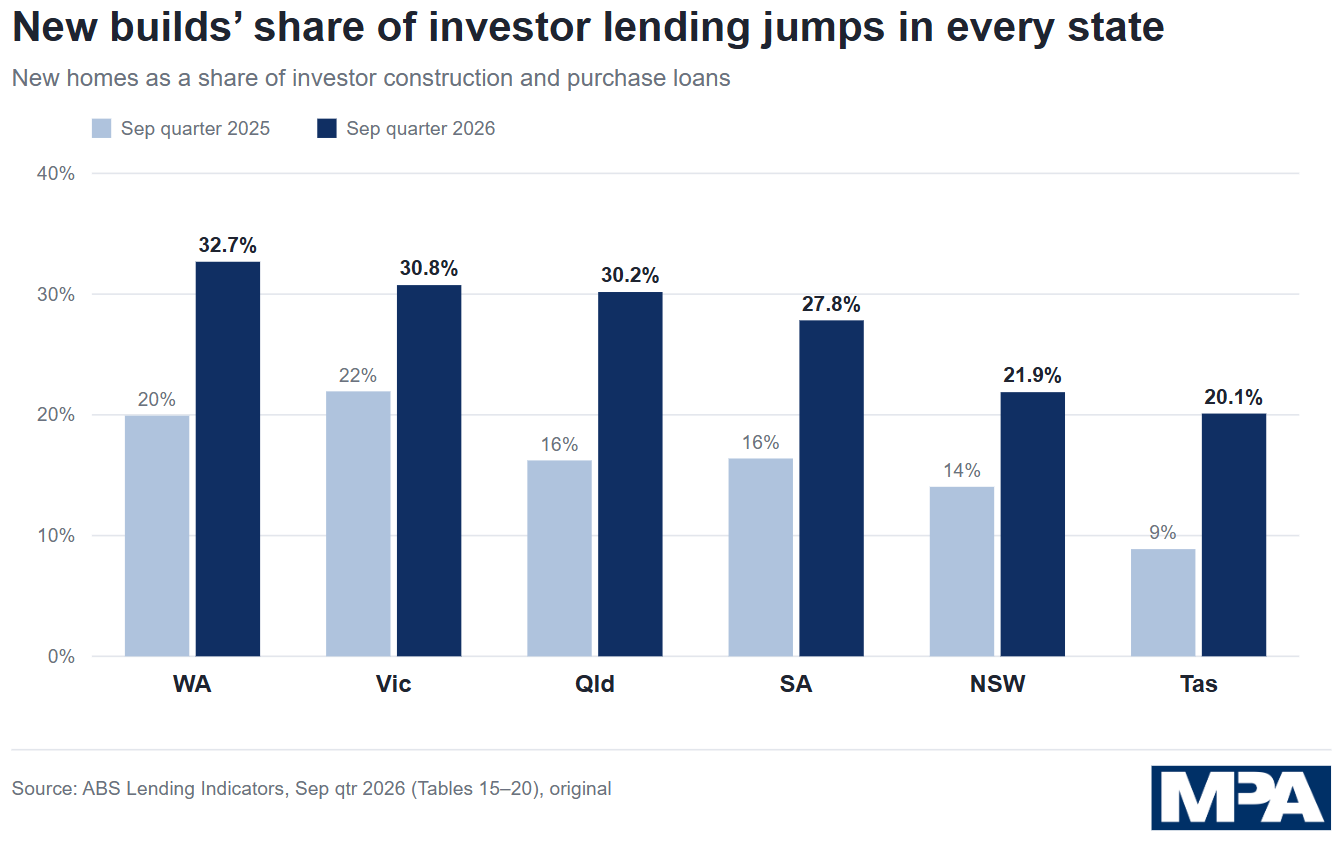
The move towards new stock is most pronounced outside New South Wales. In Western Australia, new homes made up 32.7% of investor construction and purchase loans in the quarter. Victoria was at 30.8%, Queensland at 30.2% and South Australia at 27.8%.
Queensland and South Australia are also the only large states where the number of new-build investor loans is clearly higher than a year ago, up 8.8% and 10.4% respectively. In New South Wales, new-build investor loans were down 13.9% on a year earlier, and new homes accounted for just 21.9% of investor loans, the lowest of any state except Tasmania.
Developers are borrowing more
The household figures tell only half the story – and there is a silver lining to all this as at least one sector has maintained demand. On the business side, fixed-term lending for construction hit a record $17.2 billion in the September quarter, seasonally adjusted, up 27.6% on June and 51.8% on a year ago. Business loans to build dwellings also reached a record, at $8.3 billion.
That suggests developer-side finance is picking up even as investor construction loans dip. Whether those projects find enough investor buyers is another question, given presales have traditionally relied on investors.
Why it is happening
Under the budget package confirmed in May, negative gearing on residential property will be limited to new builds from 1 July 2027. Established homes bought after budget night lose the ability to offset rental losses against salary income.
Lenders acted well before that start date. The major banks and others, including ING, now only recognise negative gearing in servicing for eligible new builds or properties bought before the cut-off. Lenders have also spelled out what counts as a new build, such as an off-the-plan apartment, a duplex built through a knockdown-rebuild, or construction on vacant land.
Rising rates have deepened the slowdown. The Reserve Bank lifted the cash rate to 4.85% this month.
What brokers should take from it
For brokers, the data confirms that investor work now leans heavily on construction and off-the-plan lending. Mortgage Choice had already reported a sharp rise in construction loan demand in the months after the budget.
That puts a premium on knowing how progress payments, valuations on unbuilt stock, builder checks and sunset clauses work, and on having lenders on the panel that are comfortable with them.
It also means managing expectations. A bigger slice of a much smaller investor market is still a smaller market, and the September figures show the pivot to new builds has not yet made up for what has been lost on established property.