Nearly 1.54 million Australian mortgage holders are now considered at risk as interest rates return to 4.35%

Around three in 10 Australian mortgage holders (29%) were at risk of mortgage stress in the three months to May, a rise of 0.8 percentage points from April and the fourth consecutive monthly increase, Roy Morgan has reported.
The figure, equivalent to 1.538 million people, compares with a record high of 35.6% during the Global Financial Crisis in mid-2008. It is also up by 100,000 on the same period a year earlier, when the Reserve Bank of Australia (RBA) had only recently cut the cash rate to 3.85%.
The increase follows a sequence of RBA rate movements over the past 12 months. The central bank reduced rates in May 2025 and August 2025, each by 25 basis points (bps), before reversing course with increases of 25bps in February, March, and May 2026, returning the cash rate to 4.35% — 50bps above its level a year prior. At its most recent meeting in mid-June, the RBA elected to hold rates steady.
Roy Morgan categorises mortgage holders as either "at risk" — where repayments exceed a defined proportion of household income relative to spending — or "extremely at risk", where even interest-only repayments would breach that threshold. The number classified as extremely at risk now stands at 1,084,000, representing 20.4% of mortgage holders, well above the 20-year long-term average of 16.4%.
Mortgage stress – Percentage of owner-occupied mortgage holders 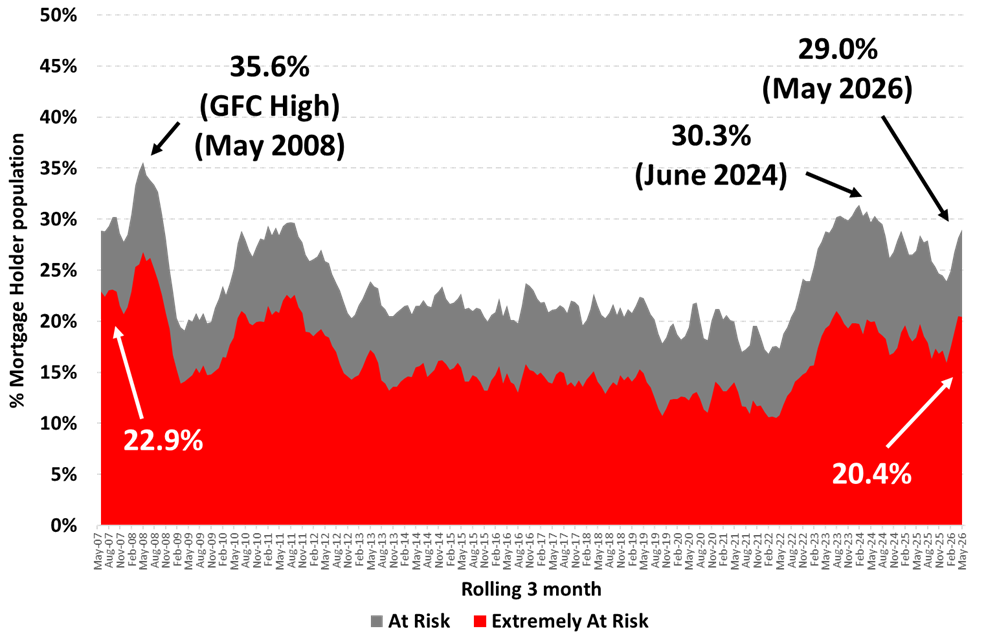 Source: Roy Morgan
The consecutive rate increases earlier this year were driven in part by a sharp rise in inflation, with the Australian Bureau of Statistics (ABS) annual Consumer Price Index (CPI) more than doubling from 1.9% in the year to June 2025 to 4.6% in the year to March 2026.
Roy Morgan has projected the flow-through effects of the May rate rise will continue to push stress levels higher in June (1.553 million mortgage holders, or 29.3%) and July (1.562 million, or 29.5%).
The firm also modelled a hypothetical further RBA rate increase of 25 basis points in August to 4.6%. Under that scenario, the proportion of mortgage holders at risk would rise to 30.2%, equivalent to approximately 1.6 million people — an increase of 62,000 from current levels. A rate of 4.60% would be the highest since November 2011.
Mortgage risk projections based on an interest rate increase in August by 0.25% to 4.6% 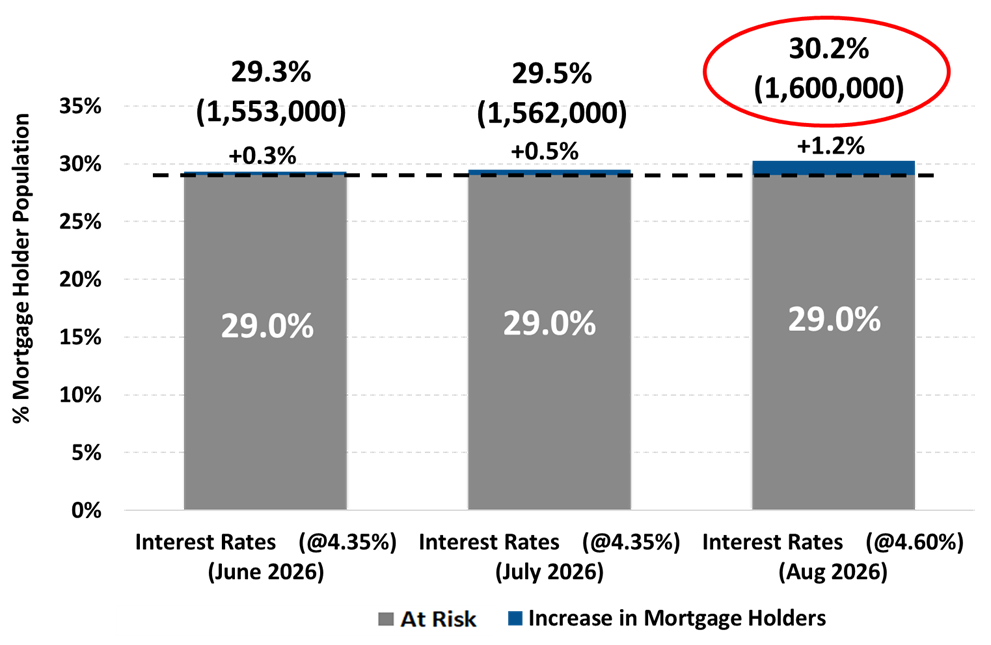 Source: Roy Morgan
However, the latest CPI data for the 12 months to May came in at 4%, down 0.6 percentage points from the March figure, a development Roy Morgan attributed in part to easing tensions in the Middle East and a tentative memorandum of understanding between the United States and Iran that, if finalised, could resume energy flows.
Roy Morgan emphasised that interest rates are not the sole determinant of mortgage stress. The firm's latest unemployment estimates show more than one in five Australian workers — approximately 3,206,000, or 20.2% of the workforce — are either unemployed or underemployed. Roy Morgan estimated "real unemployment" at 1.7 million in May.
 "Mortgage stress is just one indicator of the pressure Australians are under – mortgage stress is up four months in a row, interest rates have increased three times already this year, housing prices are coming down in key markets, and the Australian workforce has shrunk for three straight months," said Michele Levine (pictured right), chief executive of Roy Morgan.
"If the RBA does raise interest rates again in August, the level of mortgage stress would rise to 1.6 million (30.2% of mortgage holders) – up 62,000 (+1.2% points) from now. However, there is good news with regards to inflation and as tensions in the Middle East eased.
"Finally, it is important to appreciate that interest rates are only one of the variables that determines whether a mortgage holder is considered 'At Risk' – the largest impact on whether a borrower falls into the 'At Risk' category is related to household income – which is directly related to employment."
Want to be regularly updated with mortgage news and features? Get exclusive interviews, breaking news, and industry events in your inbox – subscribe to our FREE daily newsletter. You can also follow us on Facebook, X (formerly Twitter), and LinkedIn.