CommBank economist forecasts flat prices nationally in 2026, with declines expected in Sydney and Melbourne

 Australia's housing market is slowing, with higher interest rates, weaker sentiment and recent federal Budget changes combining to dampen buyer and investor activity, according to Commonwealth Bank senior economist Trent Saunders (pictured right).
"Over the past couple of months, we have clearly seen momentum in the housing market slow down," Saunders said. "Price growth has slowed, auction clearance rates have declined and homes are taking longer to sell."
The economist added that while supply, demand and interest rates shape long-term house price trends, sentiment is playing an outsized role in current conditions. "In the short term, sentiment can be a key driver of housing market activity," he said. "When there's uncertainty, buyers and investors often step back, and that can reinforce weaker conditions."
Federal budget changes to negative gearing and capital gains tax have added to existing pressures. "We've seen those three rate hikes from the RBA… and then additional pressure from the budget changes," Saunders said. "It's adding to the pressure that was already there."
The reforms are intended to channel investment into new housing and improve affordability over time, but Saunders cautioned that supply constraints remain a significant obstacle. "Until you address those supply issues, we don't see it making a meaningful dent," he said, pointing to high construction costs, regulatory complexity and infrastructure bottlenecks as key barriers.
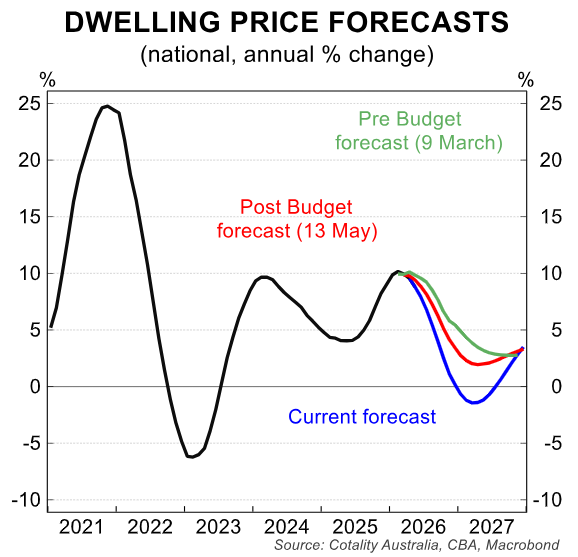 CommBank has also revised its house price outlook downward, now projecting flat national prices across 2026. "We now expect house prices to be flat over the course of this year," Saunders said.
Sydney and Melbourne are expected to record near-term price declines as softer sentiment and reduced investor demand flow through those markets. Brisbane and Perth, where supply and demand are more tightly balanced, are expected to experience a smaller pullback.
On the risk of negative equity for buyers who entered the market ahead of the Budget, Saunders said exposure is likely to remain limited. "It's a possibility that some first-home buyers could be tipped into negative equity, depending on their circumstances," he said. "But we don't expect this to be a widespread issue."
Looking ahead, CBA economists anticipate two Reserve Bank of Australia cash rate cuts in 2026 — in May and August — which Saunders said would ease borrowing constraints and support demand. He expects the housing cycle to reach a turning point in early 2027.
"As more attention shifts towards the possibility of rate cuts, that's when we see market conditions starting to stabilise," he said.
Despite near-term softness, Saunders said the longer-term outlook remains supported by underlying demand, with price growth expected to resume once short-term sentiment headwinds subside.
Want to be regularly updated with mortgage news and features? Get exclusive interviews, breaking news, and industry events in your inbox – subscribe to our FREE daily newsletter. You can also follow us on Facebook, X (formerly Twitter), and LinkedIn.