Apartment approvals fall sharply as Housing Accord shortfall widens

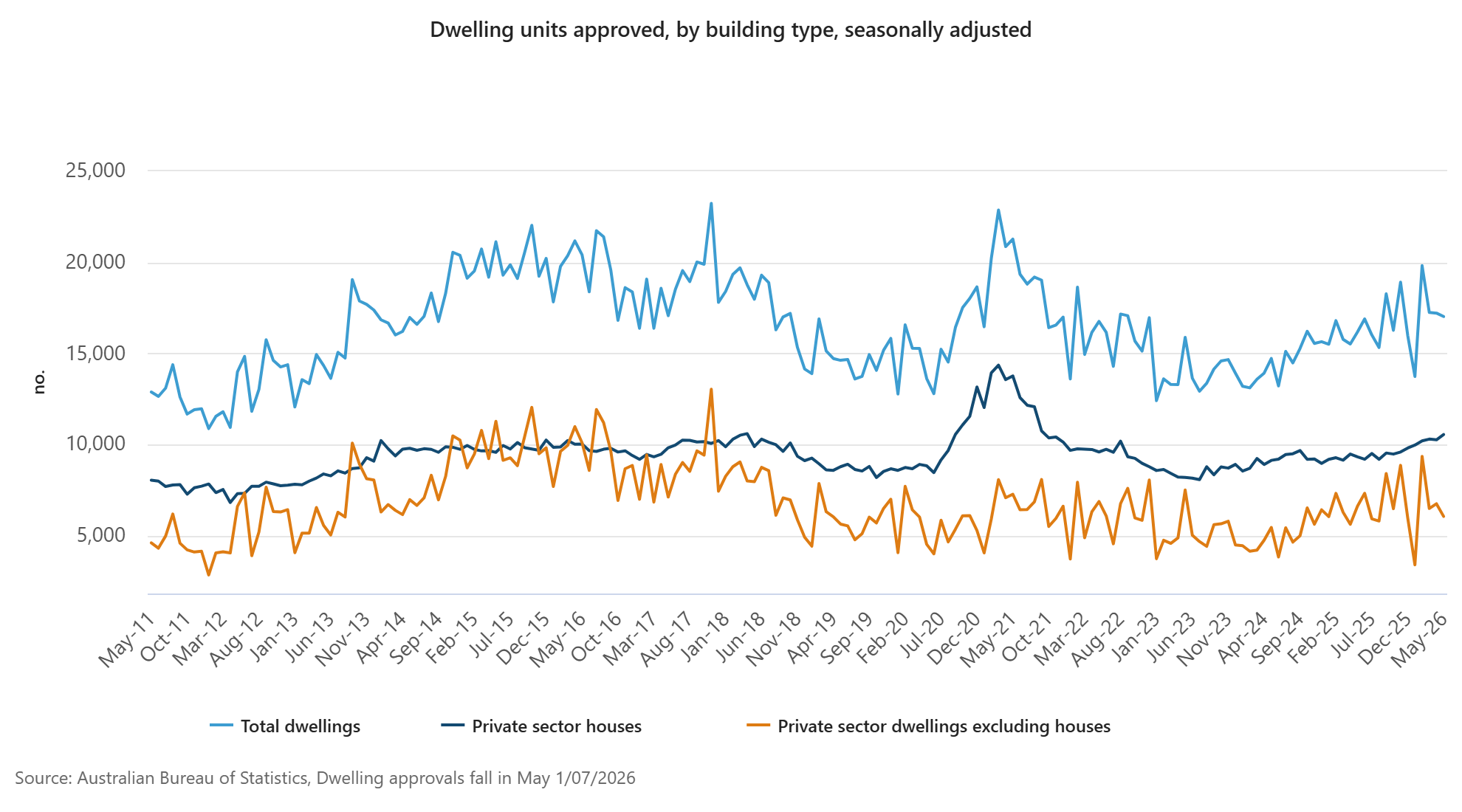
Total dwelling approvals in Australia fell 1.1% in May to 17,019, according to Australian Bureau of Statistics (ABS) data released this week, even as private house approvals reached their strongest monthly level since September 2021.
The decline was driven almost entirely by higher-density dwellings, which dropped 10.4% to 6,034 after a 4% rise in April. Private sector house approvals, by contrast, rose 2.8% to 10,537, marking the fourth straight month above the 10,000 mark and a 13.2% increase on May last year. Overall dwelling approvals remain 5.3% higher year-on-year.
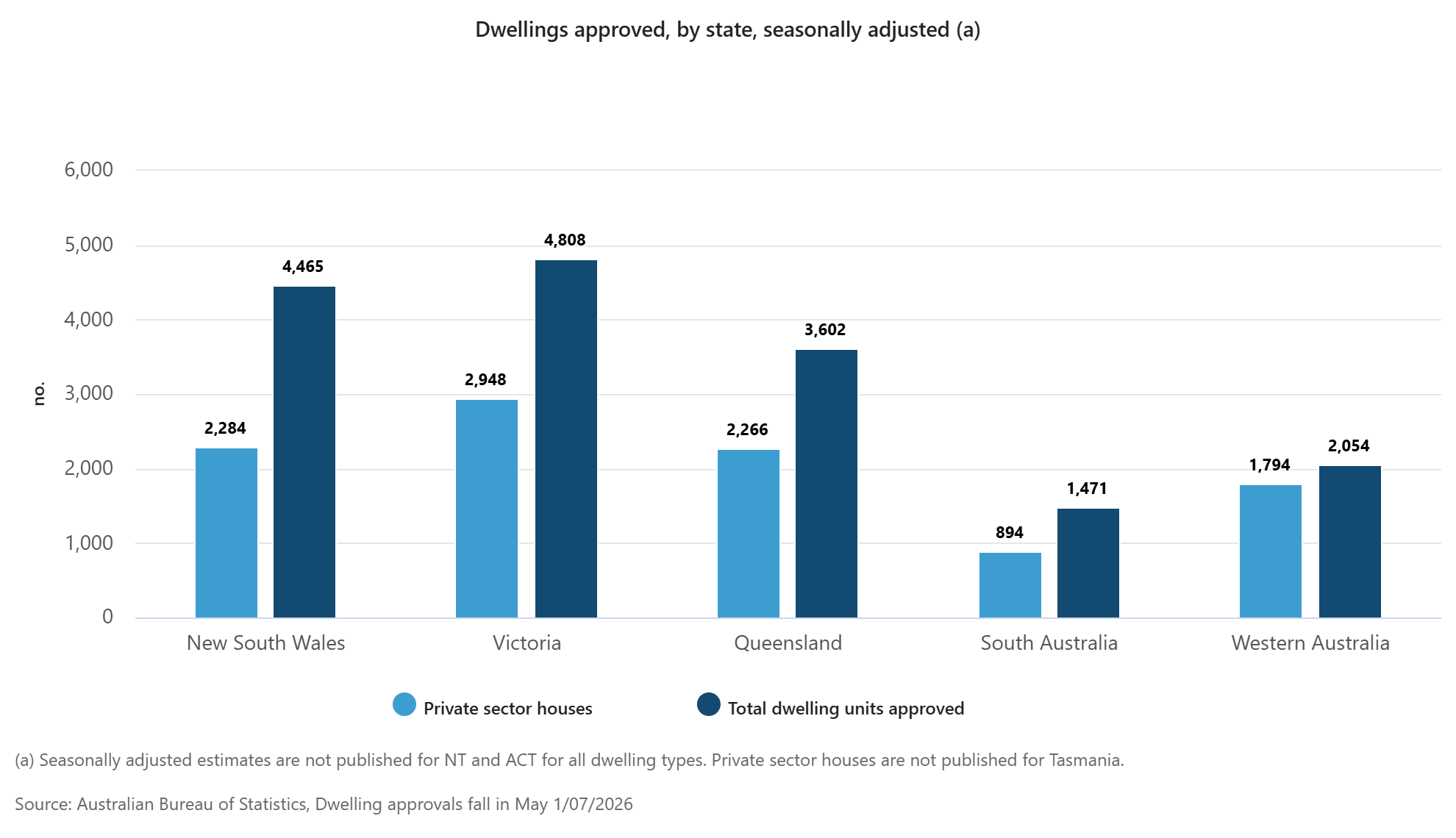
State results were mixed. Western Australia recorded a 9.9% monthly rise in detached house approvals, up 24.5% on May 2025, while New South Wales posted a fourth consecutive month above 2,000 approvals, a 7.8% monthly gain and 24.1% annual increase. Queensland house approvals fell 3.6%, following its strongest result since July 2021 the previous month.
Apartment approvals, measured in original terms, fell 30% to 2,877 dwellings, sitting 29.3% below the prior twelve-month average of 4,070.
The value of total building approved rose 13.6% to a record $21.07 billion, following a 7.9% gain in April. Non-residential approvals climbed 41% to $10.83 billion, a record high attributed largely to data centre projects in New South Wales and Victoria.
Residential building value fell 5.7% to $10.24 billion, with new residential building down 6.6% to $8.88 billion and alterations and additions up 0.1% to $1.35 billion.
The figures were released two years after the launch of the National Housing Accord, which targets 1.2 million new homes nationally. Industry groups said the result underscores a widening gap against that target.

"It is exactly two years to the day since the start of the National Housing Accord," noted Shane Garrett (pictured above, far left), chief economist at Master Builders Australia. "Unfortunately, the Accord's second birthday sees more evidence that we're moving even further away from our homebuilding targets. Annualised data shows a 91,000-homebuilding shortfall has marked the Accord's first two years."
"We need a relentless focus on supply, especially the type that delivers new homes at scale," stressed Matthew Kandelaars (pictured above, second from left), group executive of policy and advocacy at the Property Council of Australia. "Anything less than the true reform needed to unlock supply will lock in years of under delivery when Australians can least afford it."
"When we are so far behind the targets, we need to improving every month, not going backwards," added Tom Forrest (pictured above, second from right), chief executive officer at Urban Taskforce Australia.
"Incremental change will not deliver the National Housing Accord's target of 1.2 million new homes," said Denita Wawn (pictured above, far right), chief executive officer at Master Builders Australia. We need bold, coordinated reform to unlock supply at scale."
Want to be regularly updated with mortgage news and features? Get exclusive interviews, breaking news, and industry events in your inbox – subscribe to our FREE daily newsletter. You can also follow us on Facebook, X (formerly Twitter), and LinkedIn.