Sentiment falls to near-historic lows in June while business survey points to slowing activity

Australian consumer sentiment has fallen to near-historic lows while business confidence, though recovering slightly, remains in negative territory across all industries.
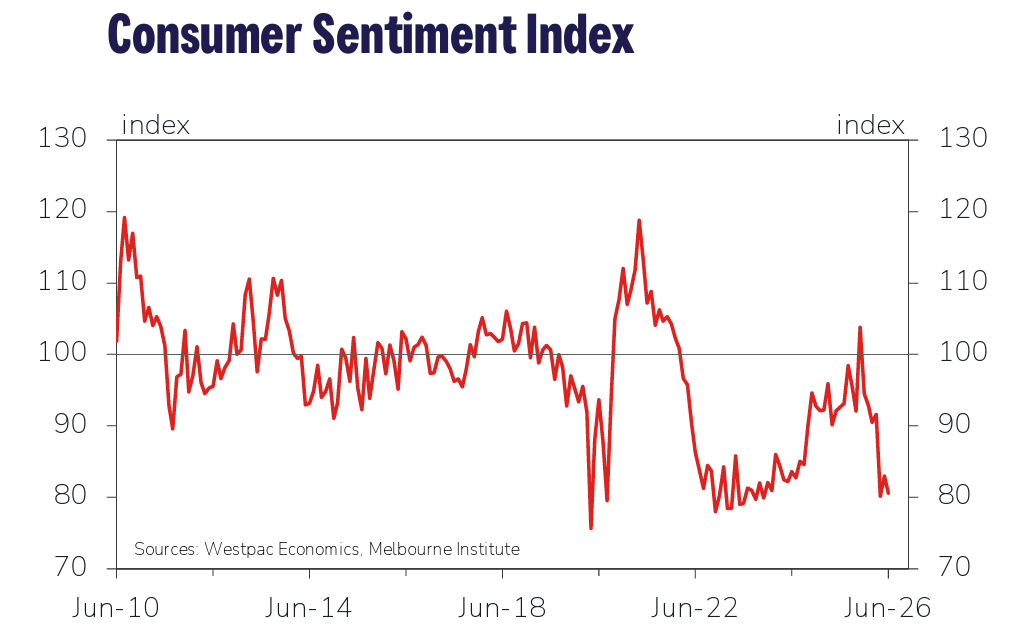
The Westpac–Melbourne Institute Consumer Sentiment Index fell 2.9% to 80.6 in June, from 83 in May, returning to levels among the weakest recorded in the survey's fifty-year history.
 "Australian consumers remain deeply pessimistic," said Matthew Hassan (pictured right), head of Australian macro-forecasting at Westpac. "The sentiment shock that hit back in April eased off a touch in May but has intensified again in June.
"At 80.6, the latest monthly Index read is back amongst the weakest seen in the 50-year history of the survey, pessimists outnumbering optimists by nearly 20%. The survey detail shows cost-of-living issues remain front and centre, the temporary halving in fuel excise tax providing only a small and brief reprieve.
"Meanwhile, other concerns may be starting to emerge with a sharp drop in house price expectations suggesting some consumers are becoming more unsettled about the impact of recently announced tax changes."
Two sub-indexes deteriorated sharply. Family finances versus a year ago fell 7.5% to 67.3, while the 12-month family finances outlook dropped 8.5% to 85.1 — reversing May's gains and returning both measures close to April lows.
"The forward view speaks to particularly acute fears," Hassan said. "Australians are more typically moderately positive about prospects for their finances, with an average index read historically of 106.5. There have been barely a handful of sub-85 reads on this sub-index over the last 50 years, one of which was back in April. Australian consumers are clearly bracing for more bad news on the financial front."
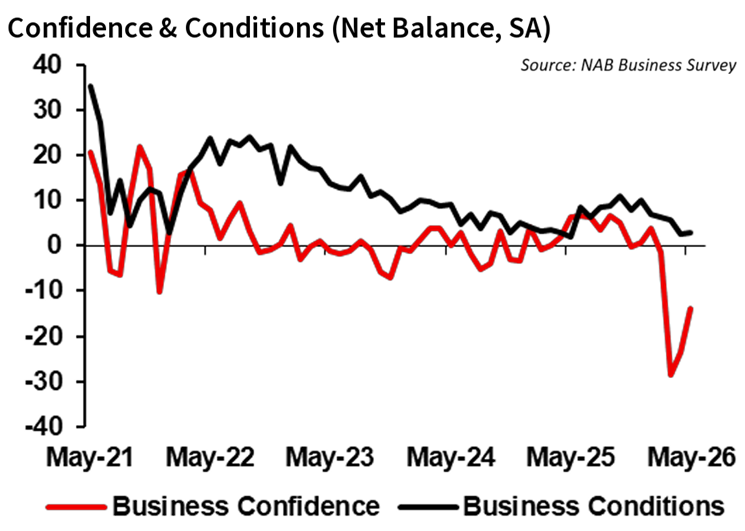
Meanwhile, NAB's Monthly Business Survey showed confidence rising 10 index points to -14 in May, though conditions held steady at a modest three index points.
Capacity utilisation slipped to 81.9%, the first reading below 82% in 12 months, while forward orders and capital expenditure lifted 5 and 6 points respectively. Cost pressures eased, with purchase cost growth slowing to 2.6% in quarterly equivalent terms, labour costs edging down to 1.5%, and product and retail price growth moderating to 0.9% and 1.5% respectively.
 "The shock has clearly been significant, but so far it doesn't look like the disruption to supply chains has been as bad as we had feared," said Gareth Spence (pictured right), head of Australian economics at NAB.
"Conditions have eased since early 2026 but remain positive, and they are not as weak as confidence suggested a month ago. That supports the view that economic growth has slowed since late 2025 but is still moving. We see the same signs in our transactions data, where spending growth has slowed but not fallen away."
On the outlook, Spence cautioned that margin pressures were likely to persist. "Overall, for the RBA, an economy that was overheating appears to have cooled somewhat, with conditions and capacity utilisation trending lower this year as rates have risen. Weak business confidence, and how it flows through to investment and hiring decisions, will remain a key theme in the months ahead."
Want to be regularly updated with mortgage news and features? Get exclusive interviews, breaking news, and industry events in your inbox – subscribe to our FREE daily newsletter. You can also follow us on Facebook, X (formerly Twitter), and LinkedIn.