New Labour Force figures show a loss of 16,000 jobs, with construction industry warning of deepening workforce shortages

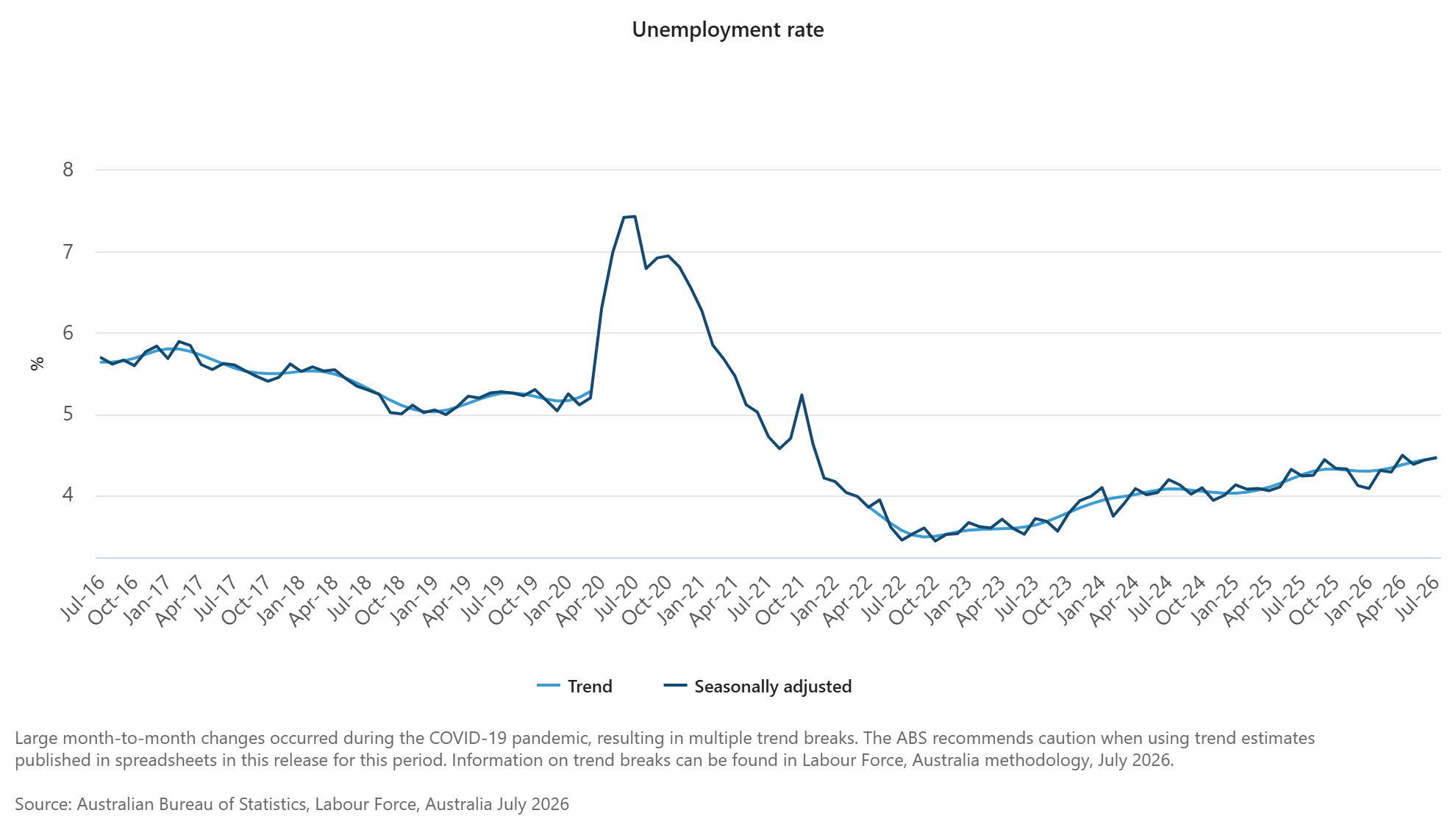
Australia's seasonally adjusted unemployment rate rose to 4.5% in July, up from 4.4% in June, according to figures released by the Australian Bureau of Statistics.
"In July, we recorded a 16,000 person fall in employment, whilst the number of unemployed people rose by 4,000," said Sean Crick, head of labour statistics at the Australian Bureau of Statistics.
"The majority of the fall in employment came from males, which fell by 11,000 people. There were 10,000 fewer males employed part-time, and 1,000 fewer in full-time employment in July.
"Female employment recorded a smaller fall of 5,000, with females employed part-time falling by 22,000 but full-time rising by 17,000."
The employment-to-population ratio and the participation rate each dropped 0.2 percentage points, to 63.9% and 66.9% respectively. The underemployment rate held at 6.4%.
Hours worked declined 0.6% over the month. "There were 12 million less hours worked this month, with those employed full-time working 7 million less hours, and those employed part-time working 5 million less hours," Crick said. New South Wales and Western Australia were the primary contributors, each recording a fall of eight million hours.
On a trend basis, unemployment also edged up to 4.5%, while trend employment grew 0.2% and hours worked fell 0.1%. The trend underutilisation rate rose 0.1 percentage points to 10.8%.
 The construction sector flagged particular concern over the figures. "The labour market typically responds to changes in economic activity with a bit of a delay, and these figures are consistent with the economic pressures that have emerged over recent months," said Shane Garrett (pictured right), chief economist at Master Builders Australia.
"The construction market is being hit from all sides, which is making it even harder to address the industry's significant workforce shortages. We remain short hundreds of thousands of workers, while apprenticeship numbers are at a five-year low.
"This is being influenced by a combination of factors, including three interest rate increases, the conflict in the Middle East and the repercussions of the federal Budget. The loss of part-time jobs is particularly notable because these roles are often among the first to be reduced when businesses become more cautious about costs and future demand."
 Denita Wawn (pictured right), chief executive of Master Builders Australia, called on the federal government to act on workforce capacity ahead of the National Housing Accord's target of 1.2 million new homes by mid-2029.
"Demand for construction work continues to grow, but that demand cannot be realised unless governments create the policy and economic conditions needed to support investment and building activity," she said. "Builders and tradies need certainty that when they take on a contract, they can employ staff and apprentices knowing that their projects are going to remain commercially viable.
"That means improving investment conditions as well as addressing workforce shortages by reversing the Budget's cuts to employer apprenticeship incentives, expanding Fee-Free TAFE funding to include not-for-profit registered training organisations that achieve strong completion rates, and strengthening school-to-trade pathways.
"The entire skilled migration system also needs to be fixed because, at the moment, it is expensive, slow and ineffective, and does not deliver what the community expects. it is imperative construction workers are a priority within the skilled migration system, especially in a housing supply crisis."
Want to be regularly updated with mortgage news and features? Get exclusive interviews, breaking news, and industry events in your inbox – subscribe to our FREE daily newsletter. You can also follow us on Facebook, X (formerly Twitter), and LinkedIn.