Sydney and Melbourne face price falls of up to 8%, Domain forecasts

Australia's property market has entered its ninth downturn in three decades, according to new analysis from Domain, with the real estate platform pointing to a long-established pattern of decline followed by recovery.
Domain expects Sydney house prices to drop by as much as 7% during the 2027 financial year, with Melbourne facing a fall of up to 8%. The platform attributes both declines to higher interest rates, which have curbed borrowing capacity and softened buyer demand.
Although the current slowdown has drawn attention to government policy settings, Domain's data spanning 30 years shows downturns have taken place under every type of policy regime. Interest rates, supply levels, credit conditions and confidence have been the consistent drivers throughout.
Australia has recorded eight completed downturns over the past three decades, and each has been followed by a recovery strong enough to push prices past their previous peaks. Domain's figures show downturns have typically lasted around eight months and averaged a 2.9% fall, while the subsequent upswings have run for close to three years and delivered average growth of 32%.
Annual change in house prices, combined capitals 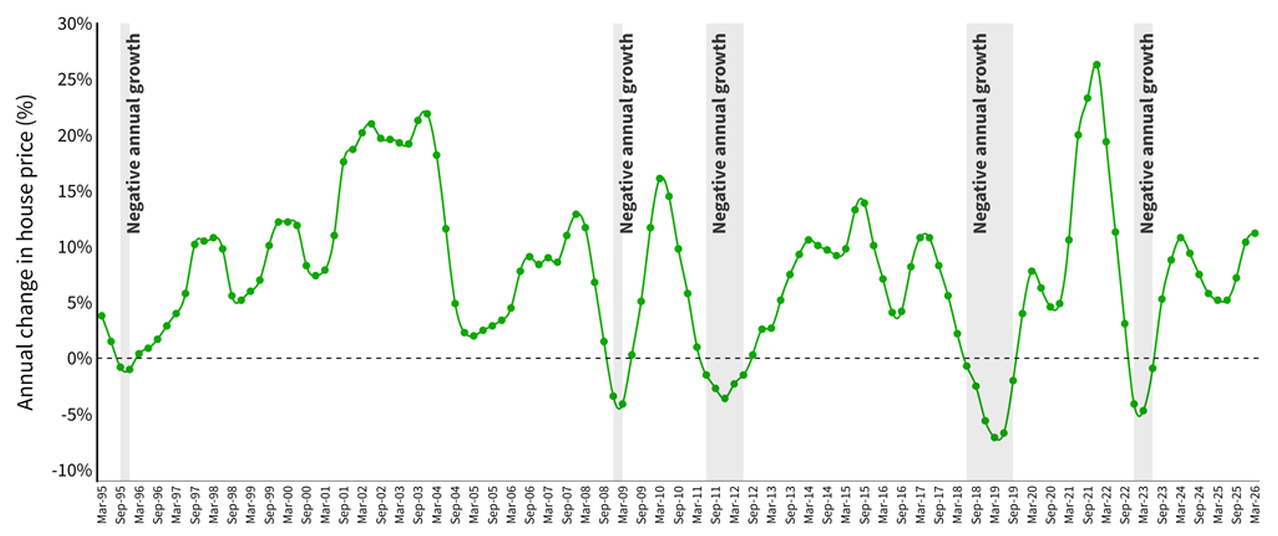 Source: Domain
Sydney and Melbourne are driving the present decline, a reflection of their greater sensitivity to borrowing limits. Brisbane, Adelaide and Perth, meanwhile, are forecast to keep growing.
Domain noted the scale of the current downturn remains limited by historical standards. Combined capital city prices would need to fall by roughly 22.8% to return to their March 2023 trough — a figure well beyond current forecasts and outside the range seen across three decades of housing cycles.
The data also shows downturns have not always involved price falls. In some cycles, growth simply flattened rather than reversed, which Domain says demonstrates that corrections can occur without steep declines. Even the deepest recent downturn, the 2017–19 correction of 8.5% driven by tighter credit conditions, was followed by a swift rebound.
Historic declines of house prices from peak to trough, combined capitals 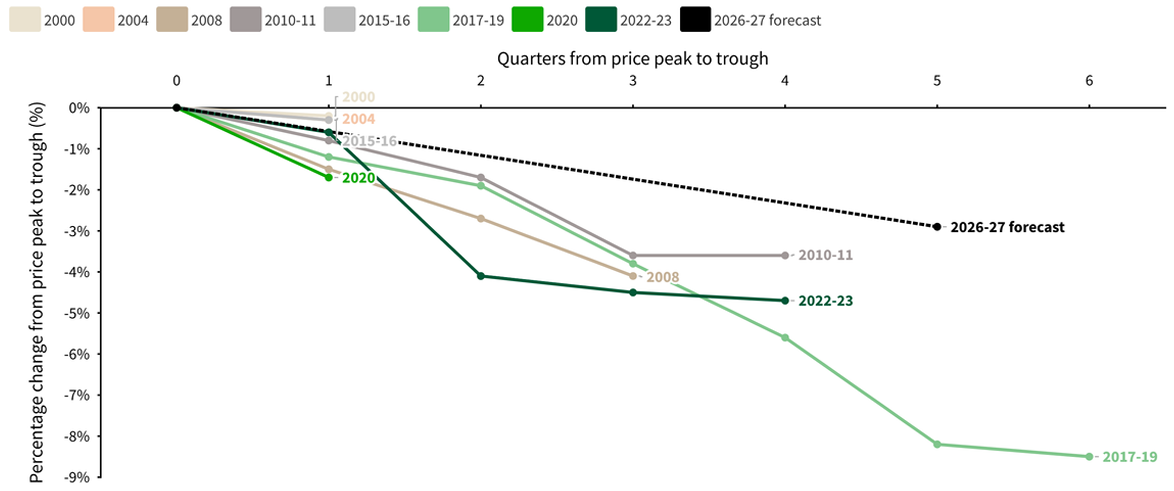 Source: Domain
 “While there's heightened focus on government policy, housing cycles have consistently been driven by interest rates, borrowing capacity and confidence,” said Nicola Powell (pictured right), chief residential economist at Domain.
“Downturns can feel sharp in real time, but historically they've been short and shallow, and have not unwound the gains that preceded them. When the interest rate cycle turns, demand that has been sitting on the sidelines tends to return quickly, bringing the next phase of growth forward.”
Want to be regularly updated with mortgage news and features? Get exclusive interviews, breaking news, and industry events in your inbox – subscribe to our FREE daily newsletter. You can also follow us on Facebook, X (formerly Twitter), and LinkedIn.