Central bank governor balances tariff and oil shocks against a cautious path back to target inflation
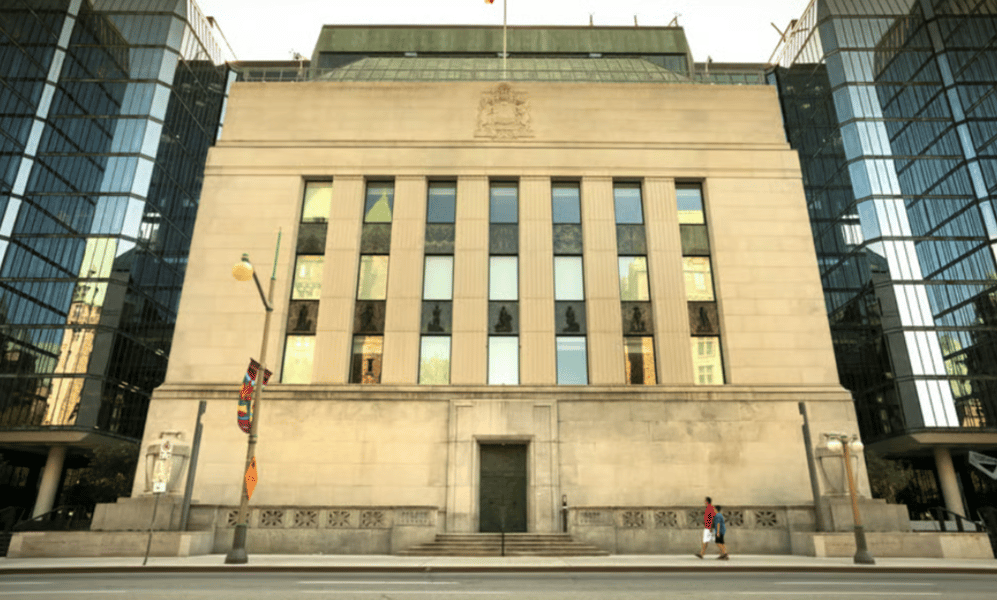
The Bank of Canada signalled that its policy rate path would likely stay close to current settings even as new shocks from oil markets, Middle East tensions and trade policy complicated the outlook for inflation and growth.
The central bank is keeping its policy rate at 2.25% for the fourth time in a row.
The message, delivered in governor Tiff Macklem’s latest opening statement, pointed to a central bank that has moved past the height of its tightening cycle but is not ready to rule out further action in either direction as risks evolve.
“Our baseline forecast assumes oil prices will come down and US tariffs will remain at the current levels. If this holds true, a policy rate close to current settings looks appropriate to support adjustment in the economy and return inflation to target,” Macklem said.
“There may still be a need to adjust the policy rate depending on how the risks evolve. But if the economy evolves broadly in line with the base case, changes in the policy rate can be expected to be small.”
Oil shock and conflict risks front of mind
Macklem stressed that the recent run-up in energy prices and the conflict in the Middle East could still upset that base case.
“If oil prices continue to increase, and particularly if they remain elevated, the risk that higher energy prices become ongoing generalized inflation increases. If this starts to happen, monetary policy will have more work to do – there may be a need for consecutive increases in the policy rate,” he said.
Even so, he noted that “so far, there is little evidence that higher oil prices have fed through to other goods and services prices more broadly. But it is early days and we will be watching this closely.”
Tariffs, USMCA review and implications for growth
On the trade front, Macklem acknowledged that renewed tensions around the United States–Mexico–Canada Agreement (USMCA) review and US tariffs are weighing on exports and business investment.
“If the United States imposes significant new trade restrictions on Canada, we may need to cut the policy rate further to support economic growth,” he said.
“In Canada, growth looks to have resumed after contracting at the end of 2025. Consumer and government spending are contributing to growth, while US tariffs and trade uncertainty are weighing on exports and business investment,” he said, adding that the Middle East conflict would likely shift the mix of growth rather than derail it entirely.
“The conflict in the Middle East will affect the composition of growth, but the impact on overall growth is expected to be small because higher global oil prices increase the value of our energy exports even as they squeeze consumers and many businesses.”
Make sure to get all the latest news to your inbox on Canada’s mortgage and housing markets by signing up for our free daily newsletter here.