AI involved in four out of five emerging corporate risks, report finds

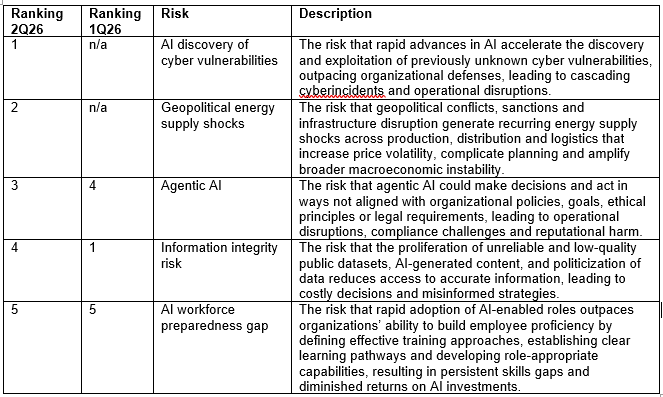
The AI-enabled discovery of cyber vulnerabilities has topped the list of emerging risks facing organisations globally, as the technology dominated the top five concerns in the corporate risk landscape, according to a new report from Gartner.
The Gartner Quarterly Emerging Risk Report revealed that rapid advances in AI are making global leaders concerned that it could accelerate the discovery and exploitation of previously unknown cyber vulnerabilities.
"The ability of AI to increase the efficiency and accessibility of vulnerability discovery is making it increasingly difficult for traditional risk management approaches to keep pace," said Kevin Mercado, Senior Principal Analyst, Research, in the Gartner Risk & Audit Practice.
This is the first time that AI-driven discovery of cyber vulnerabilities has entered the top emerging risks for businesses, following recent reports globally of AI-driven cyber attacks.
"Without corresponding improvements in governance, security operations, and remediation capabilities, AI-driven vulnerability discovery may outpace organisational defences, increasing the likelihood of significant cyber incidents and operational disruption," Mercado said.
AI-related risks dominate concerns
Other AI-related emerging risks include agentic AI, information integrity risk, and the AI workforce preparedness gap, according to the report.
Leaders are concerned that the deployment of agentic AI could lead to decisions and actions that are not aligned with organisational policies, goals, legal requirements, and ethical principles.
This, in turn, could lead to operational disruptions, compliance challenges, and reputational harm, the Gartner report read.
Information integrity risk, which was previously the top emerging concern for business leaders, placed fourth in the second quarter.
This concerns leaders being wary of costly decisions and misinformed strategies amid reduced access to accurate information due to the proliferation of unreliable and low-quality public datasets, AI-generated content, and politicisation of data.
The AI workforce preparedness gap remained the fifth-ranking concern for employers, with the risk involving AI-enabled roles outpacing organisations' capacity to build employee proficiency, resulting in skills gaps and slower returns on AI investment.
Meanwhile, the only non-AI-related risk in the top five is concerns about geopolitical energy supply shocks, which comes in the wake of the conflict in the Middle East.
The risk, which was not previously in the top five, jumped to the second rank when it comes to the top emerging risks of 2026.
According to the report, leaders are concerned about recurring energy supply shocks across their business due to geopolitical conflicts, sanctions, and infrastructure disruption.
What can leaders do?
The rapid development of AI and its capacity to discover and exploit cyber vulnerabilities will require organisations to be more agile and proactive, according to Gartner.
It recommended four ways to maintain true preparedness from these risks. They include:
- Recalibrate risk impact assessments to account for amplified exposures
- Update risk appetite to reflect the ongoing nature of vulnerability discovery
- Strengthen third-party risk controls to ensure vendors are not introducing new risks
- Accelerate cyber response strategies to enable faster patching and automated remediation to keep pace with the speed of AI-driven threats
"AI's growing capabilities are creating new and complex challenges for cybersecurity, operational resilience and organisational trust," Mercado said. "To anticipate and counter the risks associated with each, leaders must recognise the impact potential and be prepared for better response."