Three rate rises, geopolitical jitters and budget tax proposals cool appetite for new builds, report suggests

New home sales fell 16.7% nationally in May, according to the latest Housing Industry Association (HIA) New Home Sales report, which surveys the largest volume home builders across Australia's five most populous states.
Despite the monthly decline, sales over the three months to May remained 18.9% higher than the same period a year earlier.
Private new house sales - Australia (seasonally adjusted) 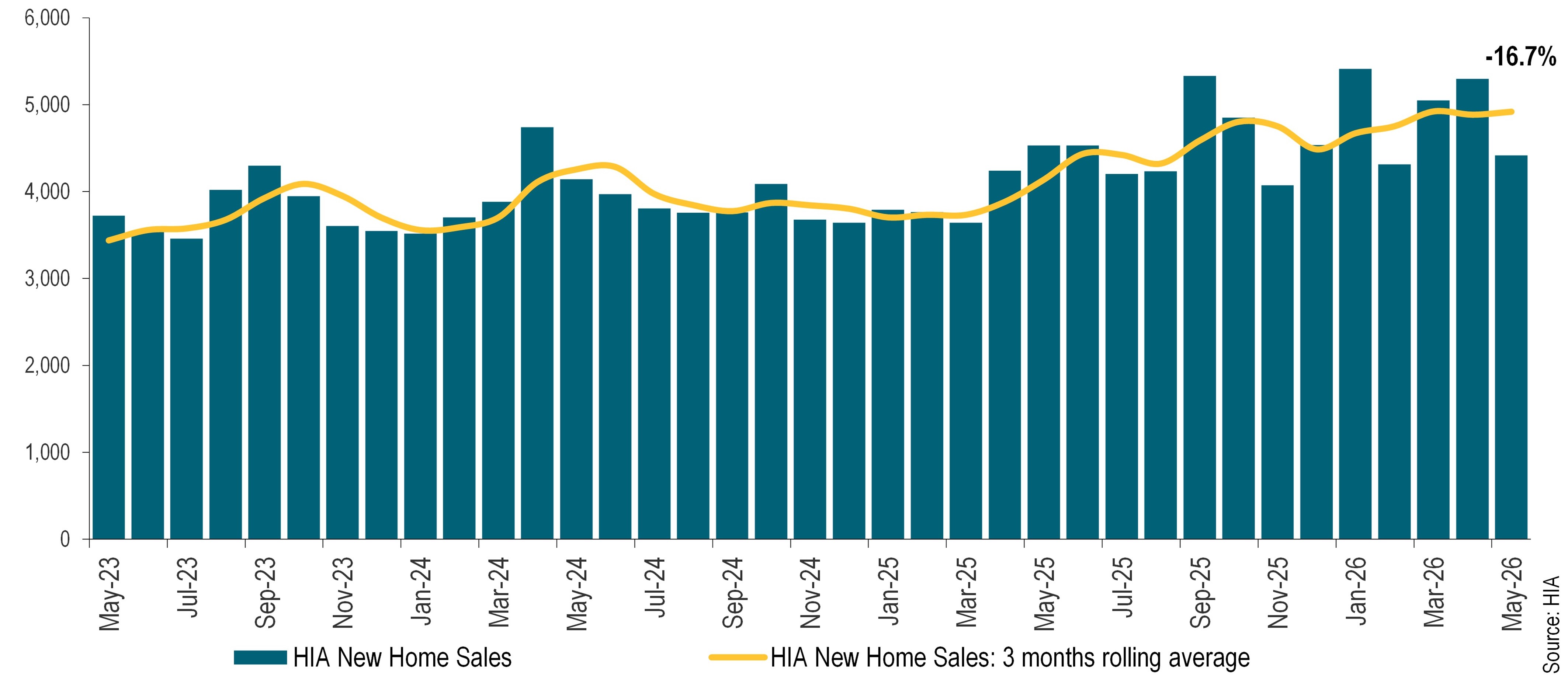
The HIA attributed the softening to a confluence of factors weighing on buyer confidence rather than a structural weakening in housing demand.
 "New home sales have softened as households navigate the cumulative impact of three cash rate increases, heightened geopolitical uncertainty and proposed changes to housing tax policy announced in the federal Budget," said Tim Reardon (pictured right), chief economist at the Housing Industry Association.
"Importantly, it is not the Budget measures themselves that have weighed on sales. Rather, it is the uncertainty surrounding the proposed changes."
Reardon noted that major financial decisions tend to be deferred when the outlook is unclear.
"Purchasing a home is the largest financial decision most households will make. When households are uncertain about the economic outlook, their employment prospects or future housing policy settings, they often delay that decision until there is greater clarity," he said.
The HIA drew a parallel with events preceding the 2019 federal election, when proposed changes to negative gearing and capital gains tax coincided with reduced housing activity before rebounding once that uncertainty passed.
"The recent moderation in sales should therefore be viewed as a decline in confidence rather than a decline in housing demand," Reardon said. "This is reinforced by the strong population growth over the past year and sustained low levels of unemployment."
At the state level, New South Wales — described by the HIA as Australia's most interest-rate-sensitive housing market — posted a 4.2% monthly increase in sales and remained more than 21% above year-earlier levels. Queensland was broadly flat, recording a 0.3% rise.
Victoria registered the steepest monthly decline at 27.4%, followed by Western Australia (-23.6%) and South Australia (-17%). The HIA noted that Queensland, South Australia and Western Australia continue to benefit from substantial pipelines of homes sold but yet to commence construction.
On the supply side, Reardon cited ongoing constraints. "Labour shortages, rising construction costs and limited access to shovel ready land continue to constrain the industry's ability to increase supply," he said. "Australia remains well short of the number of homes required to meet demand. While confidence has weakened in recent months, the May result appears to be a pause in momentum rather than a reversal in the housing cycle."
Want to be regularly updated with mortgage news and features? Get exclusive interviews, breaking news, and industry events in your inbox – subscribe to our FREE daily newsletter. You can also follow us on Facebook, X (formerly Twitter), and LinkedIn.