Mid-tier city income barriers hit record highs while rate hikes outpace price falls in the largest capitals

The amount of annual household income required to service a typical mortgage in Brisbane rose by more than $17,000 between January and May, while Perth buyers faced a near-identical income requirement increase of around $16,500 over the same period.
Although Sydney dwelling values fell 0.9% in May — now sitting 2.1% below their November 2025 peak — and Melbourne values declined 0.8% over the month to sit 3.2% below their March 2022 high, higher interest rates have prevented any meaningful improvement in affordability.
According to research firm Cotality's latest Housing Chart Pack, the serviceability cost of rate rises has fully offset the effect of price declines in the two largest capitals, while ongoing value growth in Brisbane and Perth has pushed entry requirements to record levels.
 "Rate hikes have significantly increased the challenges of servicing a mortgage across Australia," said Gerard Burg (pictured right), head of research at Cotality. "In expanding markets like Brisbane and Perth, the compounding effect of rising property values and higher interest rates creates an aggressive income barrier for buyers, even at the lower end of the spectrum."
Lower quartile housing has offered little relief. The minimum income needed to service a bottom-quartile house in both Brisbane and Perth rose by $14,500 between January and May.
Rolling annual change in dwelling values 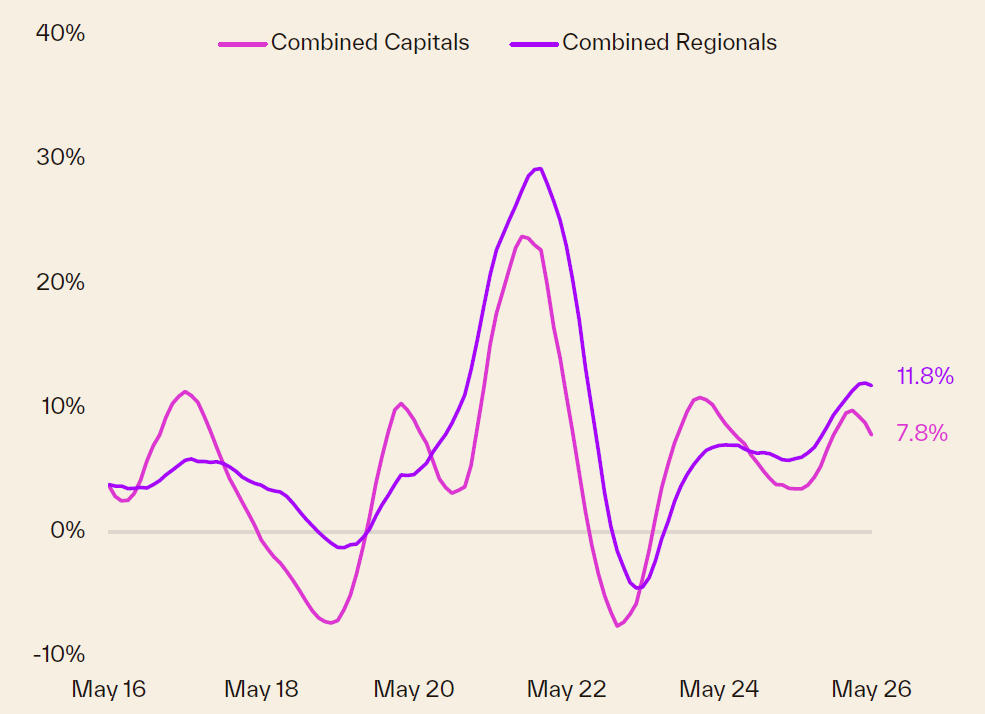 Source: Cotality
Unit market compression
The Brisbane unit market has tightened sharply in recent months, driven by accelerating demand. The gap in minimum household income required to purchase a median unit in Sydney versus Brisbane has narrowed to just over $2,000. Competition for affordable dwellings has also pushed Brisbane's lower quartile units to become the most expensive entry-level apartments in the country.
"The acceleration of the Brisbane unit market highlights how compressed the affordability landscape has become," Burg said. "Buyers are redirecting their focus toward apartments, which is rapidly erasing the traditional price gap between Brisbane and Sydney units, and making Brisbane's entry-level apartments the most expensive nationwide."
Supply conditions and vendor behaviour
New listings totalled 33,914 over the four weeks to 14 June, running 4.9% below the five-year average. Total listings across the same period reached 129,010, up 1.7% on a year ago but still 6.5% below the five-year average, suggesting supply remains relatively constrained despite the modest annual increase.
Number of new listings, national dwellings 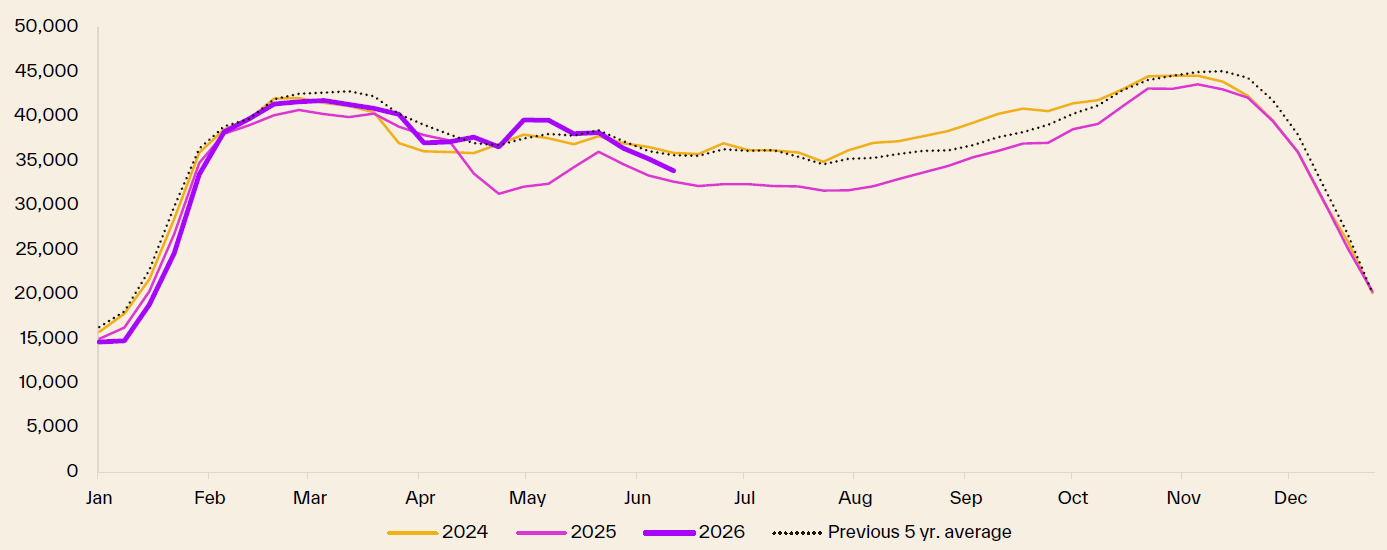 Source: Cotality
Vendor discounting has begun to edge higher, with the median discount across the combined capital cities rising to 3.3%, pointing to improved negotiating conditions for buyers.
Melbourne remains comparatively accessible
Melbourne stands apart from other major capitals. Annual dwelling value growth of just 0.5% compares with Perth's 25.8% gain over the past year — a gap in annual growth rates across the capital cities of 25 percentage points.
Constrained value growth over recent years, combined with recent monthly price falls, has left Melbourne with a significant affordability advantage. Buyers purchasing a median house in Sydney now require approximately $70,000 more in annual household income than those purchasing an equivalent property in Melbourne.
Want to be regularly updated with mortgage news and features? Get exclusive interviews, breaking news, and industry events in your inbox – subscribe to our FREE daily newsletter. You can also follow us on Facebook, X (formerly Twitter), and LinkedIn.