Rising interest rates pushed the share of income needed to service the average home loan above 50%

Housing affordability in Australia deteriorated sharply in the first three months of the year, driven by two successive cash rate increases from the Reserve Bank of Australia, according to the latest Housing Affordability Report by the Real Estate Institute of Australia (REIA).
"The proportion of median family income required to service the average home loan has risen to 50.8%, highlighting the significant pressure higher interest rates are placing on household budgets," said Jacob Caine, president of the Real Estate Institute of Australia. "The RBA increased the cash rate twice during the quarter, and this has flowed directly through to borrowing costs, lifting mortgage repayments and reducing affordability."
Affordability fell by 1.5 percentage points over the quarter and by 2.9 percentage points over the past year, reversing gains recorded through much of 2025. With the standard variable rate now at 8.5%, the average monthly loan repayment has reached $5,927 — an increase of 11.3% over the past 12 months.
 "Housing affordability is highly sensitive to interest rate movements, and the March quarter demonstrates just how quickly conditions can deteriorate when rates rise," Caine (pictured right) said.
Affordability declined across all states and territories, with the steepest falls in Tasmania and the Northern Territory. The report also noted a pullback in first-home buyer activity following a surge in the December quarter, when the federal government expanded its 5% deposit scheme.
Housing and rental affordability 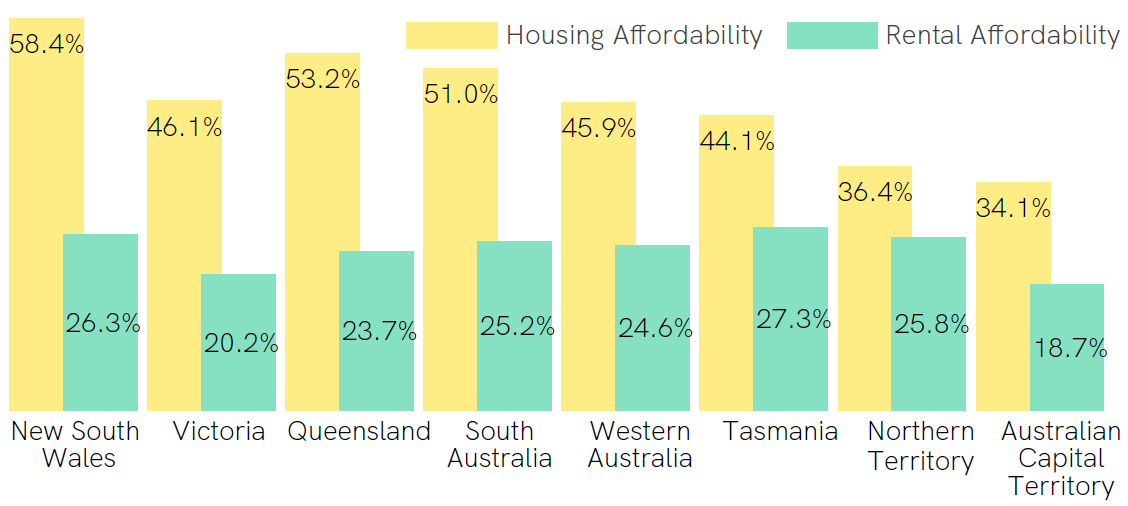 Source: Real Estate Institute of Australia
Rental affordability remained broadly stable, with the proportion of median family income required to meet median rent rising only marginally to 23.9%. However, REIA flagged medium-term risks to renters following modelling released after the 2026–27 federal budget, which projected rents could rise by as much as $9 per week over the next four years.
"Independent modelling indicates that the proposed tax reforms will reduce housing supply and push rents higher, adding further pressure to renters already facing cost-of-living challenges," Caine said.
He called for a coordinated policy response to address structural affordability pressures. "Rising interest rates are now compounding existing affordability challenges," he said. "Addressing affordability requires a sustained focus on increasing housing supply, alongside stable and predictable policy settings that support investment into housing."
Want to be regularly updated with mortgage news and features? Get exclusive interviews, breaking news, and industry events in your inbox – subscribe to our FREE daily newsletter. You can also follow us on Facebook, X (formerly Twitter), and LinkedIn.