Four years of net gains tighten the link between Melbourne affordability and Geelong housing demand

Geelong’s internal migration gains have continued for a fourth year, with new analysis suggesting the shift is structural rather than a pandemic after-effect.
Australian Bureau of Statistics regional internal migration estimates, combined with moving data from findamover.com.au, show Geelong recorded net internal migration of 3,662 people in 2025. The arrivals-to-departures balance has improved each year since 2022, ranking Geelong second nationally among 103 regions measured and first in Victoria for the fourth consecutive year.
Over four years, Geelong has added a cumulative 13,497 net internal migrants, excluding overseas arrivals and natural increase. While overall moving volumes eased from their 2022 peak, the city’s MoveFlow Index held at 1.34 in both 2024 and 2025, the highest recorded for Geelong.
Geelong net migration and MoveFlow Index, 2022–2025 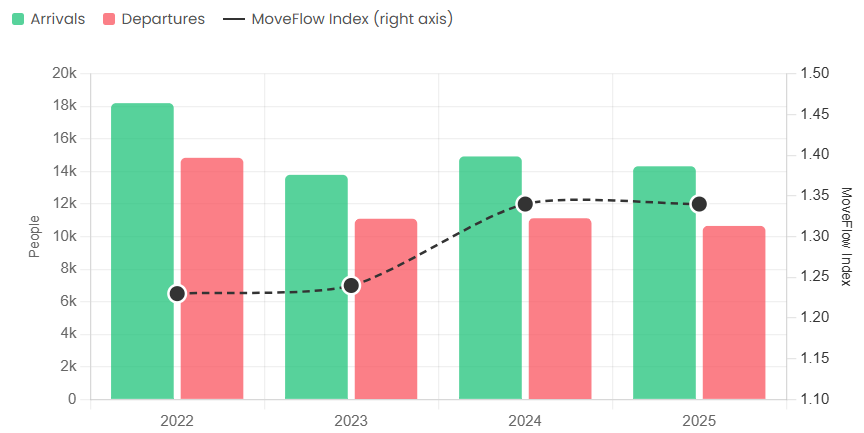 Source: ABS Regional Internal Migration Estimates
Find a Mover’s platform data shows 50% of Geelong-related jobs over the past three years were inbound moves from other regions, compared with 36% outbound, with 14% moves within Geelong.
Melbourne remains the dominant source. Of the 14,318 people who moved to Geelong in 2025, 7,742 came from Greater Melbourne, accounting for 54% of arrivals. The net gain from Melbourne was 3,222 people, or 88% of Geelong’s total net migration. The western suburbs, including Point Cook, Werribee and Melton, accounted for 2,728 moves to Geelong in 2025, which the analysis links to the M1 corridor and relative housing value.
Net migration gain to Geelong by Melbourne subregion, 2025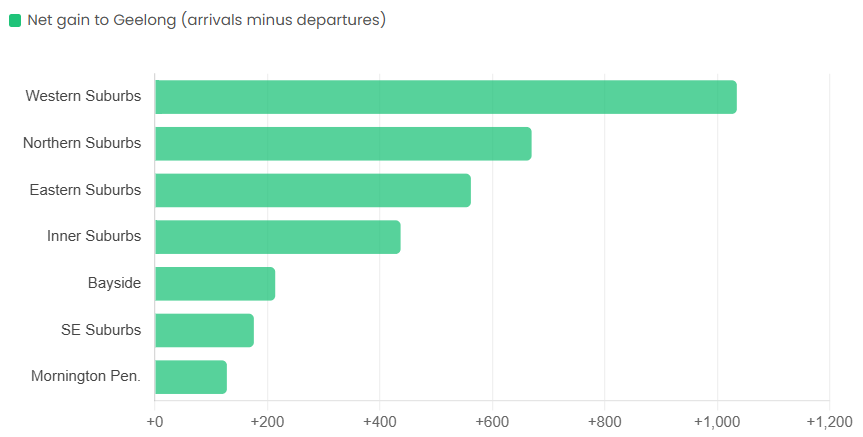 Source: ABS Regional Internal Migration Estimates
Interstate arrivals were about 2,200, led by Sydney (367), Brisbane (316), Adelaide (250) and Perth (235). However, the city recorded a net interstate loss: 3,862 arrivals versus 4,402 departures, a net decline of 540 residents.
Housing affordability is identified as the main driver. The analysis estimates inbound movers typically shift from properties averaging $864,000 to Geelong homes averaging $773,000, a like-for-like gap of about $91,000 based on suburb, dwelling type and bedroom count matched to CoreLogic median pricing. It also points to the Geelong V/Line service carrying 10.22 million passengers in FY2023–24, with a further 13% increase in 2024–25, and notes that Torquay (7%) and Ocean Grove (6.1%) are among the most common destination suburbs in the platform data.
“The MoveFlow Index has held at 1.34 for two consecutive years, the highest we’ve recorded for Geelong, and it’s come after the COVID surge subsided, not during it,” said Howe Tran, director at Find a Mover. “Most regional markets saw their ratios soften once the pandemic tailwind faded. Geelong’s has done the opposite, which tells us the demand is structural rather than circumstantial.
“The fundamentals haven’t weakened. People arriving from Melbourne are still saving close to six figures on a comparable property, the rail connection is faster and more frequent than it’s ever been, and four consecutive years of consistent net gains means tens of thousands of recent arrivals are actively vouching for Geelong to their Melbourne networks. That kind of established reputation is self-reinforcing.”
Want to be regularly updated with mortgage news and features? Get exclusive interviews, breaking news, and industry events in your inbox – subscribe to our FREE daily newsletter. You can also follow us on Facebook, X (formerly Twitter), and LinkedIn.