Construction sector flags lasting pressures as RBA rate rises weigh on economic activity

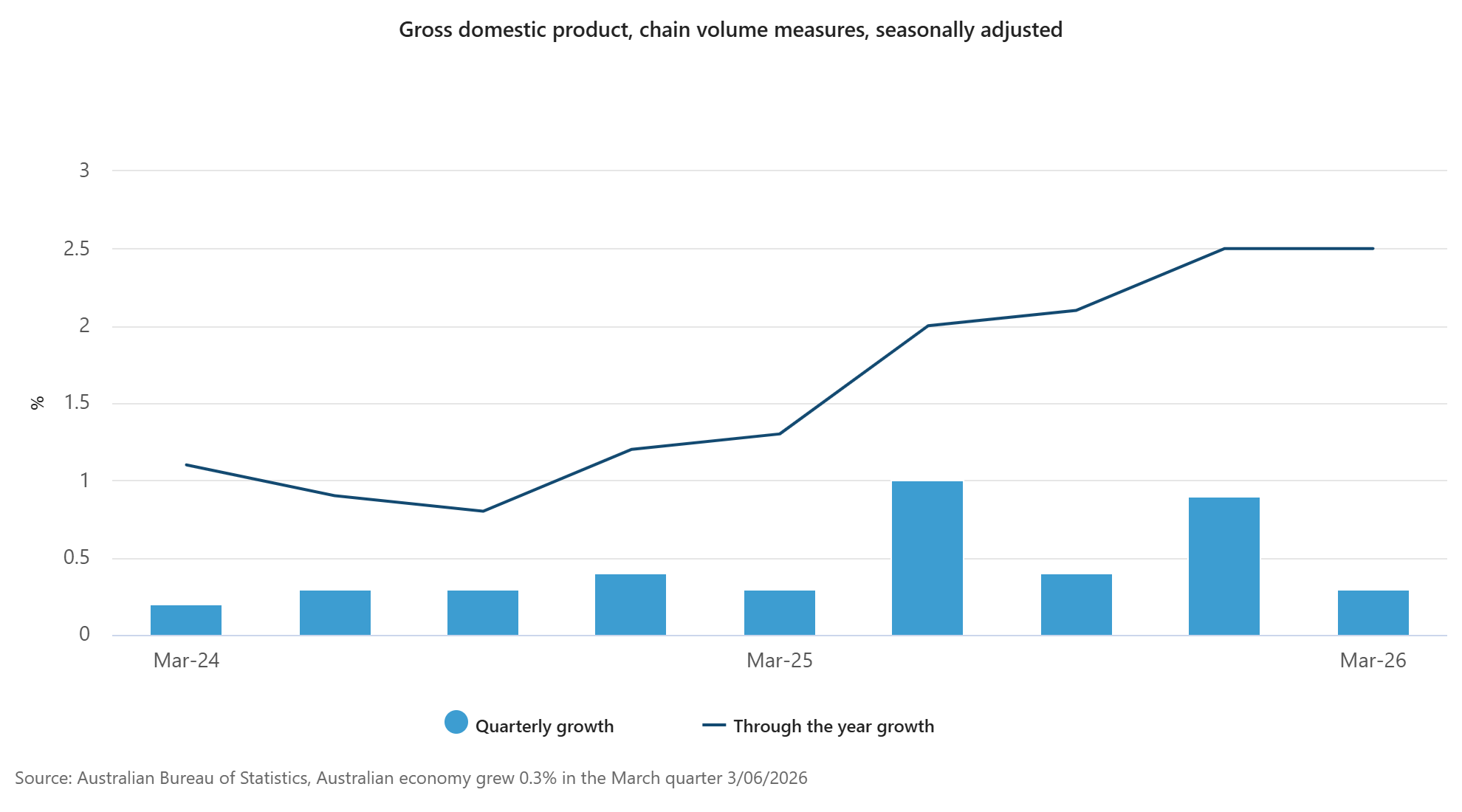
Australia's economy grew 0.3% in the March quarter of 2026 and 2.5% year-on-year, according to data released by the Australian Bureau of Statistics (ABS).
"Economic growth slowed in the March quarter, with modest household and public sector expenditure as well as cyclone disruptions to mining and export activities," said Grace Kim, ABS head of national accounts.
Household spending rose 0.5% over the quarter, driven partly by a sharp 11.7% jump in electricity, gas and fuel costs after government rebates ceased. Spending on essential goods and services rose 0.8%, while discretionary spending increased just 0.1%.
"Rising interest rates and significantly higher fuel costs in the March month likely created an environment for more cautious consumer behaviour," Kim added. "This resulted in reduced spending across a range of household expenditure categories." The data predates the halving of the fuel excise on 1 April.
 The construction sector registered particular concern in the latest GDP figures. "Interest rates have been on the way up since the start of the year, with economic activity hit by events in the Middle East," said Shane Garrett (pictured right), chief economist at Master Builders Australia. "This makes it much more challenging for the building and construction industry.
"The Federal Budget will not help this picture, with independent modelling finding that it will shave $864 million off GDP over the next four years. If we want to turbo charge our economy, we have to get construction right. It makes up 11% of GDP and multiplies spending by 2.5 times across the broader economy. $89.3 billion worth of construction activity was carried out during the first quarter of 2026, and we need a whole lot more to meet Australia's needs."
 Denita Wawn (pictured right), chief executive of Master Builders Australia, warned that small builders — comprising 98% of the industry — were being hit hard by the combination of elevated rates, global instability and budget tax increases.
"This first quarter data includes only one month of the Middle East conflict with the fuel price spikes and supply chain disruptions," she said. "It's a taste of what's to come when the economic shock is further compounded including by the Federal Government's decision to hike the taxes on housing.
"Recent developments, including policy debates about preferential treatment for tech startups over builders and tradies further demonstrates just how disconnected some of this policy making is from the reality of how tough it is to run a small business in Australia today.
"As we saw in yesterday's build approval's data, new home building was already on the back foot in the lead up to the May Federal Budget, with approvals falling in both March and April. More needs to be done to not only uplift the economy but also to deliver our roads, hospitals and homes," said Wawn.
From a macro perspective, the result broadly validated the Reserve Bank of Australia's recent policy direction, according to one analyst.
 "Australia's Q1 GDP came in slightly softer than expected but remained at a solid 2.5% year-on-year pace, validating the RBA's response of three consecutive rate hikes so far in 2026," said Wee Khoon Chong, APAC macro strategist at BNY.
"Looking ahead, we expect the RBA to stay in wait-and-see mode at the June policy meeting, given the recent downside surprise in CPI and the rise in unemployment. Markets have largely priced out further rate hikes, but we disagree with that view. Labour market conditions remain relatively tight, while elevated crude oil prices continue to pose upside inflation risks. There is no room for complacency, and the risk is that the RBA hikes again if inflation expectations remain persistently high."
Want to be regularly updated with mortgage news and features? Get exclusive interviews, breaking news, and industry events in your inbox – subscribe to our FREE daily newsletter. You can also follow us on Facebook, X (formerly Twitter), and LinkedIn.