Number of construction apprentices in training has hit a five-year low, with dropout rates outpacing completions

Australia's housing crisis risks worsening as the construction workforce pipeline weakens, with new data released this week showing the number of apprentices in training fell to 105,790 at the end of 2025 — the lowest figure in five years.
The latest quarterly figures, published by the National Centre for Vocational Education Research (NCVER), reveal that 28,290 construction apprentices abandoned their training during 2025 without completing any qualifications — more than the number who successfully finished their apprenticeships over the same period.
Apprentice and trainee contracts by occupation group, trades 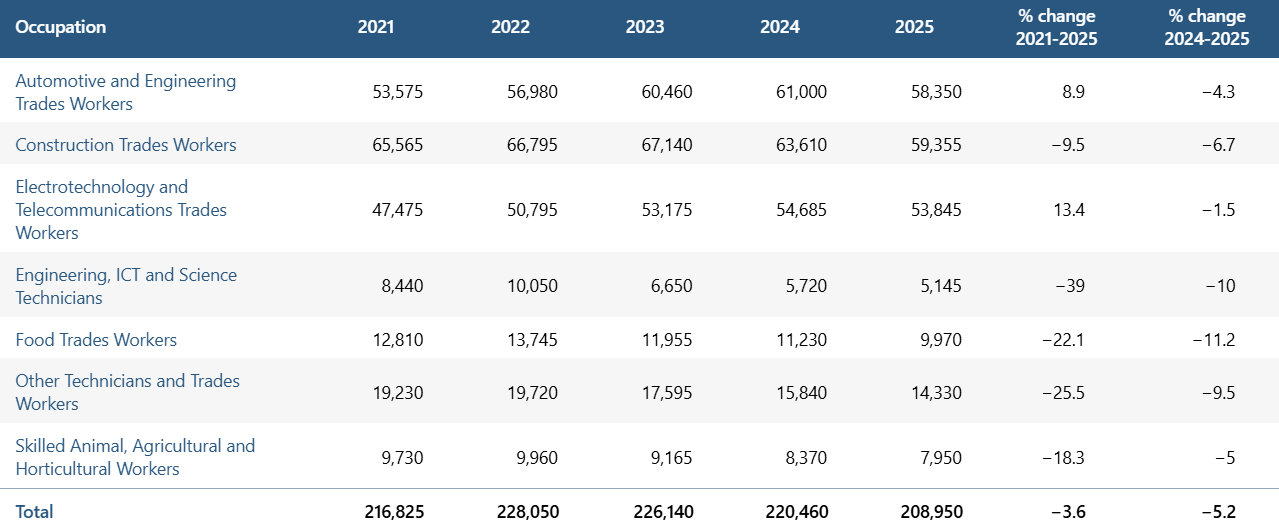 Source: National Centre for Vocational Education Research
The figures compound an already acute labour shortage. Australia requires more than 300,000 additional infrastructure workers by 2030, alongside a further 116,000 housing construction workers.
 According to Denita Wawn (pictured right), chief executive of Master Builders Australia, the shortfall had direct consequences for housing supply and affordability.
"These are the workers Australia needs right now to turn around our housing supply shortfall in order to improve affordability," she said. "Without them, targets will be missed and supply will fall further behind demand.
"We need more Australians to complete apprenticeships and to get on the tools, backed by a migration system that brings in trade‑qualified workers ready to contribute from day one. This combination will deliver a positive net impact on housing supply."
 Shane Garrett (pictured right), chief economist at Master Builders Australia, noted that new apprenticeship starts showed some improvement.
"Over 7,600 new construction apprentices started out during the December 2025 quarter," he noted. "Encouragingly, this was 10% up on the same period a year earlier.
"However, apprentice numbers are still getting hammered by worryingly high withdrawal rates. During 2025, 28,290 construction apprentices exited their training early and without any qualifications. It means that the number of people who quit construction apprenticeships last year was higher than those who successfully completed their training."
Master Builders Australia has outlined a series of policy measures to address workforce attrition and boost completions. These include a stage-based retention and completion incentive to reduce early exits; the introduction of micro-credentials to create structured entry and exit points within apprenticeships; and expanded fee-free vocational education and training access for not-for-profit registered training organisations.
The organisation also calls for extending the $10,000 Key Apprenticeship Program and broadening its eligibility to cover civil and commercial builders, reinstating the Group Training Organisation Reimbursement Program, and improving skilled migration pathways — including adding tradespeople to the priority one skilled migration visa category, expanding the Pacific Australia Labour Mobility (PALM) programme, and establishing a dedicated Construction Skills Pathway visa.
Want to be regularly updated with mortgage news and features? Get exclusive interviews, breaking news, and industry events in your inbox – subscribe to our FREE daily newsletter. You can also follow us on Facebook, X (formerly Twitter), and LinkedIn.