Brokerage edge
3–5 pts
Brokerages have out-scored lenders on staff satisfaction every year since 2024
202420252026


Jump to winners | Jump to methodology
The 2026 list reveals which lenders and brokerages are meeting rising staff expectations to become the best mortgage companies to work for in Australia
Staff loyalty isn’t cheap anymore. Mortgage Professional Australia’s Top Mortgage Employers 2026 reveals the best mortgage companies to work for in Australia and shows exactly what it costs to earn it: meeting expectations that keep climbing, not just avoiding walkouts.
Australian employee turnover just fell to its lowest level in three years, dropping to 13.5% in the June 2026 quarter from 15.2% six months earlier, according to the Australian HR Institute’s Quarterly Australian Work Outlook. Don’t mistake that for contentment. In mortgage broking, low turnover just as often means staff are watching and waiting to see if their employer steps up – not that they already have.
“When employers can’t deliver consistent lead flow, experienced brokers become more inclined to go out on their own and build their own referral networks instead of staying within an established brokerage,” says Lachie Young, team leader of financial services at Fuse Recruitment, based across Australia.
“The top brokerages are now prioritising career progression and growth within the business,” he adds. “This goes beyond salary and commission opportunities to include potential equity and leadership pathways. Candidates are increasingly looking for businesses where they can see themselves staying long term, with a clear one-, three- and five-year career plan laid out for them.”
MPA’s own survey data back this up. The share of mortgage professionals willing to switch jobs for better working options climbed from 29.5% in 2024 to 35.2% in 2025 and, even after easing this year, sits at 32.4%, still 2.9 points above where it started.
This year’s 22 Top Mortgage Employers show what responding to that pressure looks like in practice. The reasons show up in how these businesses operate day to day. The key is going beyond the minimum, then checking what has worked. That’s what earned these employers their staff’s vote this year.
Australia’s mortgage brokers have never carried more of the market than they do right now. Brokers facilitated 81% of all new residential home loans in the March 2026 quarter, a jump of 4.2 percentage points year on year and the highest share on record, according to MFAA data compiled from aggregator settlement data by Cotality. That builds on MPA’s ranking of Australia’s top-performing mortgage brokerages, reported earlier this year.
Brokerages are riding that growth. They continue to outscore lenders on staff satisfaction in this year’s survey, by a margin that has held steady for three years running.
It’s a competitive backdrop, and the industry isn't immune to broader pressure. Weighted employee satisfaction across this year’s 22 winners came in at 84.3%, down from 86.0% in 2025 and 86.8% in 2024, even as the number of employees weighing in grew by 35% over the same period, a sign more staff than ever are willing to have their say, which again reflects their trust and comfort in being transparent with employers.
“Providing employees with a strong benefits package and (employee value proposition) EVP from the outset demonstrates that the business values its people not only for their skill set but also as individuals and team members,” says Young, adding that initiatives such as birthday leave, mental health days, Friday afternoon networking drinks and food, team-building activities and company awards can all contribute to a positive employee experience and stronger culture.
MPA’s own data shows exactly where that’s falling short: the generational satisfaction gap on workplace benefits nearly quadrupled this year alone. The same tension shows up in how mortgage professionals want to work. Overall, 75.8% of respondents say their preferred arrangement matches what they currently have, but that headline figure hides a sharp split.
Just 9.5% of this year’s respondents want a fully office-based role, yet 16.6% currently work one, a gap that has held between five and eight percentage points in every year MPA has tracked it.
Among staff in a fully office-based arrangement, satisfaction with that setup sits at 44%, essentially unchanged from 2025, and roughly 43% of them say hybrid work is specifically what they want instead, echoing what MPA’s earlier guide to setting up a hybrid work model has previously reported.
Every other arrangement, hybrid, fully remote, or employee’s choice, holds onto at least eight in 10 of the people already in it. Young sees the same pattern from the recruiter’s side of the desk.
“A lot of client appointments in the mortgage broking industry take place outside standard working hours,” he says. “The employers with the strongest cultures tend to have a high level of trust in their staff, which allows them to offer greater flexibility around when and where they work.”
Money is reasserting itself, too, and just as sharply. In 2024, flexible work options were the single highest-rated benefit in four of five age bands surveyed. In 2025, that near-universal preference shifted to a different priority entirely: support for charitable and community organisations, which again led in four of five bands.
This year it has moved again. Bonus and incentive programs and flexible work options now occupy the top two positions in every age band without exception, while charitable giving, last year’s runaway favourite among 18- to 29-year-olds, has fallen from first place to seventh, its rating down from 4.52 to 4.08 out of 5 in a single year.
Young points to a related gap that may be compounding the pressure on pay. “Mortgage professionals are placing significant value on clear communication around commission structures and lead flow during the interview process,” he says. “Where some employers are falling short is by not clearly disclosing their commission structure or promising a strong volume of leads and then failing to deliver on that commitment.”
When compensation itself becomes the year’s top-rated priority across every age group, gaps like that carry more weight than they used to.
Trust is the product in a highly scrutinised industry – and at La Trobe Financial, that starts with the people delivering it.
That’s how Antonietta Sestito, chief people and marketing officer at La Trobe Financial in Melbourne, frames the investment manager's recognition as a Top Mortgage Employer. And it’s the thinking behind an employee value proposition built around four deliberate pillars, including health and wellbeing, professional development, community and social connection and lifestyle benefits, an approach MPA’s earlier feature on Australia’s best mortgage employers outlined in more detail last year.
“Our aim is to provide meaningful support whether someone is starting their career, progressing into leadership, raising a family, caring for others or maintaining their wellbeing and professional growth,” Sestito says.
Day to day, that shows up in specifics as much as structure. Birthday leave and significant parental leave offerings sit alongside free entry to Taronga Zoo and a free Collingwood Football Club membership, benefits chosen, Sestito says, to feel relevant across every stage of life and career, not just one.
The firm’s graduate program is proof the structure works. Of the graduates hired since 2020, more than half have progressed through promotion, an outcome Sestito attributes to identifying people aligned with La Trobe Financial’s culture and values and to how graduates are empowered to work once they arrive.
“They’re given the opportunity to participate in processes from end to end rather than working on isolated tasks,” she says. That exposure, she adds, builds technical capability and commercial understanding together, which positions graduates well for future opportunities and promotion.
That pipeline matters more as the business grows. Headcount, funds under management and investment capabilities have all expanded in recent years, and because the firm promotes from within, growth shows up for employees as new roles, broader mandates and exposure to asset classes La Trobe Financial did not operate in a few years ago.
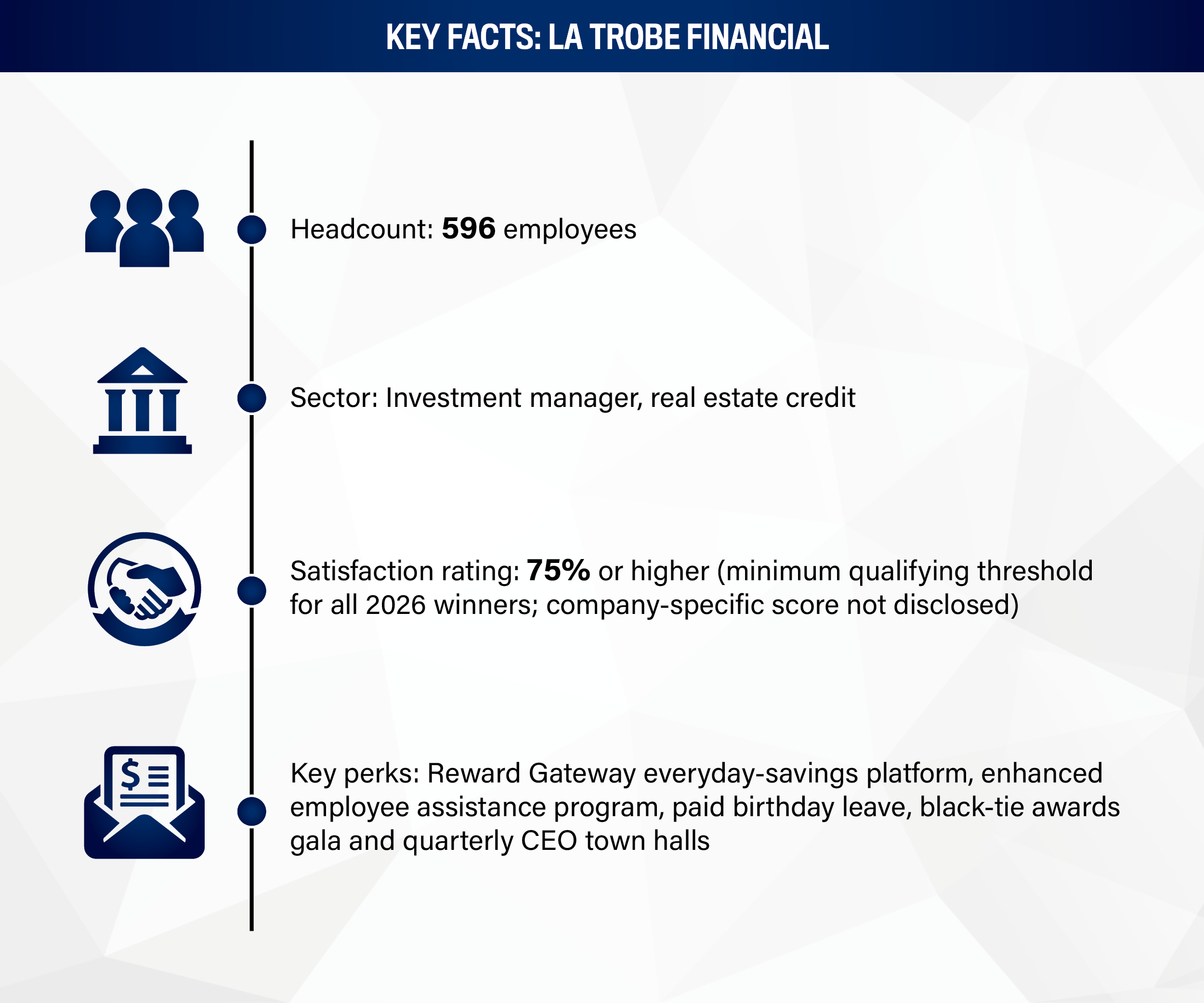
Now employing 596 people, La Trobe Financial runs two six-monthly remuneration and promotion cycles each year.
“This gives leaders regular opportunities to discuss talent across the organisation and identify employees who may be ready for increased responsibility, development opportunities or career progression,” Sestito says.


That structure sits inside a broader learning and development framework spanning five levels, from induction through to executive leadership, and covering technical training, mentoring, leadership pathways and university partnerships. This year, 60 employees, or 10% of the workforce, took part in personalised development opportunities, including MBAs, CPAs, CFAs and executive coaching.
Wellbeing support is similarly structured. Staff have access to annual health screenings and flu vaccinations, alongside an employee assistance program that is available around the clock.
Through the Reward Gateway platform, introduced as part of a relaunched employee value proposition, staff made $221,900 in purchases this year and saved $12,400 between them, supporting the organisation’s frames as directly addressing cost-of-living pressure. Work-life balance consistently ranks among the top three drivers of employee satisfaction in the firm’s engagement results.
Recognition and connection at the corporate level are built into the calendar to enhance recognition from individual managers. An annual black-tie awards gala draws more than 80% employee participation and a 91% favourable rating, with winners chosen through peer nomination across categories including Rising Star, Innovation and Customer Excellence.
Quarterly CEO town halls extend that access further up the organisation, with 92% of attendees at the July 2025 session rating the experience five stars and 85% reporting they felt more connected to the wider business afterwards.
Taken together, the four-pillar approach, the two six-monthly remuneration and promotion cycles and the graduate program outcomes point to an employer that has formalised what many workplaces treat as informal extras, turning development, recognition and wellbeing into measured, repeatable programs rather than one-off initiatives.
Set against a business that keeps growing in headcount, funds under management and capability, they also give employees somewhere to grow into.
Founded in 1952, La Trobe Financial is today an Australian global investment manager with a mature and market-leading real estate credit strategy and emerging capabilities in US private credit, Australian real estate, equities and global infrastructure.
Growth across headcount, funds under management and capabilities has been matched by continued investment in the human, people-led service the firm prides itself on, and that combination is translating into industry-leading retention and engagement outcomes.
Q: The Reward Gateway platform and your employee assistance program both speak to supporting staff through cost-of-living pressure. What feedback have you had from the team on those initiatives?
A: Feedback on Reward Gateway has been consistently positive. Employees often tell us that “every bit helps,” and people regularly share practical tips with each other on how to make purchases efficiently through the app and maximise the discounts and benefits available through the platform.
When we look at utilisation, some of the most popular retailers include Woolworths, Coles and Ampol, which is unsurprising given the rising cost of groceries, household essentials and fuel.
It is clear that employees are finding practical value in the program and using it to help manage everyday expenses. The employee assistance program remains another important resource, providing confidential support when employees or their families need it most, whether for wellbeing, financial or personal challenges.
While many organisations offer an EAP, we provide more than the standard three sessions, giving employees access to broader support when it is needed.
Q: Recognition seems to be a big part of the culture, between the awards gala and the quarterly CEO town halls. Are there any moments from the past year that really captured what that recognition means to the team?
A: One of the most memorable examples from the past year involved three employees who went above and beyond to assist members of the public in situations where emergency services were required.
In each case, our employees stepped forward to provide support and assistance at critical moments. These individuals were recognised by the firm at our town halls, and their actions resonated strongly with our people because they reflected the values we aspire to demonstrate every day.
While performance and results are important, we also celebrate the behaviours and values that define our culture. In this case, their actions reflected our founding philosophy of “others before self.”
Recognition at La Trobe Financial is not only about celebrating outcomes. It is about recognising the individuals who bring our values and purpose to life, whether that’s through supporting a client, helping a colleague, or stepping forward when someone in the community needs help.
Q: Looking ahead, is there anything new on the horizon for the employee experience at La Trobe Financial?
A: It’s an exciting time for La Trobe Financial as we continue to grow and expand our capabilities. We’re continuing to broaden our investment capabilities in line with La Trobe Financial’s evolution as an Australian global investment manager, with a mature and market-leading real estate credit strategy and emerging capabilities in US private credit, Australian real estate, equities and global infrastructure.
This year, we have also invested heavily in leadership capability through the rollout of our new Manager Fundamentals Program, focused on equipping employees with the skills and support they need to successfully transition from individual contributor roles into leadership positions.
Finally, we are planning to relocate to new premises within the next financial year, creating a workplace that further enhances collaboration, teamwork and connection through thoughtfully designed spaces that support the way we work together.
Most rapid-growth brokerages hit a wall when headcount doubles in a single year. Infinity Group Australia avoided that by replacing its formal annual review process with monthly one-on-one coaching conversations between managers and staff, a model the Gold Coast-based brokerage credits with helping it grow from 100 to 190 employees in 2025 without losing what it calls its “Infinity DNA.”
“When you almost double the size of a team in a year, you have to be very deliberate about protecting the culture that got you there in the first place,” says Rachael Howlett, finance strategist team leader at Infinity Group Australia. “We don’t want people to feel like they’re simply an employee number in a large organisation.”
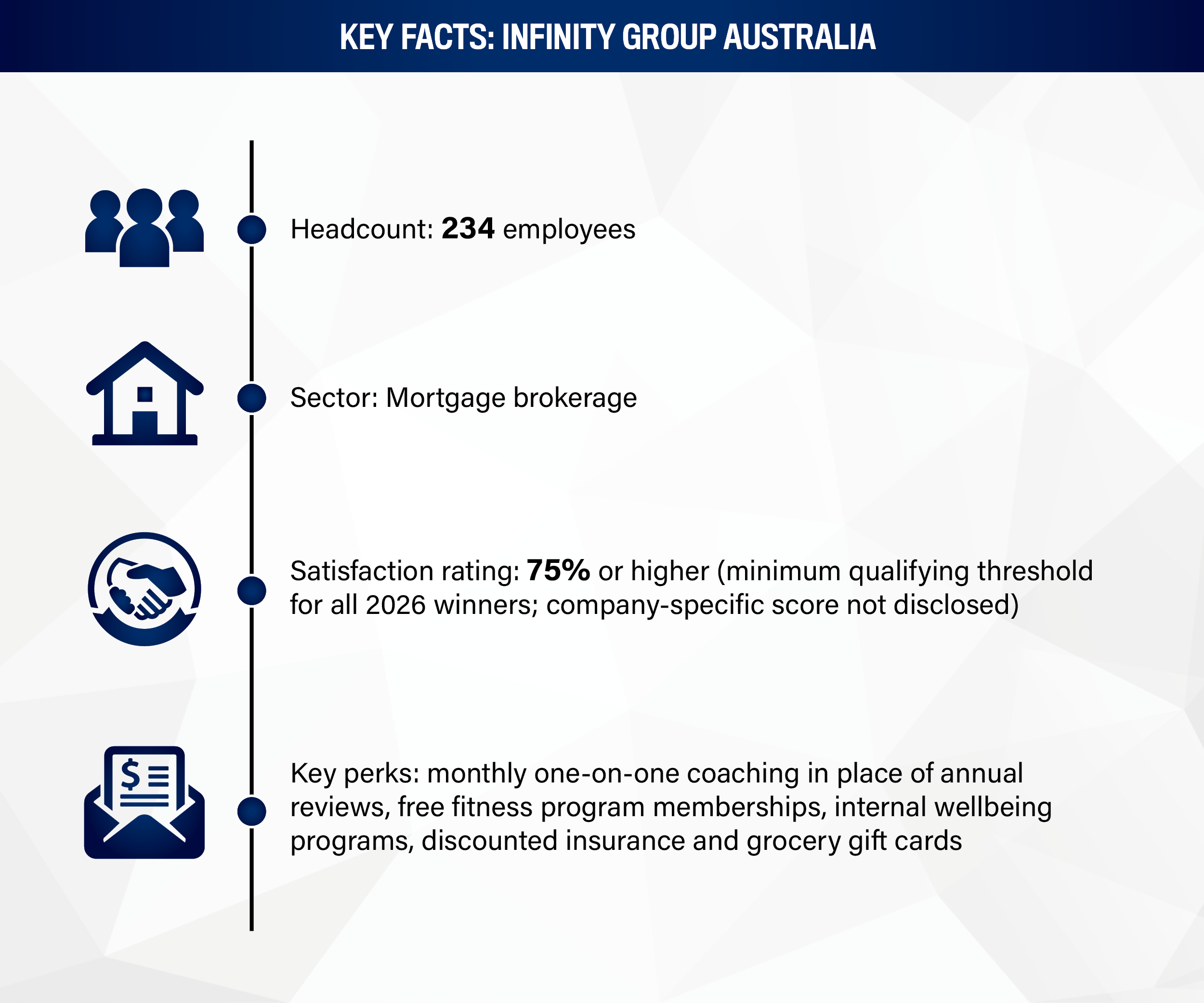
Founded in 2012 and now employing 234 people (as of September 2026), Infinity Group operates as a financial education-led brokerage. Every staff member takes part in monthly one-on-one meetings focused on performance, wellbeing and progression, replacing what had been a once-a-year assessment.
“Waiting 12 months to have a meaningful conversation about someone’s performance, goals or development just doesn’t make sense to us,” Howlett says. “The biggest change has been the quality of communication. Conversations about development are now ongoing rather than something that happens once a year.”
That accessibility has translated into measurable internal mobility. Around a quarter of Infinity’s team leaders were promoted internally in 2025, from finance strategist to head of distribution roles and promotion to national sales manager, alongside several other leadership appointments made from within the business over the same period.

In 2025, 40 staff completed the Certificate IV in Finance and Mortgage Broking, extending the same financial literacy training the business delivers to clients to its own workforce, including staff outside finance-specific roles.
Wellbeing is handled with a similarly informal touch. Internally run initiatives such as Infinity founders’ own “60 Strong” and Andy Frisella’s 75 Hard mental toughness program encourage staff, including leaders, to prioritise physical and mental wellbeing alongside their work. Participation is optional, but the company points to these programs as reinforcing accountability and connection across teams as the workforce has expanded.
Founders Graeme and Rebecca Holm remain actively involved in the business, a continuity Infinity credits with preserving the culture that saw it repeatedly named among Australia’s best mortgage employers year after year. The company says it used that recognition to reinforce its commitment to the workplace as it continued to grow.
Taken together, the approach reflects a bet that ongoing coaching, embedded financial education and internal promotion will do more for retention and performance than a formal review cycle built around a single annual conversation, even as the business roughly doubles in size within a year.
Q: Career progression clearly matters here, with a quarter of your team leaders promoted internally last year. What does that path to leadership usually look like at Infinity, and are there any stories that stand out?
A: We’re big believers in developing people from within. There isn’t necessarily one predetermined path to leadership at Infinity. We look for people who take ownership, support the people around them, want to learn and consistently demonstrate our values.
The monthly coaching structure has also helped us identify people who want to progress and then have much more deliberate conversations about what skills or experience they need to take that next step.
Seeing people come into the business in one role and then progress into leadership positions is incredibly rewarding. It also sends an important message to the rest of the team that growth here is real. When opportunities become available, we want our existing people to be genuinely considered for them, not automatically looking outside the business.
Q: As the business keeps growing, is there anything you’re working on next when it comes to flexibility or workplace benefits for the team?
A: As the business grows, we’re continually looking at what our people need from us and how we can continue improving the employee experience. For us, flexibility and benefits aren’t about introducing something simply because it sounds good on paper.
They need to genuinely add value to our people while still allowing us to deliver the level of service our clients expect. We have a large workforce made up of women or staff with children, so we look to remain flexible around working arrangements for those who require it, structuring hours outside of the standard nine-to-five, increased work-from-home opportunities and providing interstate or overseas working opportunities where appropriate.
We also offer fitness program memberships at no cost to our staff, to ensure they are looking after themselves personally.
Q: Looking ahead, is there anything new on the horizon for the employee experience at Infinity Group Australia?
A: A major focus for us is making sure the employee experience continues to improve as the business gets bigger. Growth creates opportunity, but it also means the systems around our people need to grow with it.
We’re continuing to invest in leadership development, education, coaching and clearer career pathways so people can see what their future at Infinity could look like, paired with the opportunity to consider interstate and overseas opportunities as our business expands into broader markets, as well as discounted services such as insurance, property management and grocery shopping gift cards.
We want someone joining Infinity today to feel like they’re joining a business where they can build a genuine career, continue learning and potentially grow into roles that may not even exist yet. Ultimately, we don’t just want to grow the number of people at Infinity; we want to keep creating more opportunities for the people who choose to grow with us.
The next test for this year’s winners is whether internal mobility can keep pace with growth. Young sees the shift already underway. “I’m starting to see medium-sized practices doing this particularly well,” he says. “They’re having conversations with experienced brokers who have been with the business for three or four years and asking, ‘What do you want from your career here?’”
That kind of conversation is what turns a tenured broker into a future GM of broking, head of sales or head of partnerships, instead of a resignation letter.
Both La Trobe Financial’s move to twice-yearly reviews and Infinity Group’s monthly coaching model say the same thing: career progression is now an ongoing conversation, not a once-a-year formality.
As market share climbs and competition for experienced brokers intensifies, the employers still winning this award next year will be the ones that got ahead of that shift early, not the ones scrambling to build a career pathway after their best people have already left – a shift MFAA’s reporting on career pathway and retention challenges facing brokers has been tracking across the industry.
What unites this year’s winners isn’t a perk or a policy – it’s discipline. They treat their people with the same rigour they apply to a loan book or a client portfolio: measured, reviewed and improved on a recurring cycle.
That discipline is what separates growth from chaos. It shows up whether a business is growing its headcount by 90% in a year, tightening its review cycle from once a year to twice, or checking every quarter whether last year’s engagement score actually moved.
Discipline doesn’t guarantee results. But it gives an employer somewhere to look when satisfaction slips and across the wider industry this year, it did. It’s notable that 12 employers have made this list in the three previous annual reports.
That consistency isn’t luck. It’s what happens when discipline becomes routine and is the cornerstone of being a top employer.




What are the best mortgage companies to work for in Australia in 2026?
Mortgage Professional Australia’s 2026 list names the 22 best mortgage companies to work for in Australia, ranked by their own staff. Each qualifying lender, brokerage or aggregator reached a staff satisfaction rating of 75% or higher through an anonymous employee survey.
What is MPA’s Top Mortgage Employers list?
MPA’s Top Mortgage Employers is an annual employer recognition report that ranks Australian mortgage brokerages, lenders and aggregators based on how their own staff rate them. In 2026, 22 employers qualified, each required to reach a staff satisfaction rating of 75% or higher through an anonymous employee survey.
Do mortgage brokerages have more satisfied staff than lenders?
Yes. Brokerages have outscored lenders on staff satisfaction in every year MPA has measured it, 2024 through 2026, by a margin of three to five percentage points each year.
What do mortgage industry employees value most in an employer in 2026?
Bonus and incentive programs and flexible work options rank as the two most important benefits across every age group surveyed in 2026, according to MPA data. That is a shift from 2025, when support for charitable and community organisations was the top priority for most age groups, and from 2024, when flexible work options led.
How many Australian mortgage professionals want to work fully in an office?
Just 9.5% of respondents to MPA’s 2026 survey said they want a fully office-based role, compared with 16.6% who currently work in one, a gap that has held between five and eight percentage points in every year MPA has tracked it.
What will shape mortgage industry workplaces over the next few years?
Recruiters expect internal mobility to become a bigger differentiator than pay alone, as employers build clearer career pathways to retain experienced brokers instead of losing them to independent practice. Employers already holding more frequent career conversations, instead of a single annual review, are expected to have an advantage as competition for skilled brokers increases.
The process of finding and recognising the best employers in the Australian mortgage industry took place in two phases. First, Mortgage Professional Australia invited organisations to submit their details in a survey, in which they were able to describe their offerings and business practices. Second, employees from the nominated companies were asked to fill out an anonymous survey to rate their satisfaction with a number of key factors, such as compensation, employee development, culture and work environment.
Each company was required to meet a minimum number of employee responses based on its overall size. Any company that achieved a satisfaction rating of 75% or greater was named a Top Mortgage Employer 2026.